




The radius of a sphere is changing at the rate of 0.1 cm/s. The rate of change of its surface area when the radius is 200 cm, is \[\]
A. $ 8\pi \text{ c}{{\text{m}}^{2}}/\text{sec} $ \[\]
B. $ 12\pi \text{ c}{{\text{m}}^{2}}/\text{sec} $ \[\]
C. $ 160\pi \text{ c}{{\text{m}}^{2}}/\text{sec} $ \[\]
D. $ 200\pi \text{ c}{{\text{m}}^{2}}/\text{sec} $ \[\]
Answer
 Verified
588.6k+ views
Hint: We recall the surface area of a sphere with radius $ r $ is given by $ A=4\pi {{r}^{2}} $ . We use the idea that the rate of change of any measurable quantity can be expressed as derivative of that quantity with the time variable $ t $ . We differentiate $ A=4\pi {{r}^{2}} $ with respect to $ t $ and put $ r,\dfrac{dr}{dt} $ which are given in the question to get the answer. \[\]
Complete step by step answer:
We know that a sphere is the locus of the outline of a circle when it is moved one turn around its fixed diameter. The surface area of sphere is only curved and the total surface area of the sphere is given by
\[A=4\pi {{r}^{2}}\]
We also know that the rate of change of any measurable quantity is given by the derivative of the quantity with respect to time as an independent variable. We denote the time variable as $ t $ and differentiate the surface area with respect to $ t $ and have;
\[\begin{align}
& \dfrac{d}{dt}A=\dfrac{d}{dt}\left( 4\pi {{r}^{2}} \right) \\
& \Rightarrow \dfrac{dA}{dt}=4\pi \dfrac{d}{dt}\left( {{r}^{2}} \right) \\
\end{align}\]
We use the standard differentiation $ \dfrac{d}{dx}{{x}^{n}}=n{{x}^{n-1}} $ to have;
\[\begin{align}
& \Rightarrow \dfrac{dA}{dt}=4\pi \cdot 2r\dfrac{dr}{dt} \\
& \Rightarrow \dfrac{dA}{dt}=8\pi r\dfrac{dr}{dt} \\
\end{align}\]
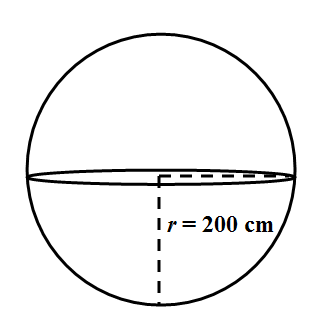
We are given in the question that the radius of a sphere is changing at the rate of 0.1 cm/s which means $ \dfrac{d}{dt}r=\dfrac{dr}{dt}=0.1\text{ cm/sec} $ . We are asked to find the rate of change of its surface area when the radius is 200 cm which means at $ r=200 $ cm. We put $ r=200,\dfrac{dr}{dt}=0.1 $ in the above step to have;
\[\Rightarrow \dfrac{dA}{dt}=8\pi \times 200\times 0.1=160\pi \text{ c}{{\text{m}}^{2}}/s\]
Here $ \dfrac{dA}{dt} $ represents rate of change of surface area and the correct choice is C. \[\]
Note:
We must properly place the units of rate of change. We see that the radius is a function of time here $ r\left( t \right) $ and its rate of change is constant and is also increasing. The rate of change with derivative is called instantaneous rate of change and without derivative is called average rate of change which is given by $ \dfrac{f\left( {{t}_{2}} \right)-f\left( {{t}_{1}} \right)}{{{t}_{2}}-{{t}_{1}}} $ .
Complete step by step answer:
We know that a sphere is the locus of the outline of a circle when it is moved one turn around its fixed diameter. The surface area of sphere is only curved and the total surface area of the sphere is given by
\[A=4\pi {{r}^{2}}\]
We also know that the rate of change of any measurable quantity is given by the derivative of the quantity with respect to time as an independent variable. We denote the time variable as $ t $ and differentiate the surface area with respect to $ t $ and have;
\[\begin{align}
& \dfrac{d}{dt}A=\dfrac{d}{dt}\left( 4\pi {{r}^{2}} \right) \\
& \Rightarrow \dfrac{dA}{dt}=4\pi \dfrac{d}{dt}\left( {{r}^{2}} \right) \\
\end{align}\]
We use the standard differentiation $ \dfrac{d}{dx}{{x}^{n}}=n{{x}^{n-1}} $ to have;
\[\begin{align}
& \Rightarrow \dfrac{dA}{dt}=4\pi \cdot 2r\dfrac{dr}{dt} \\
& \Rightarrow \dfrac{dA}{dt}=8\pi r\dfrac{dr}{dt} \\
\end{align}\]
We are given in the question that the radius of a sphere is changing at the rate of 0.1 cm/s which means $ \dfrac{d}{dt}r=\dfrac{dr}{dt}=0.1\text{ cm/sec} $ . We are asked to find the rate of change of its surface area when the radius is 200 cm which means at $ r=200 $ cm. We put $ r=200,\dfrac{dr}{dt}=0.1 $ in the above step to have;
\[\Rightarrow \dfrac{dA}{dt}=8\pi \times 200\times 0.1=160\pi \text{ c}{{\text{m}}^{2}}/s\]
Here $ \dfrac{dA}{dt} $ represents rate of change of surface area and the correct choice is C. \[\]
Note:
We must properly place the units of rate of change. We see that the radius is a function of time here $ r\left( t \right) $ and its rate of change is constant and is also increasing. The rate of change with derivative is called instantaneous rate of change and without derivative is called average rate of change which is given by $ \dfrac{f\left( {{t}_{2}} \right)-f\left( {{t}_{1}} \right)}{{{t}_{2}}-{{t}_{1}}} $ .
Recently Updated Pages
Master Class 12 Economics: Engaging Questions & Answers for Success

Master Class 12 English: Engaging Questions & Answers for Success
Master Class 12 Social Science: Engaging Questions & Answers for Success
Master Class 12 Maths: Engaging Questions & Answers for Success
Master Class 12 Physics: Engaging Questions & Answers for Success
Master Class 9 General Knowledge: Engaging Questions & Answers for Success
Trending doubts
Explain the Treaty of Vienna of 1815 class 10 social science CBSE
Why is it 530 pm in india when it is 1200 afternoon class 10 social science CBSE
What is the full form of POSCO class 10 social science CBSE
Define Potential, Developed, Stock and Reserved resources
Which Country Has the Largest Border with India?
Complete the sentence with the most appropriate word class 10 english CBSE