




The radius of a cylindrical box is 8cm and the height is 3cm. The numbers of inches that may be added to either the radius or the height to give the same non-zero increase in volume is:
A. 1
B. \[5\dfrac{1}{3}\]
C. any number
D. non-existence
E. none of these
Answer
 Verified
658.2k+ views
Hint: Formulae of volume of a cylinder is \[V=\pi {{r}^{2}}h\] where “V” is the volume, “r” is the radius and “h” is the height of a cylindrical box. If we increase the radius or the height the volume will be the same. First increase radius and then increase height. As the volume is equal in both cases so after increasing radius and height both equations will be the same. Then just evaluate the rest of the problem.
Complete step-by-step answer:
In the question the radius and height of a cylindrical box is 8cm and 3cm respectively.
We know that the volume of a cylinder is \[V=\pi {{r}^{2}}h\] where “V” is the volume, “r” is the radius and “h” is the height of a cylinder.
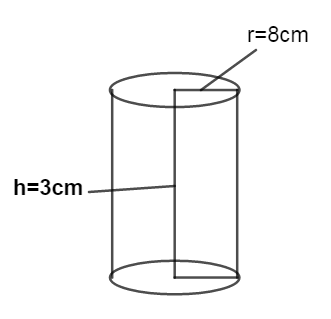
Let us assume that the x cm is the increase of height and radius of the cylindrical box.
If we increase the radius or the height of the cylindrical box then the volume will be the same.
First of all if we increase the radius x cm then the volume of the cylindrical box will be \[V=\pi {{\left( r+x \right)}^{2}}h\].
And if we increase the height x cm then the volume of the cylindrical box will be \[V=\pi {{r}^{2}}\left( h+x \right)\]
According to the question the numbers of inches that may be added to either the radius or the height to give the same non-zero increase.
So that,
\[\pi {{\left( r+x \right)}^{2}}h=\pi {{r}^{2}}\left( h+x \right)\]
\[\pi \] will be cut on both side, and breaking the whole square we get,
\[\Rightarrow \left( {{r}^{2}}+2rx+{{x}^{2}} \right)h={{r}^{2}}h+{{r}^{2}}x\]
Breaking the square and multiply with h we get
\[\begin{align}
& \Rightarrow {{r}^{2}}h+2rxh+{{x}^{2}}h={{r}^{2}}h+{{r}^{2}}x \\
& \Rightarrow 2rxh+{{x}^{2}}h={{r}^{2}}x \\
\end{align}\]
Taking x common from left hand side we get,
\[\begin{align}
& \Rightarrow x\left( 2rh+xh \right)={{r}^{2}}x \\
& \Rightarrow 2rh+xh={{r}^{2}}x \\
& \Rightarrow xh={{r}^{2}}-2rh \\
& \Rightarrow x=\dfrac{\left( {{r}^{2}}-2rh \right)}{h} \\
\end{align}\]
Putting the value of “r” and “h” in the equation we got,
\[\begin{align}
& \Rightarrow x=\dfrac{{{8}^{2}}-2\times 8\times 3}{3} \\
& \Rightarrow x=\dfrac{64-48}{3} \\
& \Rightarrow x=\dfrac{16}{3} \\
& \Rightarrow x=5\dfrac{1}{3} \\
\end{align}\]
The numbers of inches that may be added to either the radius or the height to give the same non-zero increase in volume is \[5\dfrac{1}{3}\](Option B).
Note: Students gets confused with the formulae of surface area of the side which is \[2\pi {{r}^{2}}\] with the volume of cylindrical box which is \[\pi {{r}^{2}}h\]. Sometimes students miss calculating the equation by doing step jumps. If you remember the proper formulae and evaluate the formulae accordingly to the question, problem solving will be efficient and error free.
Complete step-by-step answer:
In the question the radius and height of a cylindrical box is 8cm and 3cm respectively.
We know that the volume of a cylinder is \[V=\pi {{r}^{2}}h\] where “V” is the volume, “r” is the radius and “h” is the height of a cylinder.
Let us assume that the x cm is the increase of height and radius of the cylindrical box.
If we increase the radius or the height of the cylindrical box then the volume will be the same.
First of all if we increase the radius x cm then the volume of the cylindrical box will be \[V=\pi {{\left( r+x \right)}^{2}}h\].
And if we increase the height x cm then the volume of the cylindrical box will be \[V=\pi {{r}^{2}}\left( h+x \right)\]
According to the question the numbers of inches that may be added to either the radius or the height to give the same non-zero increase.
So that,
\[\pi {{\left( r+x \right)}^{2}}h=\pi {{r}^{2}}\left( h+x \right)\]
\[\pi \] will be cut on both side, and breaking the whole square we get,
\[\Rightarrow \left( {{r}^{2}}+2rx+{{x}^{2}} \right)h={{r}^{2}}h+{{r}^{2}}x\]
Breaking the square and multiply with h we get
\[\begin{align}
& \Rightarrow {{r}^{2}}h+2rxh+{{x}^{2}}h={{r}^{2}}h+{{r}^{2}}x \\
& \Rightarrow 2rxh+{{x}^{2}}h={{r}^{2}}x \\
\end{align}\]
Taking x common from left hand side we get,
\[\begin{align}
& \Rightarrow x\left( 2rh+xh \right)={{r}^{2}}x \\
& \Rightarrow 2rh+xh={{r}^{2}}x \\
& \Rightarrow xh={{r}^{2}}-2rh \\
& \Rightarrow x=\dfrac{\left( {{r}^{2}}-2rh \right)}{h} \\
\end{align}\]
Putting the value of “r” and “h” in the equation we got,
\[\begin{align}
& \Rightarrow x=\dfrac{{{8}^{2}}-2\times 8\times 3}{3} \\
& \Rightarrow x=\dfrac{64-48}{3} \\
& \Rightarrow x=\dfrac{16}{3} \\
& \Rightarrow x=5\dfrac{1}{3} \\
\end{align}\]
The numbers of inches that may be added to either the radius or the height to give the same non-zero increase in volume is \[5\dfrac{1}{3}\](Option B).
Note: Students gets confused with the formulae of surface area of the side which is \[2\pi {{r}^{2}}\] with the volume of cylindrical box which is \[\pi {{r}^{2}}h\]. Sometimes students miss calculating the equation by doing step jumps. If you remember the proper formulae and evaluate the formulae accordingly to the question, problem solving will be efficient and error free.
Recently Updated Pages
Differentiate between voluntary action and reflex class 10 biology CBSE

The uses of bleaching powder are A It is used bleaching class 10 chemistry CBSE
Fill in the blanks with abstract nouns of the words class 10 english CBSE
How many threedigit numbers are there class 10 maths CBSE
What is a reflex arc class 10 biology CBSE
Construct a square whose diagonal is 6cm Measure the class 10 maths CBSE
Trending doubts
Explain the Treaty of Vienna of 1815 class 10 social science CBSE
The slogan Jai Hind was given by A Lal Bahadur Shastri class 10 social science CBSE
10 examples of evaporation in daily life with explanations
What is the full form of POSCO class 10 social science CBSE
Identify the feminine form of noun nephew a shenephew class 10 english CBSE
CSIR full form?