




The radius of a cone is 7 cm and its slant height is 10 cm. Calculate the curved surface area of the cone.
Answer
 Verified
639.6k+ views
Hint: Here, first we can calculate the formula for the curved surface area of the cone when the slant height $l$ and radius r is given. The formula is:
Curved surface, \[CSA=\left( \dfrac{Arc\text{ }length\text{ }of\text{ }the\text{ }circle}{circumference\text{ }of\text{ }the\text{ }circle}\text{ } \right)~\times Area\text{ }of\text{ }the\text{ }circle\text{ }curved.\]
Complete step-by-step answer:
After getting the formula substitute the values of r and $l$ to obtain the curved surface area of the cone.
We are given that the radius of a cone is 7 cm and its slant height is 10 cm.
Now, we have to calculate the curved surface area of the cone.
We have the figure as follows:
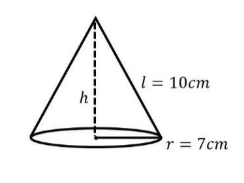
First we have to get the formula for curved surface area when radius, r and slant height $l$ is given:
Curved surface, CSA = (Arc length of the circle / circumference of the circle) $\times $ Area of the circle curved
We know that:
Arc length of the circle = $2\pi r$
Circumference of the circle = $2\pi l$
Area of the circle = $\pi {{r}^{2}}$
Therefore, we will get:
CSA = $\dfrac{2\pi r}{2\pi l}\times \pi {{l}^{2}}$
Hence, by cancellation we obtain:
CSA = $\pi rl$
Now, for $r=7cm$ and $l=10cm$ we have:
CSA = $\dfrac{22}{7}\times 7\times 10$ ….. (take $\pi =\dfrac{22}{7}$)
Now, by cancellation we get:
CSA = $22\times 10$
CSA = $220c{{m}^{2}}$
Note: Here, you have to find the curved surface area not the total surface area of the cone. Total surface area of the cone is the sum of the area of the circle and the curved surface area.
$TSA=\pi {{r}^{2}}+\pi rl$
Curved surface, \[CSA=\left( \dfrac{Arc\text{ }length\text{ }of\text{ }the\text{ }circle}{circumference\text{ }of\text{ }the\text{ }circle}\text{ } \right)~\times Area\text{ }of\text{ }the\text{ }circle\text{ }curved.\]
Complete step-by-step answer:
After getting the formula substitute the values of r and $l$ to obtain the curved surface area of the cone.
We are given that the radius of a cone is 7 cm and its slant height is 10 cm.
Now, we have to calculate the curved surface area of the cone.
We have the figure as follows:
First we have to get the formula for curved surface area when radius, r and slant height $l$ is given:
Curved surface, CSA = (Arc length of the circle / circumference of the circle) $\times $ Area of the circle curved
We know that:
Arc length of the circle = $2\pi r$
Circumference of the circle = $2\pi l$
Area of the circle = $\pi {{r}^{2}}$
Therefore, we will get:
CSA = $\dfrac{2\pi r}{2\pi l}\times \pi {{l}^{2}}$
Hence, by cancellation we obtain:
CSA = $\pi rl$
Now, for $r=7cm$ and $l=10cm$ we have:
CSA = $\dfrac{22}{7}\times 7\times 10$ ….. (take $\pi =\dfrac{22}{7}$)
Now, by cancellation we get:
CSA = $22\times 10$
CSA = $220c{{m}^{2}}$
Note: Here, you have to find the curved surface area not the total surface area of the cone. Total surface area of the cone is the sum of the area of the circle and the curved surface area.
$TSA=\pi {{r}^{2}}+\pi rl$
Recently Updated Pages
Master Class 9 General Knowledge: Engaging Questions & Answers for Success

Master Class 9 Maths: Engaging Questions & Answers for Success
Master Class 9 Science: Engaging Questions & Answers for Success
Master Class 9 English: Engaging Questions & Answers for Success
Master Class 9 Social Science: Engaging Questions & Answers for Success
Class 9 Question and Answer - Your Ultimate Solutions Guide
Trending doubts
Find the sum of series 1 + 2 + 3 + 4 + 5 + + 100 class 9 maths CBSE
Difference Between Plant Cell and Animal Cell
Fill the blanks with the suitable prepositions 1 The class 9 english CBSE
What is pollution? How many types of pollution? Define it
Name 10 Living and Non living things class 9 biology CBSE
What is the full form of pH?