




The radius and height of a cylinder are equal. If the radius of the sphere is equal to the cylinder, then the ratio of the rates of increase of the volume of the sphere and the volume of the cylinder is
A.4:3
B.3:4
C.4: \[3\pi \]
D.\[3:4\pi \]
Answer
 Verified
580.2k+ views
Hint: The rate of change of the quantities are to be denoted by \[\dfrac{d}{{dt}}\](quantity) and have to proceed with the given conditions in the problem.
Complete step-by-step answer:
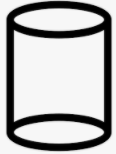
As per the formula known to us, the volume of the cylinder, \[{V_1}\]=\[\pi {r^2}h\], where r is the radius and h is the height of the cylinder.
Now, according to the question, the radius and height of the cylinder are same,
So, we have, r = h,
Thus, the volume turns out to be,
\[ \Rightarrow {V_1} = \pi {h^3}\]
Differentiating both sides with respect to “t” keeping\[{V_1}\] and h as variables.
\[ \Rightarrow \dfrac{{d{V_1}}}{{dt}} = 3\pi {h^2}\dfrac{{dh}}{{dt}}\]
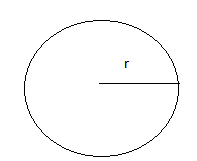
Also, as per the formula, the volume of the sphere, \[{V_2}\]\[ = \dfrac{4}{3}\pi {R^3}\]
Where, R is the radius of the given sphere.
Differentiating both sides with respect to “t” keeping\[{V_2}\] and R as variables.
\[ \Rightarrow \dfrac{{d{V_2}}}{{dt}} = 4\pi {R^2}\dfrac{{dR}}{{dt}}\]
Now, as per the problem, the radius of the cylinder and sphere are the same. As the height is also equal with the radius of the cylinder,
We can write, \[r = {\text{ }}h = R\]
Now, we can write, \[h = R\]
Differentiating both sides with respect to “t” keeping h and R as variables.
\[ \Rightarrow \dfrac{{dh}}{{dt}} = \dfrac{{dR}}{{dt}}\]
So, \[\dfrac{{\dfrac{{d{V_2}}}{{dt}}}}{{\dfrac{{d{V_1}}}{{dt}}}} = \dfrac{{3\pi {h^2}\dfrac{{dh}}{{dt}}}}{{4\pi {R^2}\dfrac{{dR}}{{dt}}}}\]
As, \[\dfrac{{dh}}{{dt}} = \dfrac{{dR}}{{dt}}\]
\[ = \dfrac{{3\pi {h^2}\dfrac{{dh}}{{dt}}}}{{4\pi {R^2}\dfrac{{dh}}{{dt}}}}\]
\[ = \dfrac{{3\pi {h^2}}}{{4\pi {R^2}}}\]
As \[h = R\]
\[ = \dfrac{{3\pi {h^2}}}{{4\pi {h^2}}}\]
On cancelling common terms we get,
\[ = \dfrac{3}{4}\]
Since the ratio of the rates of increase of the volume of the sphere and the volume of the cylinder is \[\dfrac{3}{4}\], therefore the ratio of the rates of increase of the volume of the cylinder and the volume of the sphere is \[\dfrac{4}{3}\]
Hence, option (A) is correct.
Note: We have to keep that in mind that, when we differentiate with respect to “t” we don’t multiply with \[\dfrac{d}{{dt}}\]term. We differentiate a term to find a smaller version of it. Till the quantity is zero any term can be differentiated, i.e. , we can find a smaller version of this theoretically.
Complete step-by-step answer:
As per the formula known to us, the volume of the cylinder, \[{V_1}\]=\[\pi {r^2}h\], where r is the radius and h is the height of the cylinder.
Now, according to the question, the radius and height of the cylinder are same,
So, we have, r = h,
Thus, the volume turns out to be,
\[ \Rightarrow {V_1} = \pi {h^3}\]
Differentiating both sides with respect to “t” keeping\[{V_1}\] and h as variables.
\[ \Rightarrow \dfrac{{d{V_1}}}{{dt}} = 3\pi {h^2}\dfrac{{dh}}{{dt}}\]
Also, as per the formula, the volume of the sphere, \[{V_2}\]\[ = \dfrac{4}{3}\pi {R^3}\]
Where, R is the radius of the given sphere.
Differentiating both sides with respect to “t” keeping\[{V_2}\] and R as variables.
\[ \Rightarrow \dfrac{{d{V_2}}}{{dt}} = 4\pi {R^2}\dfrac{{dR}}{{dt}}\]
Now, as per the problem, the radius of the cylinder and sphere are the same. As the height is also equal with the radius of the cylinder,
We can write, \[r = {\text{ }}h = R\]
Now, we can write, \[h = R\]
Differentiating both sides with respect to “t” keeping h and R as variables.
\[ \Rightarrow \dfrac{{dh}}{{dt}} = \dfrac{{dR}}{{dt}}\]
So, \[\dfrac{{\dfrac{{d{V_2}}}{{dt}}}}{{\dfrac{{d{V_1}}}{{dt}}}} = \dfrac{{3\pi {h^2}\dfrac{{dh}}{{dt}}}}{{4\pi {R^2}\dfrac{{dR}}{{dt}}}}\]
As, \[\dfrac{{dh}}{{dt}} = \dfrac{{dR}}{{dt}}\]
\[ = \dfrac{{3\pi {h^2}\dfrac{{dh}}{{dt}}}}{{4\pi {R^2}\dfrac{{dh}}{{dt}}}}\]
\[ = \dfrac{{3\pi {h^2}}}{{4\pi {R^2}}}\]
As \[h = R\]
\[ = \dfrac{{3\pi {h^2}}}{{4\pi {h^2}}}\]
On cancelling common terms we get,
\[ = \dfrac{3}{4}\]
Since the ratio of the rates of increase of the volume of the sphere and the volume of the cylinder is \[\dfrac{3}{4}\], therefore the ratio of the rates of increase of the volume of the cylinder and the volume of the sphere is \[\dfrac{4}{3}\]
Hence, option (A) is correct.
Note: We have to keep that in mind that, when we differentiate with respect to “t” we don’t multiply with \[\dfrac{d}{{dt}}\]term. We differentiate a term to find a smaller version of it. Till the quantity is zero any term can be differentiated, i.e. , we can find a smaller version of this theoretically.
Recently Updated Pages
Master Class 11 Computer Science: Engaging Questions & Answers for Success

Master Class 11 Business Studies: Engaging Questions & Answers for Success
Master Class 11 Economics: Engaging Questions & Answers for Success
Master Class 11 English: Engaging Questions & Answers for Success
Master Class 11 Maths: Engaging Questions & Answers for Success
Master Class 11 Biology: Engaging Questions & Answers for Success
Trending doubts
One Metric ton is equal to kg A 10000 B 1000 C 100 class 11 physics CBSE
There are 720 permutations of the digits 1 2 3 4 5 class 11 maths CBSE
Discuss the various forms of bacteria class 11 biology CBSE
Draw a diagram of a plant cell and label at least eight class 11 biology CBSE
State the laws of reflection of light
Explain zero factorial class 11 maths CBSE