




The radii of the ends of a frustum of a cone 45 cm high are 28 cm and 7 cm. Find its volume, curved surface area and total surface area.
Answer
 Verified
606.3k+ views
Hint:
Here, take $\pi = \dfrac{{22}}{7}$ .
It is given that height \[h = 45\] cm, radius of larger end ${r_1} = 28$ cm and radius of smaller end ${r_2} = 7$ cm.
Then, find slant height l by using the formula $l = \sqrt {{h^2} + {{\left( {{r_1} - {r_2}} \right)}^2}} $ .
Finally, for volume of frustum of cone use $V = \dfrac{1}{3} \times \pi \times h\left( {{r_1}^2 + {r_2}^2 + {r_1}{r_2}} \right)$ , for curved surface area of the frustum of cone use $C.S.A. = \pi \left( {{r_1} + {r_2}} \right)l$ and for total surface area of frustum of cone use $T.S.A. = C.S.A. + \pi r_1^2 + \pi r_2^2$ . Thus, find volume, curved surface area and total surface area of frustum of cone.
Complete step by step solution:
It is given that the radii of the ends of a frustum of a cone 45 cm high are 28 cm and 7 cm.
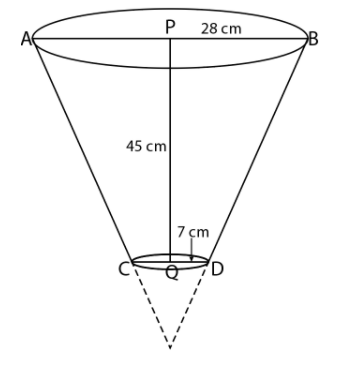
So, from the above diagram, we get height \[h = PQ = 45\] cm, radius of larger end ${r_1} = PB = 28$ cm and radius of smaller end ${r_2} = QD = 7$ cm.
Now, we will find the slant height l of the frustum of cone using the formula $l = \sqrt {{h^2} + {{\left( {{r_1} - {r_2}} \right)}^2}} $ .
$\therefore l = \sqrt {{{45}^2} + {{\left( {28 - 7} \right)}^2}} $
$
= \sqrt {2025 + {{\left( {21} \right)}^2}} \\
= \sqrt {2025 + 441} \\
= \sqrt {2466} \\
$
=49.65
So, we get slant height l = 49.67 cm.
We are asked to find volume, curved surface area and total surface area of the frustum of the cone.
Now, volume of frustum of cone is given by $V = \dfrac{1}{3} \times \pi \times h\left( {{r_1}^2 + {r_2}^2 + {r_1}{r_2}} \right)$ .
$
\therefore V = \dfrac{1}{3} \times \dfrac{{22}}{7} \times 45\left[ {{{\left( {28} \right)}^2} + {{\left( 7 \right)}^2} + 28 \times 7} \right] \\
= \dfrac{1}{3} \times \dfrac{{22}}{7} \times 45\left( {784 + 49 + 196} \right) \\
= \dfrac{{22}}{7} \times 15\left( {1029} \right) \\
= 22 \times 15\left( {147} \right) \\
= 48510c{m^3} \\
$
Curved surface area of the frustum of the cone is given by $C.S.A. = \pi \left( {{r_1} + {r_2}} \right)l$ .
$\therefore C.S.A. = \dfrac{{22}}{7}\left( {28 + 7} \right) \times 49.65$
$
= \dfrac{{22}}{7} \times 35 \times 49.65 \\
= 22 \times 5 \times 49.65 \\
= 5461.5c{m^2} \\
$
Total surface area of the frustum of cone is given by $T.S.A. = C.S.A. + \pi r_1^2 + \pi r_2^2$ .
$\therefore T.S.A. = 5461.5 + \dfrac{{22}}{7}{\left( {28} \right)^2} + \dfrac{{22}}{7}{\left( 7 \right)^2}$
$
= 54631.5 + \dfrac{{22}}{7}\left( {784} \right) + \dfrac{{22}}{7}\left( {49} \right) \\
= 5461.5 + 22\left( {112} \right) + 22\left( 7 \right) \\
= 5461.5 + 2464 + 154 \\
= 8079.5c{m^2} \\
\\
$
Thus, volume of frustum $V = 48510c{m^3}$ , curved surface area of frustum $C.S.A. = 5461.5c{m^2}$ and the total surface area of frustum $T.S.A. = 8079.5c{m^2}$.
Note:
Frustum of a cone:
If a right circular cone is cut off into two parts by a plane parallel to the base of the cone, the part between the plane and the base of the cone is called the frustum of the cone.
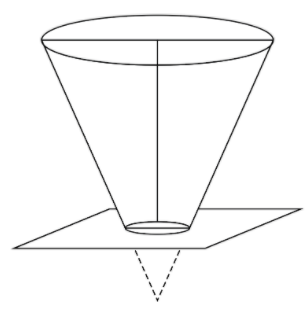
In the figure given above, the portion between the plane parallel to the base and the base of the cone is called the frustum of the cone.
Here, take $\pi = \dfrac{{22}}{7}$ .
It is given that height \[h = 45\] cm, radius of larger end ${r_1} = 28$ cm and radius of smaller end ${r_2} = 7$ cm.
Then, find slant height l by using the formula $l = \sqrt {{h^2} + {{\left( {{r_1} - {r_2}} \right)}^2}} $ .
Finally, for volume of frustum of cone use $V = \dfrac{1}{3} \times \pi \times h\left( {{r_1}^2 + {r_2}^2 + {r_1}{r_2}} \right)$ , for curved surface area of the frustum of cone use $C.S.A. = \pi \left( {{r_1} + {r_2}} \right)l$ and for total surface area of frustum of cone use $T.S.A. = C.S.A. + \pi r_1^2 + \pi r_2^2$ . Thus, find volume, curved surface area and total surface area of frustum of cone.
Complete step by step solution:
It is given that the radii of the ends of a frustum of a cone 45 cm high are 28 cm and 7 cm.
So, from the above diagram, we get height \[h = PQ = 45\] cm, radius of larger end ${r_1} = PB = 28$ cm and radius of smaller end ${r_2} = QD = 7$ cm.
Now, we will find the slant height l of the frustum of cone using the formula $l = \sqrt {{h^2} + {{\left( {{r_1} - {r_2}} \right)}^2}} $ .
$\therefore l = \sqrt {{{45}^2} + {{\left( {28 - 7} \right)}^2}} $
$
= \sqrt {2025 + {{\left( {21} \right)}^2}} \\
= \sqrt {2025 + 441} \\
= \sqrt {2466} \\
$
=49.65
So, we get slant height l = 49.67 cm.
We are asked to find volume, curved surface area and total surface area of the frustum of the cone.
Now, volume of frustum of cone is given by $V = \dfrac{1}{3} \times \pi \times h\left( {{r_1}^2 + {r_2}^2 + {r_1}{r_2}} \right)$ .
$
\therefore V = \dfrac{1}{3} \times \dfrac{{22}}{7} \times 45\left[ {{{\left( {28} \right)}^2} + {{\left( 7 \right)}^2} + 28 \times 7} \right] \\
= \dfrac{1}{3} \times \dfrac{{22}}{7} \times 45\left( {784 + 49 + 196} \right) \\
= \dfrac{{22}}{7} \times 15\left( {1029} \right) \\
= 22 \times 15\left( {147} \right) \\
= 48510c{m^3} \\
$
Curved surface area of the frustum of the cone is given by $C.S.A. = \pi \left( {{r_1} + {r_2}} \right)l$ .
$\therefore C.S.A. = \dfrac{{22}}{7}\left( {28 + 7} \right) \times 49.65$
$
= \dfrac{{22}}{7} \times 35 \times 49.65 \\
= 22 \times 5 \times 49.65 \\
= 5461.5c{m^2} \\
$
Total surface area of the frustum of cone is given by $T.S.A. = C.S.A. + \pi r_1^2 + \pi r_2^2$ .
$\therefore T.S.A. = 5461.5 + \dfrac{{22}}{7}{\left( {28} \right)^2} + \dfrac{{22}}{7}{\left( 7 \right)^2}$
$
= 54631.5 + \dfrac{{22}}{7}\left( {784} \right) + \dfrac{{22}}{7}\left( {49} \right) \\
= 5461.5 + 22\left( {112} \right) + 22\left( 7 \right) \\
= 5461.5 + 2464 + 154 \\
= 8079.5c{m^2} \\
\\
$
Thus, volume of frustum $V = 48510c{m^3}$ , curved surface area of frustum $C.S.A. = 5461.5c{m^2}$ and the total surface area of frustum $T.S.A. = 8079.5c{m^2}$.
Note:
Frustum of a cone:
If a right circular cone is cut off into two parts by a plane parallel to the base of the cone, the part between the plane and the base of the cone is called the frustum of the cone.
In the figure given above, the portion between the plane parallel to the base and the base of the cone is called the frustum of the cone.
Recently Updated Pages
Master Class 12 Business Studies: Engaging Questions & Answers for Success

Master Class 12 Biology: Engaging Questions & Answers for Success
Master Class 12 Chemistry: Engaging Questions & Answers for Success
Class 12 Question and Answer - Your Ultimate Solutions Guide
Master Class 11 Social Science: Engaging Questions & Answers for Success
Master Class 11 English: Engaging Questions & Answers for Success
Trending doubts
Explain the Treaty of Vienna of 1815 class 10 social science CBSE
Which Indian city is known as the "City of Victory"?
Which instrument is used to measure the Blood Pressure?
Who Won 36 Oscar Awards? Record Holder Revealed
What is the median of the first 10 natural numbers class 10 maths CBSE
Why is it 530 pm in india when it is 1200 afternoon class 10 social science CBSE