




The quadrilaterals having four right angles are either square or rectangle.
(a) True
(b) False
Answer
 Verified
594.6k+ views
Hint: We solve this problem in the way of contradiction. We assume that the quadrilaterals having four right angles are not squares or rectangles. Then, if we are able to prove that the diagonals are equal then we get the wrong result which contradicts the given statement. This is because only squares and rectangles will have both the diagonals of equal length.
Complete step by step answer:
We are given that there are four right angles to a quadrilateral.
Let us assume a quadrilateral ‘ABCD’ having four right angles as shown below
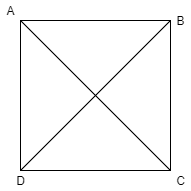
Let us assume that this quadrilateral is neither a square nor a rectangle.
Now, we know that
If \[AC=BD\] then our consideration is wrong because only squares and rectangles have diagonals of equal length.
Now, let us assume the two triangles \[\Delta ADC\] and \[\Delta BCD\].
Here we can write three equations
(i)\[DC=CD\]
(ii)\[\angle ADC=\angle BCD={{90}^{0}}\], this is given in the question.
(iii)\[\angle DAC=\angle CBD\]
We know that if two angles and one side of two triangles are equal then we can say that from A.A.S congruence those two triangles are equal.
So, from A.A.S congruence we can write \[\Delta ADC\] and \[\Delta BCD\] are congruent to each other.
We know that if two triangles are congruent then all the corresponding sides and angles are equal.
So, from the definition of congruence we can say that
\[\Rightarrow AC=BD\]
So, this proves that our consideration of quadrilateral ‘ABCD’ is neither a square nor a rectangle is wrong.
We can say that quadrilateral ‘ABCD’ is either a square or a rectangle.
Therefore, the given statement is true.
So, the correct answer is “Option a”.
Note: The shortcut explanation to the given statement is
Only squares and rectangles have all the angles equal to \[{{90}^{0}}\]. We can say that there is no other quadrilateral having four right angles.
For example if we take a rhombus, it has all the sides are equal but not angles.
If we take a trapezium, it neither has equal angles nor equal sides. It has one set of parallel sides.
If we take a parallelogram, it has opposite sides are equal and opposite angles are equal not all angles are equal.
From these definitions we can say that the given statement is true.
So, option (a) is correct.
Complete step by step answer:
We are given that there are four right angles to a quadrilateral.
Let us assume a quadrilateral ‘ABCD’ having four right angles as shown below
Let us assume that this quadrilateral is neither a square nor a rectangle.
Now, we know that
If \[AC=BD\] then our consideration is wrong because only squares and rectangles have diagonals of equal length.
Now, let us assume the two triangles \[\Delta ADC\] and \[\Delta BCD\].
Here we can write three equations
(i)\[DC=CD\]
(ii)\[\angle ADC=\angle BCD={{90}^{0}}\], this is given in the question.
(iii)\[\angle DAC=\angle CBD\]
We know that if two angles and one side of two triangles are equal then we can say that from A.A.S congruence those two triangles are equal.
So, from A.A.S congruence we can write \[\Delta ADC\] and \[\Delta BCD\] are congruent to each other.
We know that if two triangles are congruent then all the corresponding sides and angles are equal.
So, from the definition of congruence we can say that
\[\Rightarrow AC=BD\]
So, this proves that our consideration of quadrilateral ‘ABCD’ is neither a square nor a rectangle is wrong.
We can say that quadrilateral ‘ABCD’ is either a square or a rectangle.
Therefore, the given statement is true.
So, the correct answer is “Option a”.
Note: The shortcut explanation to the given statement is
Only squares and rectangles have all the angles equal to \[{{90}^{0}}\]. We can say that there is no other quadrilateral having four right angles.
For example if we take a rhombus, it has all the sides are equal but not angles.
If we take a trapezium, it neither has equal angles nor equal sides. It has one set of parallel sides.
If we take a parallelogram, it has opposite sides are equal and opposite angles are equal not all angles are equal.
From these definitions we can say that the given statement is true.
So, option (a) is correct.
Recently Updated Pages
Master Class 10 Social Science: Engaging Questions & Answers for Success

Master Class 10 Science: Engaging Questions & Answers for Success
Master Class 10 Maths: Engaging Questions & Answers for Success
Master Class 10 General Knowledge: Engaging Questions & Answers for Success
Master Class 10 Computer Science: Engaging Questions & Answers for Success
Class 10 Question and Answer - Your Ultimate Solutions Guide
Trending doubts
What is the full form of PNG A Petrol Natural Gas B class 10 chemistry CBSE
Explain the Treaty of Vienna of 1815 class 10 social science CBSE
Why is there a time difference of about 5 hours between class 10 social science CBSE
Who Won 36 Oscar Awards? Record Holder Revealed
What is the median of the first 10 natural numbers class 10 maths CBSE
The power of the lens is 2D What is its focal length class 10 physics CBSE