




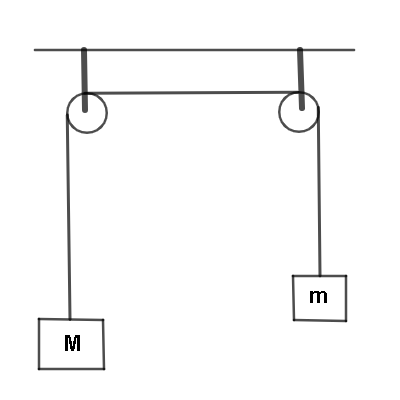
The pulleys in figure are identical, each having a radius R and moment of inertia I. Find the acceleration of the block M.
Answer
 Verified
528.9k+ views
Hint: We will first label all the diagrams mentioning the tensions in strings , accelerations and weights. Then we will form certain equations that will include all the forces due to the pulley, and the blocks to finally get the value of acceleration of block M.
Complete answer:
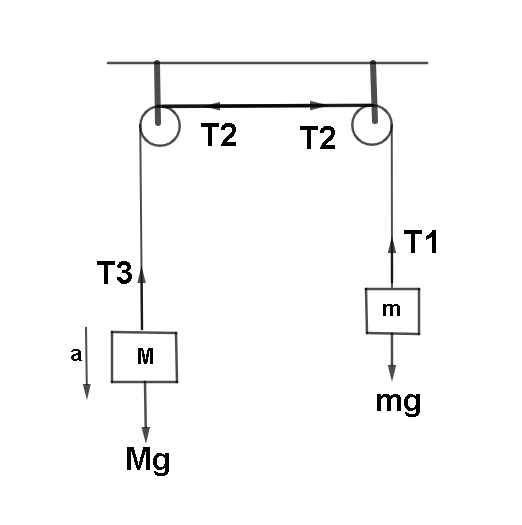
Here T stands for tension in strings and a stands for acceleration.
Now let's form equations : considering the mass M, we get:
\[Mg - {T_1} = Ma\;\;\;...(1)\]
Also,
\[({T_1} - {T_2})R = I\dfrac{\alpha }{R}\] (where \[\alpha \] is angular acceleration)
Or,
\[ \Rightarrow ({T_1} - {T_2}) = I\dfrac{\alpha }{{{R^2}}}\;\;...(2)\]
Similarly,
\[ \Rightarrow ({T_2} - {T_3})R = I\dfrac{\alpha }{{{R^2}}}\;\;...(3)\]
And
\[ \Rightarrow {T_3} - mg = ma\;\;\;\;\;\;\;\;\;...(4)\]
Looking at the above equations we will now add equations 2 and 3.
We will get as follows:
\[({T_1} - {T_3}) = \dfrac{{2I\alpha }}{{{R^2}}}\;\;\;\;\;\;\;\;\;\;\;\;\;\;\;\;\;\;\;\;\;.......(5)\]
Again by adding equations 1 and 4 we will get as follows:
\[ - mg + Mg + ({T_3} - {T_1}) = Ma + ma.......(6)\]
We will now substitute the value of \[{T_3} - {T_1}\] from equation 5 in equation 6.
We will get;
\[ \Rightarrow Mg - mg = Ma + ma + \dfrac{{2I\alpha }}{{{R^2}}}\]
From this we will get the acceleration of block M as,
\[ \Rightarrow a = \dfrac{{(M - m)G}}{{(M + m + \dfrac{{2I}}{{{R^2}}})}}\].
Additional information:
A pulley is a wheel on an axle or shaft that allows a taut cable or belt to move and change directions while also transferring power between the shaft and the cable or belt..
Note:
Remember according to equation 5, \[({T_1} - {T_3})\;\] has been found but we need \[{T_3} - {T_1}\]. Hence do not forget to change the sign .
Be very careful while assigning the directions of tensions in the strings. Short trick to remember is that tension will be away from mass.
Complete answer:
Here T stands for tension in strings and a stands for acceleration.
Now let's form equations : considering the mass M, we get:
\[Mg - {T_1} = Ma\;\;\;...(1)\]
Also,
\[({T_1} - {T_2})R = I\dfrac{\alpha }{R}\] (where \[\alpha \] is angular acceleration)
Or,
\[ \Rightarrow ({T_1} - {T_2}) = I\dfrac{\alpha }{{{R^2}}}\;\;...(2)\]
Similarly,
\[ \Rightarrow ({T_2} - {T_3})R = I\dfrac{\alpha }{{{R^2}}}\;\;...(3)\]
And
\[ \Rightarrow {T_3} - mg = ma\;\;\;\;\;\;\;\;\;...(4)\]
Looking at the above equations we will now add equations 2 and 3.
We will get as follows:
\[({T_1} - {T_3}) = \dfrac{{2I\alpha }}{{{R^2}}}\;\;\;\;\;\;\;\;\;\;\;\;\;\;\;\;\;\;\;\;\;.......(5)\]
Again by adding equations 1 and 4 we will get as follows:
\[ - mg + Mg + ({T_3} - {T_1}) = Ma + ma.......(6)\]
We will now substitute the value of \[{T_3} - {T_1}\] from equation 5 in equation 6.
We will get;
\[ \Rightarrow Mg - mg = Ma + ma + \dfrac{{2I\alpha }}{{{R^2}}}\]
From this we will get the acceleration of block M as,
\[ \Rightarrow a = \dfrac{{(M - m)G}}{{(M + m + \dfrac{{2I}}{{{R^2}}})}}\].
Additional information:
A pulley is a wheel on an axle or shaft that allows a taut cable or belt to move and change directions while also transferring power between the shaft and the cable or belt..
Note:
Remember according to equation 5, \[({T_1} - {T_3})\;\] has been found but we need \[{T_3} - {T_1}\]. Hence do not forget to change the sign .
Be very careful while assigning the directions of tensions in the strings. Short trick to remember is that tension will be away from mass.
Recently Updated Pages
If x a + bt + ct2 where x is in meters and t is in class 11 physics CBSE

A car covers the first half distance between two places class 11 physics CBSE
The resultant of two vectors overrightarrow P and overrightarrow class 11 physics CBSE
Find the value of cos 135 class 11 maths CBSE
A mass M is held in place by an applied force F and class 11 physics CBSE
A solution of glucose in water is labelled as 10 dfracwv class 11 chemistry CBSE
Trending doubts
One Metric ton is equal to kg A 10000 B 1000 C 100 class 11 physics CBSE
Find the value of the expression given below sin 30circ class 11 maths CBSE
What do you mean by retardation What is its SI uni class 11 physics CBSE
Draw a diagram of nephron and explain its structur class 11 biology CBSE
10 examples of friction in our daily life
Difference between physical and chemical change class 11 chemistry CBSE