




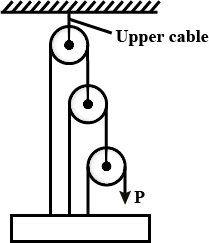
The Pull P is just sufficient to keep the 14N block in equilibrium as shown. Pulleys are ideal. Find the tension (in N) in the upper cable connected with ceiling.
Answer
 Verified
531k+ views
Hint: Tension is defined in physics as the pulling force conveyed axially by a thread, cable, cord, or other one-dimensional continuous component, or by each end of a pole, truss member, or other three-dimensional object; tension may also be defined as the action-reaction pair of forces acting at each end of such elements. Tension can be thought of as the polar opposite of compression.
Formula used:
The mass of an object multiplied by the gravitational force plus/minus the mass multiplied by acceleration equals the object's tension.
T = mg + ma
m = Mass of the body
g = acceleration due to gravity
a = object's acceleration
Complete step-by-step answer:
Tension is the pulling force that acts on the body as it is suspended from objects such as chains, cables, and strings. T is the symbol for it.
The strain would be T = mg+ ma if the body is moving upward.
If the body is travelling downward, the tension will be T = mg – ma
T = mg if the strain is equal to the weight of the body
When atoms or molecules are pulled apart and gain potential energy while a restoring force is still present, the restoring force will cause stress. In order to return the string/rod to its relaxed length, each end of a string or rod under certain strain could tug on the object it is attached to.
To determine the stress force acting on some material, the Tension Formula is used. It is beneficial in solving problems. Since tension is a force, it is measured in Newtons (N).
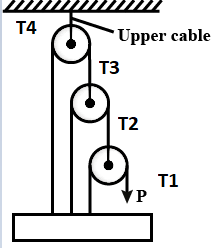
Now if we consider the above figure ${T_1},{T_2},{T_3},{T_4}$are the tensions respectively.
Now if we find the tension in the cable
Tension is equal to the pull of the cable
${T_1} = P$
${T_2} = 2{T_1} = 2P$
${T_3} = 2{T_2} = 4P$
\[{T_4} = 2{T_3} = 8P\]
So applying equilibrium of block
${T_1} + {T_2} + {T_3} = 14\;{\text{N}}$
7P = 14 N
P = 2N
So, the tension in the cable is ${T_4} = 8P = 16N$
Note: Tension may be a force in mechanics, such as a transmitted force, an action-reaction pair of forces, or a restoring force, and the units of force are newtons (or sometimes pounds-force). The ends of a string or other material transmitting stress will exert forces in the direction of the string at the point of connection on the surfaces to which the string or rod is attached. Tension-induced forces are also known as "passive forces." For systems of particles held by strings, there are two simple possibilities: either the acceleration is zero, indicating that the system is in equilibrium, or there is acceleration, indicating that the system has a net force.
Formula used:
The mass of an object multiplied by the gravitational force plus/minus the mass multiplied by acceleration equals the object's tension.
T = mg + ma
m = Mass of the body
g = acceleration due to gravity
a = object's acceleration
Complete step-by-step answer:
Tension is the pulling force that acts on the body as it is suspended from objects such as chains, cables, and strings. T is the symbol for it.
The strain would be T = mg+ ma if the body is moving upward.
If the body is travelling downward, the tension will be T = mg – ma
T = mg if the strain is equal to the weight of the body
When atoms or molecules are pulled apart and gain potential energy while a restoring force is still present, the restoring force will cause stress. In order to return the string/rod to its relaxed length, each end of a string or rod under certain strain could tug on the object it is attached to.
To determine the stress force acting on some material, the Tension Formula is used. It is beneficial in solving problems. Since tension is a force, it is measured in Newtons (N).
Now if we consider the above figure ${T_1},{T_2},{T_3},{T_4}$are the tensions respectively.
Now if we find the tension in the cable
Tension is equal to the pull of the cable
${T_1} = P$
${T_2} = 2{T_1} = 2P$
${T_3} = 2{T_2} = 4P$
\[{T_4} = 2{T_3} = 8P\]
So applying equilibrium of block
${T_1} + {T_2} + {T_3} = 14\;{\text{N}}$
7P = 14 N
P = 2N
So, the tension in the cable is ${T_4} = 8P = 16N$
Note: Tension may be a force in mechanics, such as a transmitted force, an action-reaction pair of forces, or a restoring force, and the units of force are newtons (or sometimes pounds-force). The ends of a string or other material transmitting stress will exert forces in the direction of the string at the point of connection on the surfaces to which the string or rod is attached. Tension-induced forces are also known as "passive forces." For systems of particles held by strings, there are two simple possibilities: either the acceleration is zero, indicating that the system is in equilibrium, or there is acceleration, indicating that the system has a net force.
Recently Updated Pages
Master Class 11 Social Science: Engaging Questions & Answers for Success

Master Class 11 Physics: Engaging Questions & Answers for Success
Master Class 11 Maths: Engaging Questions & Answers for Success
Master Class 11 Economics: Engaging Questions & Answers for Success
Master Class 11 Computer Science: Engaging Questions & Answers for Success
Master Class 11 Chemistry: Engaging Questions & Answers for Success
Trending doubts
One Metric ton is equal to kg A 10000 B 1000 C 100 class 11 physics CBSE
There are 720 permutations of the digits 1 2 3 4 5 class 11 maths CBSE
1 Quintal is equal to a 110 kg b 10 kg c 100kg d 1000 class 11 physics CBSE
State and prove Bernoullis theorem class 11 physics CBSE
Difference Between Prokaryotic Cells and Eukaryotic Cells
Discuss the various forms of bacteria class 11 biology CBSE