




The protein part of the enzyme is known as
A Holoenzyme
B Apoenzyme
C Isoenzyme
D All of the above
Answer
 Verified
605.4k+ views
Hint:Enzymes are the bio-catalyst. They are made up of protein. The function of the enzyme is to speed up the reaction without being utilized. Essential biological reactions such as respiration, photosynthesis, digestion, protein synthesis are catalyzed by enzymes.
Complete answer:
Enzymes are large molecules. Only a small part of a large enzyme has an affinity to bind with the substrate. This small region is known as the active site. Enzymes are specific i.e. they bind to a specific substrate. Example RuBisCo is specific for RUDP. The enzyme converts the substrate molecule into the product.
Enzymes are made up of protein. Enzymes are not fully active. Enzymes show a specific site for binding of Co-factor. Cofactors are non-protein, usually inorganic molecules. Which binds to the inactive enzyme and makes it active for substrate binding.
The protein part i.e. inactive part of the enzyme is called Apoenzyme.
When the cofactor binds to Apoenzyme it becomes active it is called Holoenzyme.
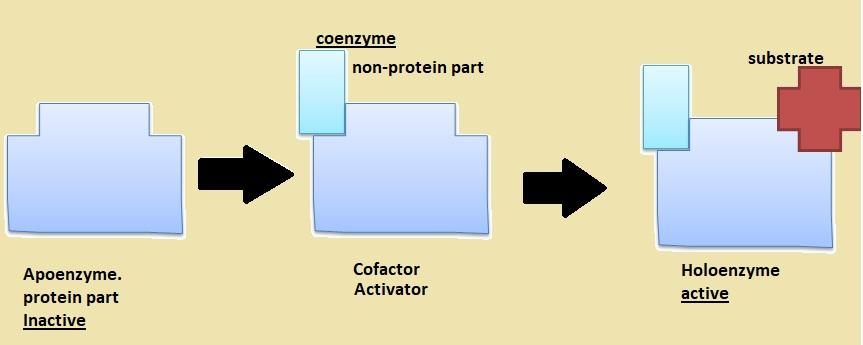
Cofactor when loosely attached to apoenzyme it is called a coenzyme. When the cofactor is firmly bound to the apoenzyme it is called a Prosthetic group.
Isoenzyme is the enzyme which differs in amino acid sequence but catalyzes the same biochemical reaction.
So the correct answer to the given question is option B) Apoenzyme
Note: Apoenzyme is inactive and Holoenzyme is active. A molecule that works with an enzyme is called a substrate. The substrate binds to a specific site known as an active site for substrate binding.
Complete answer:
Enzymes are large molecules. Only a small part of a large enzyme has an affinity to bind with the substrate. This small region is known as the active site. Enzymes are specific i.e. they bind to a specific substrate. Example RuBisCo is specific for RUDP. The enzyme converts the substrate molecule into the product.
Enzymes are made up of protein. Enzymes are not fully active. Enzymes show a specific site for binding of Co-factor. Cofactors are non-protein, usually inorganic molecules. Which binds to the inactive enzyme and makes it active for substrate binding.
The protein part i.e. inactive part of the enzyme is called Apoenzyme.
When the cofactor binds to Apoenzyme it becomes active it is called Holoenzyme.
Cofactor when loosely attached to apoenzyme it is called a coenzyme. When the cofactor is firmly bound to the apoenzyme it is called a Prosthetic group.
Isoenzyme is the enzyme which differs in amino acid sequence but catalyzes the same biochemical reaction.
So the correct answer to the given question is option B) Apoenzyme
Note: Apoenzyme is inactive and Holoenzyme is active. A molecule that works with an enzyme is called a substrate. The substrate binds to a specific site known as an active site for substrate binding.
Recently Updated Pages
Master Class 11 English: Engaging Questions & Answers for Success

Master Class 11 Social Science: Engaging Questions & Answers for Success
Master Class 11 Maths: Engaging Questions & Answers for Success
Master Class 11 Biology: Engaging Questions & Answers for Success
Master Class 11 Physics: Engaging Questions & Answers for Success
Master Class 11 Chemistry: Engaging Questions & Answers for Success
Trending doubts
One Metric ton is equal to kg A 10000 B 1000 C 100 class 11 physics CBSE
Difference Between Prokaryotic Cells and Eukaryotic Cells
1 ton equals to A 100 kg B 1000 kg C 10 kg D 10000 class 11 physics CBSE
Find the value of the expression given below sin 30circ class 11 maths CBSE
Two of the body parts which do not appear in MRI are class 11 biology CBSE
What are hard magnetic materials class 11 physics CBSE