




The production of spores of two different sizes and sexes by the sporophytes of land plants is known as ………….
Answer
 Verified
562.8k+ views
Hint: In this process the smaller of those, the spore, is male and therefore the larger or macrospore is feminine/ female. These spores dissent in size.
Complete answer:
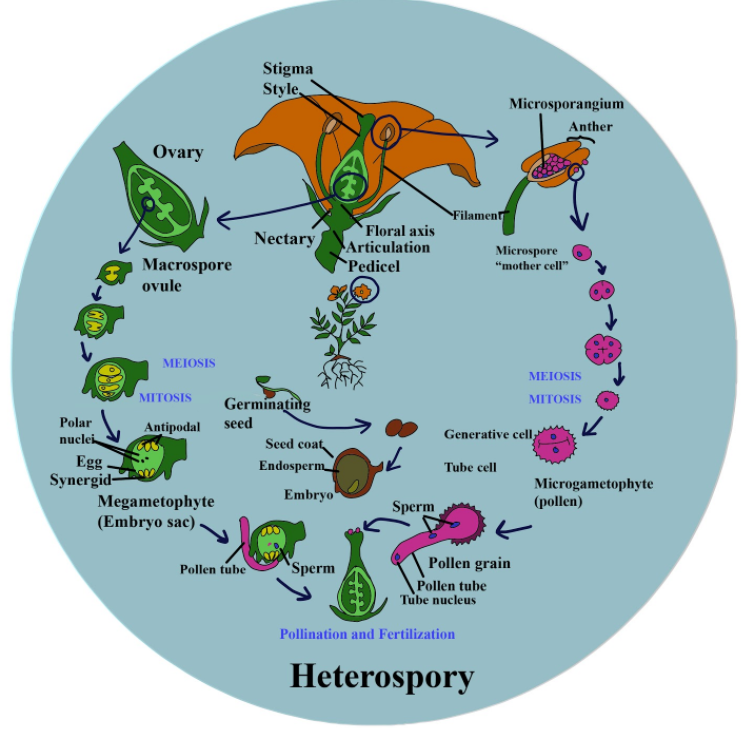
The production of spores of two different sizes and sexes by the sporophytes of land plants is known as ‘Heterospory’, could be a development during which 2 styles of spores square measure borne by the identical plant. The smaller one is understood as a spore and therefore the larger one is understood as a macrospore. The spore germinates to create the male plant life and therefore the macrospore germinates to create the feminine plant life. The male plant life releases the male gametes and these reach the feminine plant life to fuse with the egg. The event of the fertilized ovum takes place within the feminine plant life.
This retention and germination of the macrospore among the sporangium guarantee correct development of the fertilized ovum. The fertilized ovum develops into longer-term plant life. The evolution of the seed habit is expounded to the retention of the macrospore.
Heterospory is thought of as a very important step in evolution because it could be a precursor to the seed habit.
Heterospory evolved initially in pteridophytes like fern genus and genus Salvinia.
Additional information:
Heterospory was a key event within the evolution of each fossil and living plant. The retention of megaspores and therefore the spread of microspores leave each spread and institution procreative ways. This adaptive ability of monogenesis will increase procreative success as any variety of setting favors having these 2 ways. monogenesis stops impregnation from occurring in a very plant life however doesn't stop 2 gametophytes that originated from identical plant life from the coupling. This specific variety of impregnation is termed sporophytic selfing, and it happens most ordinarily among angiosperms. whereas monogenesis stops extreme sexual union from occurring, it doesn't forestall sexual union altogether as sporophytic selfing will still occur.
Note:
Megaspores contain the feminine gametophytes in heterosporic plant species. They develop archegonia that manufacture egg cells that square measure fertilized by spermatozoan of the male plant life originating from the spore. This ends up in the formation of a fertilized diploid fertilized ovum, that develops into the plant life embryo. whereas sporulation plants manufacture fewer megaspores, they're considerably larger than their male counterparts.
Complete answer:
The production of spores of two different sizes and sexes by the sporophytes of land plants is known as ‘Heterospory’, could be a development during which 2 styles of spores square measure borne by the identical plant. The smaller one is understood as a spore and therefore the larger one is understood as a macrospore. The spore germinates to create the male plant life and therefore the macrospore germinates to create the feminine plant life. The male plant life releases the male gametes and these reach the feminine plant life to fuse with the egg. The event of the fertilized ovum takes place within the feminine plant life.
This retention and germination of the macrospore among the sporangium guarantee correct development of the fertilized ovum. The fertilized ovum develops into longer-term plant life. The evolution of the seed habit is expounded to the retention of the macrospore.
Heterospory is thought of as a very important step in evolution because it could be a precursor to the seed habit.
Heterospory evolved initially in pteridophytes like fern genus and genus Salvinia.
Additional information:
Heterospory was a key event within the evolution of each fossil and living plant. The retention of megaspores and therefore the spread of microspores leave each spread and institution procreative ways. This adaptive ability of monogenesis will increase procreative success as any variety of setting favors having these 2 ways. monogenesis stops impregnation from occurring in a very plant life however doesn't stop 2 gametophytes that originated from identical plant life from the coupling. This specific variety of impregnation is termed sporophytic selfing, and it happens most ordinarily among angiosperms. whereas monogenesis stops extreme sexual union from occurring, it doesn't forestall sexual union altogether as sporophytic selfing will still occur.
Note:
Megaspores contain the feminine gametophytes in heterosporic plant species. They develop archegonia that manufacture egg cells that square measure fertilized by spermatozoan of the male plant life originating from the spore. This ends up in the formation of a fertilized diploid fertilized ovum, that develops into the plant life embryo. whereas sporulation plants manufacture fewer megaspores, they're considerably larger than their male counterparts.
Recently Updated Pages
Master Class 11 Social Science: Engaging Questions & Answers for Success

Master Class 11 English: Engaging Questions & Answers for Success
Master Class 11 Maths: Engaging Questions & Answers for Success
Master Class 11 Chemistry: Engaging Questions & Answers for Success
Master Class 11 Biology: Engaging Questions & Answers for Success
Master Class 11 Physics: Engaging Questions & Answers for Success
Trending doubts
Differentiate between an exothermic and an endothermic class 11 chemistry CBSE
One Metric ton is equal to kg A 10000 B 1000 C 100 class 11 physics CBSE
Difference Between Prokaryotic Cells and Eukaryotic Cells
There are 720 permutations of the digits 1 2 3 4 5 class 11 maths CBSE
Two of the body parts which do not appear in MRI are class 11 biology CBSE
Which gas is abundant in air class 11 chemistry CBSE