




The process used in the conversion of pyruvate to acetyl CoA is
A.Oxidative dehydration
B.Oxidative decarboxylation
C.Oxidative Phosphorylation
D.Oxidative dephosphorylation
E.None of the above
Answer
 Verified
653.7k+ views
Hint: This reaction is very common to link between glycolysis and the citric acid cycle. This is in the process used to convert pyruvate to acetyl CoA is oxidative decarboxylation.
Complete answer:
The correct answer is Oxidative decarboxylation. Decarboxylation or oxidative decarboxylation reaction is the biochemical reaction which uses pyruvate in order to form acetyl-CoA, by releasing NADH, which is a reducing equivalent, and carbon dioxide upon decarboxylation. We can observe such kinds of reactions in many organisms which are in between glycolysis and the citric acid cycle.
Additional Information: - Pyruvate is converted to acetyl CoA in an intermediate process just before the citric acid cycle. Here, in oxidative decarboxylation, it reacts with coenzyme A. Here, it loses two of its oxygen and one of its carbons to form carbon dioxide. In addition, an NAD + molecule is reduced to form NADH. The resulting molecule is an acetyl-CoA molecule. The reaction in which a carboxylate group is removed and forms carbon dioxide is called Oxidative decarboxylation reactions. These reactions usually occur in biological systems and some of the examples are in the citric acid cycle. This type of reaction probably started early in the origin of life.
So, the correct answer is ‘oxidative Decarboxylation’.
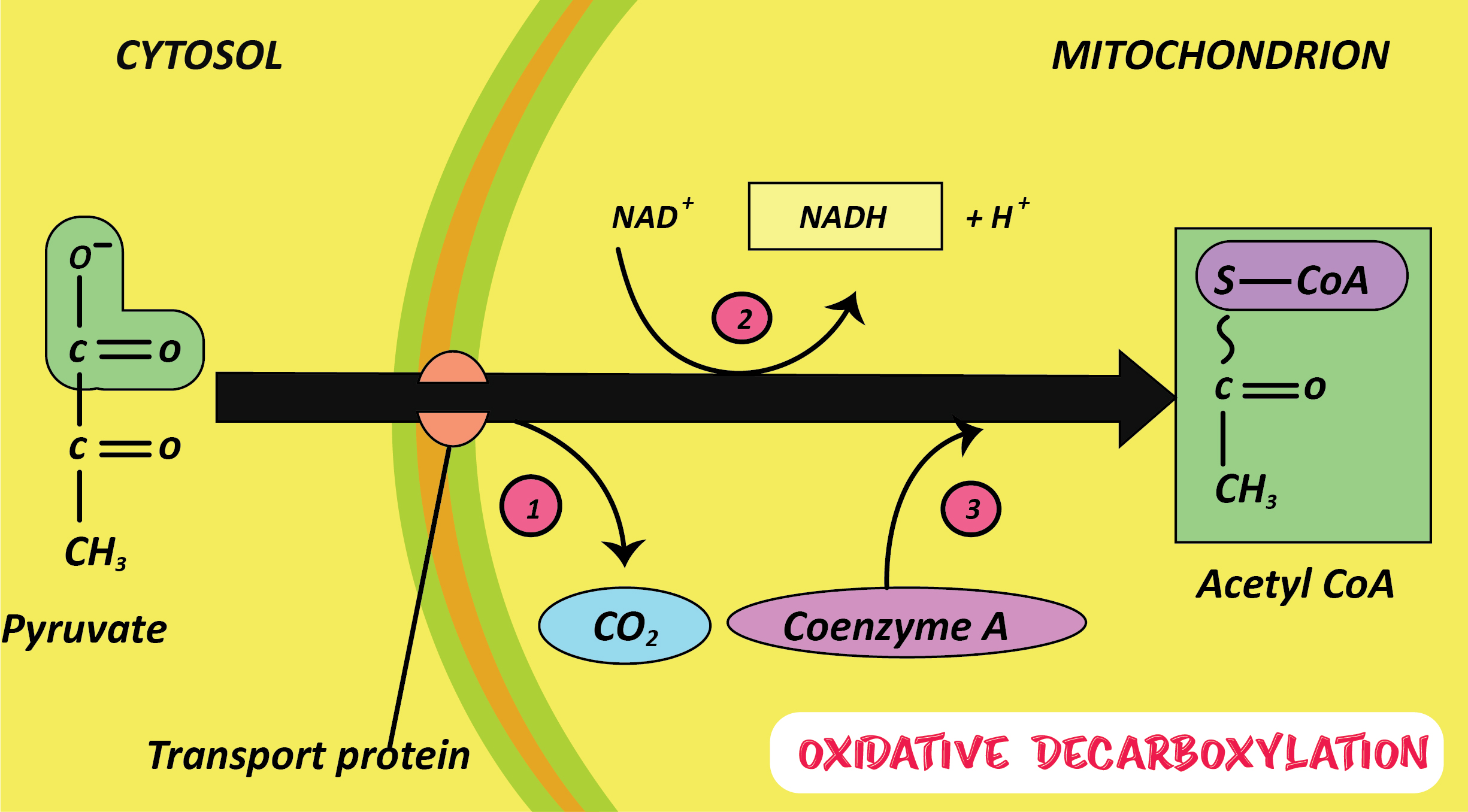
Note: Aerobic respiration starts after the conversion of pyruvate to acetyl CoA. This conversion takes place in three steps: decarboxylation, reduction of NAD +, and binding of coenzyme A. This conversion begins with the decarboxylation (removal of $CO_2$) of pyruvate. Krebs cycle is also known as the tricarboxylic acid cycle or the citric acid cycle.
- When glucose levels are low in the cell, CoA is acetylated using acetate by acetyl-CoA synthetase.
- Krebs cycle occurs in the mitochondria of eukaryotic cells.
Complete answer:
The correct answer is Oxidative decarboxylation. Decarboxylation or oxidative decarboxylation reaction is the biochemical reaction which uses pyruvate in order to form acetyl-CoA, by releasing NADH, which is a reducing equivalent, and carbon dioxide upon decarboxylation. We can observe such kinds of reactions in many organisms which are in between glycolysis and the citric acid cycle.
Additional Information: - Pyruvate is converted to acetyl CoA in an intermediate process just before the citric acid cycle. Here, in oxidative decarboxylation, it reacts with coenzyme A. Here, it loses two of its oxygen and one of its carbons to form carbon dioxide. In addition, an NAD + molecule is reduced to form NADH. The resulting molecule is an acetyl-CoA molecule. The reaction in which a carboxylate group is removed and forms carbon dioxide is called Oxidative decarboxylation reactions. These reactions usually occur in biological systems and some of the examples are in the citric acid cycle. This type of reaction probably started early in the origin of life.
So, the correct answer is ‘oxidative Decarboxylation’.
Note: Aerobic respiration starts after the conversion of pyruvate to acetyl CoA. This conversion takes place in three steps: decarboxylation, reduction of NAD +, and binding of coenzyme A. This conversion begins with the decarboxylation (removal of $CO_2$) of pyruvate. Krebs cycle is also known as the tricarboxylic acid cycle or the citric acid cycle.
- When glucose levels are low in the cell, CoA is acetylated using acetate by acetyl-CoA synthetase.
- Krebs cycle occurs in the mitochondria of eukaryotic cells.
Recently Updated Pages
Which will be the least stable resonating structure class 11 chemistry CBSE

How many 5 digit telephone numbers can be construc-class-11-maths-CBSE
How do you find the angle of the resultant vector class 11 physics CBSE
Draw labelled diagram of the following i Gram seed class 11 biology CBSE
1 Quintal is equal to a 110 kg b 10 kg c 100kg d 1000 class 11 physics CBSE
What is the need and importance of classification class 11 biology CBSE
Trending doubts
Find the value of the expression given below sin 30circ class 11 maths CBSE
One Metric ton is equal to kg A 10000 B 1000 C 100 class 11 physics CBSE
10 examples of friction in our daily life
Draw a diagram of a plant cell and label at least eight class 11 biology CBSE
Difference between physical and chemical change class 11 chemistry CBSE
Proton was discovered by A Thomson B Rutherford C Chadwick class 11 chemistry CBSE