




The process of splicing in eukaryotes:
A) is reminiscent of antiquity
B) represents dominance of RNA world
C) is an indicator of the complexity of human genome
D) is a legacy of organic evolution
Answer
 Verified
565.3k+ views
Hint: One of the events in eukaryotes that are known for processing the primary RNA transcript into the mature mRNA transcript is the splicing event. The primary RNA transcript is composed of introns and exons and the process of splicing is known for removing the introns and ligating the exons together to form mature mRNA.
Complete answer:
Option (A) is incorrect. The process of splicing in eukaryotes is not reminiscent of antiquity but the presence of introns is reminiscent of antiquity because introns were present in the past before the splicing event, indicating that they must have some important information to form RNA but now it is of no importance once the RNA is formed.
Option (B) is correct. The process of splicing in eukaryotes represents the dominance of the RNA world, because for the formation of mature mRNA, primary RNA transcript containing the introns and exons have to undergo splicing event to remove the introns indicating that RNA decides whether to keep the introns or not while the DNA has both introns and exons and from these RNAs, proteins are formed by the translation process.
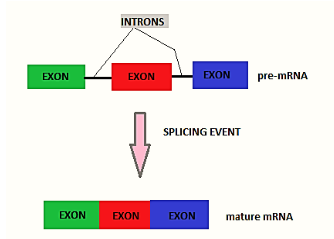
Splicing event.
Option (C) is incorrect. The process of splicing in eukaryotes is not an indicator of the complexity of the human genome but it represents the dominance of the RNA world.
Option (D) is incorrect. The splicing process in eukaryotes is not a legacy of organic evolution. It was the process of natural selection described by Charles Darwin as the legacy of organic evolution.
Hence, the correct option is (B).
Note: Splicing is a post-transcriptional modification in eukaryotes in which introns are removed and the remaining exon portions can be ligated in different ways leading to the formation of multiple proteins from a single gene. Thus, this modification is an important source of protein diversity.
Complete answer:
Option (A) is incorrect. The process of splicing in eukaryotes is not reminiscent of antiquity but the presence of introns is reminiscent of antiquity because introns were present in the past before the splicing event, indicating that they must have some important information to form RNA but now it is of no importance once the RNA is formed.
Option (B) is correct. The process of splicing in eukaryotes represents the dominance of the RNA world, because for the formation of mature mRNA, primary RNA transcript containing the introns and exons have to undergo splicing event to remove the introns indicating that RNA decides whether to keep the introns or not while the DNA has both introns and exons and from these RNAs, proteins are formed by the translation process.
Splicing event.
Option (C) is incorrect. The process of splicing in eukaryotes is not an indicator of the complexity of the human genome but it represents the dominance of the RNA world.
Option (D) is incorrect. The splicing process in eukaryotes is not a legacy of organic evolution. It was the process of natural selection described by Charles Darwin as the legacy of organic evolution.
Hence, the correct option is (B).
Note: Splicing is a post-transcriptional modification in eukaryotes in which introns are removed and the remaining exon portions can be ligated in different ways leading to the formation of multiple proteins from a single gene. Thus, this modification is an important source of protein diversity.
Recently Updated Pages
Master Class 11 English: Engaging Questions & Answers for Success

Master Class 11 Social Science: Engaging Questions & Answers for Success
Master Class 11 Maths: Engaging Questions & Answers for Success
Master Class 11 Biology: Engaging Questions & Answers for Success
Master Class 11 Physics: Engaging Questions & Answers for Success
Master Class 11 Chemistry: Engaging Questions & Answers for Success
Trending doubts
One Metric ton is equal to kg A 10000 B 1000 C 100 class 11 physics CBSE
Agaragar is obtained from A Chlorella B Spirogyra C class 11 biology CBSE
Agaragar is derived from a A fungi b An algae c Both class 11 biology CBSE
Hydrogen bonding is seen in H2O and not in H2S Why class 11 chemistry CBSE
Find R and S configuration of the following compou class 11 chemistry CBSE
Draw a welllabelled diagram of a plant cell class 11 biology CBSE