




The process of budding can be seen in (The question has multiple correct options)
(a)Flatworms
(b)Amoeba
(c)Yeast
(d)Hydra
Answer
 Verified
631.5k+ views
Hint: Some organisms that belong to phylum Coelenterata, Phylum Platyhelminthes, and kingdom Fungi use budding as a process of asexual reproduction and develop new similar organisms through an outgrowth or bud in the parent cell or organism.
Complete step-by-step answer:
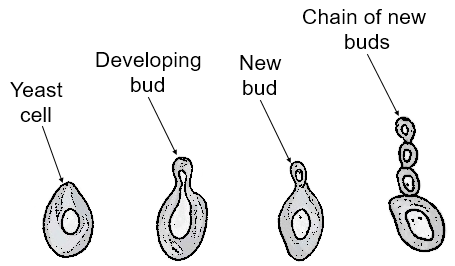
Budding is a type of asexual reproduction where the new organisms develop from an outgrowth or bud in the parent organism and occur in some fungi like yeast, some coelenterates like a hydra, and flatworms. In yeast, a small bulb-like projection comes out from the parent cell, and later it separates and becomes a new organism after a period of growth. The daughter cells that are produced as a result of budding are generally smaller than the parent cell. As the budding is a type of asexual reproduction, it occurs in yeast only in favorable conditions. A diagram showing the process of budding in yeast has been given below –
Additional Information: In hydra, some regenerative cells form a bud due to repeated cell division at one specific site. These buds develop into small individuals and get detached from the body of the parent organism after attaining maturity. Similar to yeast, hydra also reproduces by budding only in favorable conditions. A diagram representing the budding in hydra has been given below

Note: Amoeba is a unicellular organism and thus it reproduces through the process of binary fission just like the other unicellular bacteria. Here, the genetic material is replicated through mitosis and then the parent cell divides into two equal-sized daughter cells. The reproduction in amoeba takes place approximately every two days.
Complete step-by-step answer:
Budding is a type of asexual reproduction where the new organisms develop from an outgrowth or bud in the parent organism and occur in some fungi like yeast, some coelenterates like a hydra, and flatworms. In yeast, a small bulb-like projection comes out from the parent cell, and later it separates and becomes a new organism after a period of growth. The daughter cells that are produced as a result of budding are generally smaller than the parent cell. As the budding is a type of asexual reproduction, it occurs in yeast only in favorable conditions. A diagram showing the process of budding in yeast has been given below –
Additional Information: In hydra, some regenerative cells form a bud due to repeated cell division at one specific site. These buds develop into small individuals and get detached from the body of the parent organism after attaining maturity. Similar to yeast, hydra also reproduces by budding only in favorable conditions. A diagram representing the budding in hydra has been given below
Note: Amoeba is a unicellular organism and thus it reproduces through the process of binary fission just like the other unicellular bacteria. Here, the genetic material is replicated through mitosis and then the parent cell divides into two equal-sized daughter cells. The reproduction in amoeba takes place approximately every two days.
Recently Updated Pages
Master Class 11 English: Engaging Questions & Answers for Success

Master Class 11 Social Science: Engaging Questions & Answers for Success
Master Class 11 Maths: Engaging Questions & Answers for Success
Master Class 11 Biology: Engaging Questions & Answers for Success
Master Class 11 Physics: Engaging Questions & Answers for Success
Master Class 11 Chemistry: Engaging Questions & Answers for Success
Trending doubts
One Metric ton is equal to kg A 10000 B 1000 C 100 class 11 physics CBSE
Difference Between Prokaryotic Cells and Eukaryotic Cells
Find the value of the expression given below sin 30circ class 11 maths CBSE
1 ton equals to A 100 kg B 1000 kg C 10 kg D 10000 class 11 physics CBSE
Two of the body parts which do not appear in MRI are class 11 biology CBSE
What are hard magnetic materials class 11 physics CBSE