




The process of breakdown of glucose is:
Answer
 Verified
617.1k+ views
Hint: The process of breakdown of glucose includes metabolic pathways like aerobic, anaerobic respiration. The process of breakdown of glucose includes various metabolic cycles and enzyme actions.
Complete step by step answer:
The process of breaking down of glucose comprises of 4 stages:
Initially, the glucose complex molecule is broken down into a three-carbon molecule called “pyruvate” Pyruvate is further broken down by different ways to provide energy in various organisms.
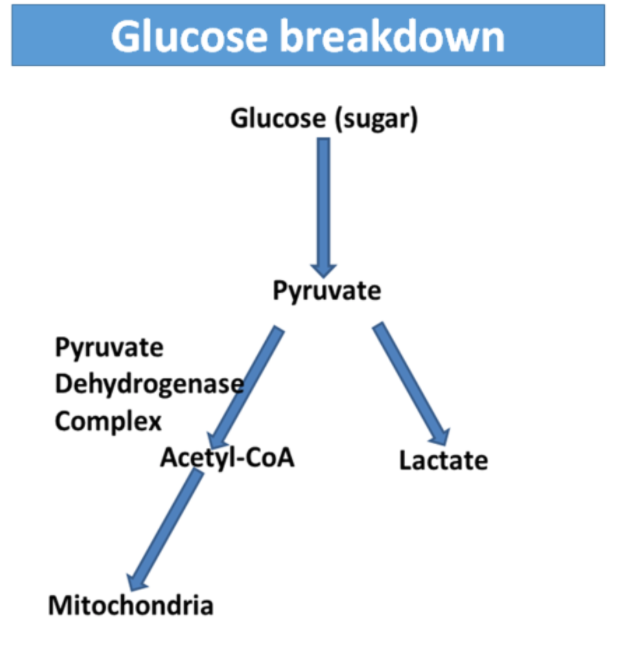
During fermentation, pyruvate is converted into ethanol and carbon dioxide in the absence of oxygen in yeast cells. The breakdown of glucose takes place in the mitochondria inside the cell in the presence of oxygen (aerobic respiration). Under certain conditions, where there is a lack of oxygen, the breakdown takes place anaerobically and results in the production of lactic acid.
Additional information: The process of breakdown of glucose occurs in various stages, in the presence and absence of oxygen. Various cycles like glycolysis, citric acid cycle, and electron transport chain are involved. The glucose breakdown is the basis of energy production. In the process of respiration, the first step is the breakdown of glucose, a 6-carbon molecule breaks into 2 molecules of 3-carbon molecules called pyruvate. This process takes place in the cytoplasm. The following pathway depends on the absence or presence of oxygen as follows (i) Aerobic respiration takes place in the mitochondria in the presence of oxygen. Pyruvic acid is converted into carbon dioxide, and water also releases an abundant amount of energy. (ii) Anaerobic respiration takes place in the cytoplasm in the absence of oxygen. Pyruvic acid is converted either into Carbon Dioxide and ethanol ( i.e., fermentation in yeast) or into lactic acid (in the case of muscle cells during sudden activity in humans).
Note: We must have a clear understanding of various types of respiration for better understanding. Also, understanding the various breakdown products of glucose such as pyruvate and other products of various cycles must be clear for a better understanding of the glucose breakdown process.
Complete step by step answer:
The process of breaking down of glucose comprises of 4 stages:
Initially, the glucose complex molecule is broken down into a three-carbon molecule called “pyruvate” Pyruvate is further broken down by different ways to provide energy in various organisms.
During fermentation, pyruvate is converted into ethanol and carbon dioxide in the absence of oxygen in yeast cells. The breakdown of glucose takes place in the mitochondria inside the cell in the presence of oxygen (aerobic respiration). Under certain conditions, where there is a lack of oxygen, the breakdown takes place anaerobically and results in the production of lactic acid.
Additional information: The process of breakdown of glucose occurs in various stages, in the presence and absence of oxygen. Various cycles like glycolysis, citric acid cycle, and electron transport chain are involved. The glucose breakdown is the basis of energy production. In the process of respiration, the first step is the breakdown of glucose, a 6-carbon molecule breaks into 2 molecules of 3-carbon molecules called pyruvate. This process takes place in the cytoplasm. The following pathway depends on the absence or presence of oxygen as follows (i) Aerobic respiration takes place in the mitochondria in the presence of oxygen. Pyruvic acid is converted into carbon dioxide, and water also releases an abundant amount of energy. (ii) Anaerobic respiration takes place in the cytoplasm in the absence of oxygen. Pyruvic acid is converted either into Carbon Dioxide and ethanol ( i.e., fermentation in yeast) or into lactic acid (in the case of muscle cells during sudden activity in humans).
Note: We must have a clear understanding of various types of respiration for better understanding. Also, understanding the various breakdown products of glucose such as pyruvate and other products of various cycles must be clear for a better understanding of the glucose breakdown process.
Recently Updated Pages
Master Class 11 English: Engaging Questions & Answers for Success

Master Class 11 Social Science: Engaging Questions & Answers for Success
Master Class 11 Maths: Engaging Questions & Answers for Success
Master Class 11 Biology: Engaging Questions & Answers for Success
Master Class 11 Physics: Engaging Questions & Answers for Success
Master Class 11 Chemistry: Engaging Questions & Answers for Success
Trending doubts
One Metric ton is equal to kg A 10000 B 1000 C 100 class 11 physics CBSE
Difference Between Prokaryotic Cells and Eukaryotic Cells
Find the value of the expression given below sin 30circ class 11 maths CBSE
Difference between physical and chemical change class 11 chemistry CBSE
Two of the body parts which do not appear in MRI are class 11 biology CBSE
Draw a diagram of a plant cell and label at least eight class 11 biology CBSE