




The potential gradient along the length of a uniform wire is \[10{\text{ }}volt/m\] \[B\] and \[C\] are two points at \[30cm\] and \[60cm\] in a scale fitted along the wire. The PD between the \[B\] and \[C\] is
A. $3V$
B. \[0.4V\]
C. \[7V\]
D. \[4V\]
Answer
 Verified
487.5k+ views
Hint: The measure of the strength of the field is known as the potential difference. It is frequently used to measure the voltage difference between the two points.
The required amount of work to move the positively charged particles can be measured as the potential difference.
Complete step by step solution:
The Law of conservation of energy is known as the KVL which explains that the sum of the electrical energy in the circuit is equal to the sum of the electrical energy drops.
Here, the source voltage is always equal to the potential drop between the resistances or the various passive elements connected in the circuit. Here it is noted that we had assumed the source voltage as constant for all AC sources when applying KVL.
Inside the electrical circuit, The difference of energy at the two different points is known as the potential difference. Here the electromotive force is the driving force.
Hence, The potential difference of the wire is \[10{\text{ }}volt/m\]
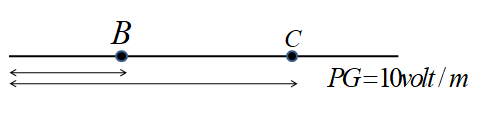
potential at the point \[B\] is
\[ = {\text{ }}10 \times 0.3 = 3volt.\]
Potential at the point \[C\] is
\[ = 10 \times 0.6 = {\text{ }}6volt\]
the potential difference between the \[B\] and \[C\] is as follows,
\[6 - 3{\text{ }} = {\text{ }}3volt\]
So, the potential difference between the \[B\] and \[C\] is \[3V.\]
Note:
We can measure the potential difference using the voltmeter or multimeter.
At infinity, the potential is zero.
The work is always done because the charged particle always experiences some force that can be attractive or repulsive.
The required amount of work to move the positively charged particles can be measured as the potential difference.
Complete step by step solution:
The Law of conservation of energy is known as the KVL which explains that the sum of the electrical energy in the circuit is equal to the sum of the electrical energy drops.
Here, the source voltage is always equal to the potential drop between the resistances or the various passive elements connected in the circuit. Here it is noted that we had assumed the source voltage as constant for all AC sources when applying KVL.
Inside the electrical circuit, The difference of energy at the two different points is known as the potential difference. Here the electromotive force is the driving force.
Hence, The potential difference of the wire is \[10{\text{ }}volt/m\]
potential at the point \[B\] is
\[ = {\text{ }}10 \times 0.3 = 3volt.\]
Potential at the point \[C\] is
\[ = 10 \times 0.6 = {\text{ }}6volt\]
the potential difference between the \[B\] and \[C\] is as follows,
\[6 - 3{\text{ }} = {\text{ }}3volt\]
So, the potential difference between the \[B\] and \[C\] is \[3V.\]
Note:
We can measure the potential difference using the voltmeter or multimeter.
At infinity, the potential is zero.
The work is always done because the charged particle always experiences some force that can be attractive or repulsive.
Recently Updated Pages
Master Class 12 Economics: Engaging Questions & Answers for Success

Master Class 12 Physics: Engaging Questions & Answers for Success
Master Class 12 English: Engaging Questions & Answers for Success
Master Class 12 Social Science: Engaging Questions & Answers for Success
Master Class 12 Maths: Engaging Questions & Answers for Success
Master Class 12 Business Studies: Engaging Questions & Answers for Success
Trending doubts
Which are the Top 10 Largest Countries of the World?
What are the major means of transport Explain each class 12 social science CBSE
Draw a labelled sketch of the human eye class 12 physics CBSE
Differentiate between insitu conservation and exsitu class 12 biology CBSE
Draw a neat and well labeled diagram of TS of ovary class 12 biology CBSE
Give 10 examples of unisexual and bisexual flowers