




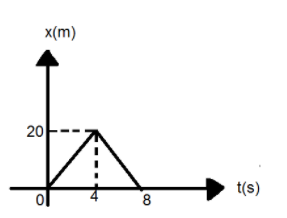
The position ($x$ ) - time ($t$ ) graph of a particle of mass $1kg$ moving along in x-direction is shown in the figure. find the impulse of the particle at $t = 4s$.
Answer
 Verified
495.9k+ views
Hint: Impulse defined the overall effect of force acting over time. Impulse is important because real-world forces are not constant mostly, for example, forces due to people or engines are changed with time and can rely on many factors. Impulse can also be known as a change in momentum.
Complete step by step solution:
Impulse $(J) = F.\Delta t$………………. (1)
$\Delta p = F.\Delta t$……………. (2)
$J = \Delta p$
$J = {p_f} - {p_i}$ ……………… (3)
Where $\Delta p$ the change in momentum is, ${p_f}$ is final momentum, ${p_i}$ is initial momentum, $F$ is the force, $\Delta t$ is the time difference
From equation (3) $J = {p_f} - {p_i}$
Where ${p_i} = m{v_i}$ …….. (4)
${v_i} = \dfrac{{{x_i}}}{{{t_i}}} = \dfrac{{20}}{4}$
$m = 1kg$
Put these values in equation (4)
We get ${p_i} = 5kgm/s$
Similarly ${p_f} = mvf$
${v_f} = \dfrac{{ - 20}}{4}$
${p_f} = - 5kgm/s$
Change in momentum = impulse
${p_f} - {p_i} = J$
$J = - 5 - 5$
$J = - 10kgm/s$
Note:
When we find the value of impulse we multiply force with time difference which is similar to finding the area under the force-time curve. This is useful since the area can easily be calculated for a complicated curve as for a simple curve.
The concept of impulse internal or external is fundamental to understanding the change in momentum.
Specific impulse commonly used when an engine produces thrust Force, it is mostly used in jet engines and rocket engines. It is the measure of the efficiency of using fuel to produce thrust.
Complete step by step solution:
Impulse $(J) = F.\Delta t$………………. (1)
$\Delta p = F.\Delta t$……………. (2)
$J = \Delta p$
$J = {p_f} - {p_i}$ ……………… (3)
Where $\Delta p$ the change in momentum is, ${p_f}$ is final momentum, ${p_i}$ is initial momentum, $F$ is the force, $\Delta t$ is the time difference
From equation (3) $J = {p_f} - {p_i}$
Where ${p_i} = m{v_i}$ …….. (4)
${v_i} = \dfrac{{{x_i}}}{{{t_i}}} = \dfrac{{20}}{4}$
$m = 1kg$
Put these values in equation (4)
We get ${p_i} = 5kgm/s$
Similarly ${p_f} = mvf$
${v_f} = \dfrac{{ - 20}}{4}$
${p_f} = - 5kgm/s$
Change in momentum = impulse
${p_f} - {p_i} = J$
$J = - 5 - 5$
$J = - 10kgm/s$
Note:
When we find the value of impulse we multiply force with time difference which is similar to finding the area under the force-time curve. This is useful since the area can easily be calculated for a complicated curve as for a simple curve.
The concept of impulse internal or external is fundamental to understanding the change in momentum.
Specific impulse commonly used when an engine produces thrust Force, it is mostly used in jet engines and rocket engines. It is the measure of the efficiency of using fuel to produce thrust.
Recently Updated Pages
Master Class 11 Computer Science: Engaging Questions & Answers for Success

Master Class 11 Business Studies: Engaging Questions & Answers for Success
Master Class 11 Economics: Engaging Questions & Answers for Success
Master Class 11 English: Engaging Questions & Answers for Success
Master Class 11 Maths: Engaging Questions & Answers for Success
Master Class 11 Biology: Engaging Questions & Answers for Success
Trending doubts
One Metric ton is equal to kg A 10000 B 1000 C 100 class 11 physics CBSE
There are 720 permutations of the digits 1 2 3 4 5 class 11 maths CBSE
Discuss the various forms of bacteria class 11 biology CBSE
Draw a diagram of a plant cell and label at least eight class 11 biology CBSE
State the laws of reflection of light
Explain zero factorial class 11 maths CBSE