




The population of four towns A, B, C and D as in 2011 are as follows:
Town Population A 6863 B 519 C 12185 D 1755
What is the appropriate diagram to present the above data?
(A) Pie Chart
(B) Bar Chart
(C) Histogram
(D) Line Graph
| Town | Population |
| A | 6863 |
| B | 519 |
| C | 12185 |
| D | 1755 |
Answer
 Verified
615.6k+ views
Hint: Here, we must know that there are only two variables (Town and population) and only four data points. A bar chart is a graph with rectangular bars. The graph usually compares different categories. Although the graphs can be plotted vertically (bars standing up) or horizontally (bars lying flat from left to right), the most usual type of bar graph is vertical.
Complete step-by-step solution:
A bar chart is a way of summarizing a set of categorical data (continuous data can be made categorical by auto-binning).
Here we have to draw a bar chart for the given information as follows:
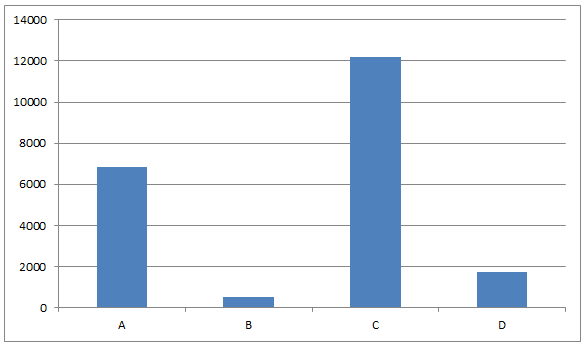
The bar chart displays data using a number of bars, each representing a particular category.
The height of each bar is proportional to a specific aggregation (for example the sum of the values in the category it represents).
The categories could be something like an age group or a geographical location.
It is also possible to color or split each bar into another categorical column in the data, which enables you to see the contribution from different categories to each bar or group of bars in the bar chart.
Thus a Bar Chart can be used to compare the population in four towns.
So the answer to the above question is option (B).
Note: That in some of the cases the category axis can be referred to as X-axis and the value axis can be referred to as Y-axis. This is the case in some varied curves and the lines. Bar graphs are used to compare things between different groups or to track changes over time. However, when trying to measure change over time bar graphs are best when the changes are larger.
Complete step-by-step solution:
A bar chart is a way of summarizing a set of categorical data (continuous data can be made categorical by auto-binning).
Here we have to draw a bar chart for the given information as follows:
The bar chart displays data using a number of bars, each representing a particular category.
The height of each bar is proportional to a specific aggregation (for example the sum of the values in the category it represents).
The categories could be something like an age group or a geographical location.
It is also possible to color or split each bar into another categorical column in the data, which enables you to see the contribution from different categories to each bar or group of bars in the bar chart.
Thus a Bar Chart can be used to compare the population in four towns.
So the answer to the above question is option (B).
Note: That in some of the cases the category axis can be referred to as X-axis and the value axis can be referred to as Y-axis. This is the case in some varied curves and the lines. Bar graphs are used to compare things between different groups or to track changes over time. However, when trying to measure change over time bar graphs are best when the changes are larger.
Recently Updated Pages
If x a + bt + ct2 where x is in meters and t is in class 11 physics CBSE

A car covers the first half distance between two places class 11 physics CBSE
The resultant of two vectors overrightarrow P and overrightarrow class 11 physics CBSE
Find the value of cos 135 class 11 maths CBSE
A mass M is held in place by an applied force F and class 11 physics CBSE
A solution of glucose in water is labelled as 10 dfracwv class 11 chemistry CBSE
Trending doubts
One Metric ton is equal to kg A 10000 B 1000 C 100 class 11 physics CBSE
Find the value of the expression given below sin 30circ class 11 maths CBSE
What do you mean by retardation What is its SI uni class 11 physics CBSE
Draw a diagram of nephron and explain its structur class 11 biology CBSE
10 examples of friction in our daily life
Difference between physical and chemical change class 11 chemistry CBSE