




The polarisation angle of glass is $57{}^\circ $. A ray of light which is incident at this angle will be having an angle of refraction as,
$\begin{align}
& A.25{}^\circ \\
& B.33{}^\circ \\
& C.42{}^\circ \\
& D.38{}^\circ \\
\end{align}$
Answer
 Verified
627.9k+ views
Hint: Brewster's angle is defined as the incident angle at which light having a specific polarisation has been transmitted completely through a transparent dielectric surface, without being reflected. When the unpolarised light is being incident at this angle, then the light which will be reflected from the surface also will be perfectly polarized. This may help you to solve this question.
Complete step by step answer:
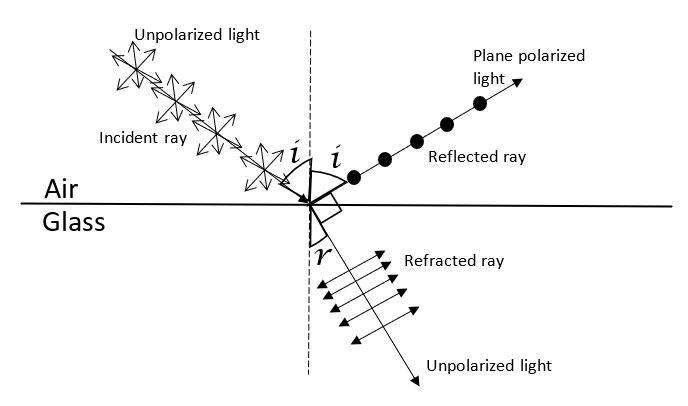
As we all know, the process of refraction and polarisation are being related by the concept of Brewster’s angle. Brewster's angle is defined as the angle of incidence at which light having a specific polarisation is being transmitted completely through a transparent surface of dielectric. This means that there will be no reflection happening.
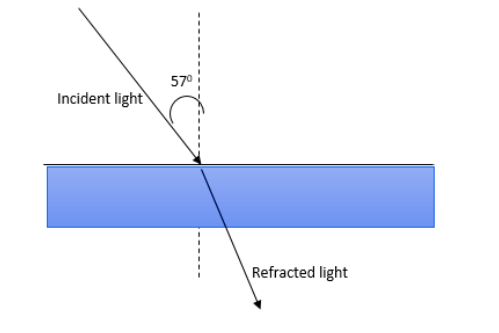
We all know that, the angle of refraction is given by the formula,
$r=90{}^\circ -i$
In which $r$ is the angle of refraction and \[i\] is the angle of incidence.
As per the question, the polarisation angle, which is the incidence angle, can be written as,
\[i=57{}^\circ \]
Substituting this into the equation of angle of refraction will give,
\[\begin{align}
& r=90{}^\circ -57{}^\circ \\
& r=33{}^\circ \\
\end{align}\]
Therefore the correct answer is given as the option B.
Note:
When the angle of incidence equals the angle of Brewster’s, then we can say that the reflected ray will be perpendicular to the refracted ray. If the light wave strikes the interface of a medium such that there is an $90{}^\circ $ angle between the refracted and the reflected rays, then we can say that the reflected light is linearly polarized. The direction of polarisation will be parallel to the plane of the interface of the medium. This is known as polarisation by reflection.
Complete step by step answer:
As we all know, the process of refraction and polarisation are being related by the concept of Brewster’s angle. Brewster's angle is defined as the angle of incidence at which light having a specific polarisation is being transmitted completely through a transparent surface of dielectric. This means that there will be no reflection happening.
We all know that, the angle of refraction is given by the formula,
$r=90{}^\circ -i$
In which $r$ is the angle of refraction and \[i\] is the angle of incidence.
As per the question, the polarisation angle, which is the incidence angle, can be written as,
\[i=57{}^\circ \]
Substituting this into the equation of angle of refraction will give,
\[\begin{align}
& r=90{}^\circ -57{}^\circ \\
& r=33{}^\circ \\
\end{align}\]
Therefore the correct answer is given as the option B.
Note:
When the angle of incidence equals the angle of Brewster’s, then we can say that the reflected ray will be perpendicular to the refracted ray. If the light wave strikes the interface of a medium such that there is an $90{}^\circ $ angle between the refracted and the reflected rays, then we can say that the reflected light is linearly polarized. The direction of polarisation will be parallel to the plane of the interface of the medium. This is known as polarisation by reflection.
Recently Updated Pages
Master Class 12 Business Studies: Engaging Questions & Answers for Success

Master Class 12 Chemistry: Engaging Questions & Answers for Success
Master Class 12 Biology: Engaging Questions & Answers for Success
Class 12 Question and Answer - Your Ultimate Solutions Guide
Master Class 11 English: Engaging Questions & Answers for Success
Master Class 11 Social Science: Engaging Questions & Answers for Success
Trending doubts
Differentiate between Pyramid of energy and pyramid class 12 biology CBSE
Draw the diagram of the pyramid of energy Explain In class 12 biology CBSE
When was the first election held in India a 194748 class 12 sst CBSE
What is the Full Form of PVC, PET, HDPE, LDPE, PP and PS ?
Suicide bags of cells are aEndoplasmic reticulum bLysosome class 12 biology CBSE
The first general election of Lok Sabha was held in class 12 social science CBSE