




The polar coordinates of the point whose Cartesian coordinates are (-1, -1) is
$
(a){\text{ }}\left( {\sqrt 2 ,\dfrac{\pi }{4}} \right) \\
(b){\text{ }}\left( {\sqrt 2 ,\dfrac{{3\pi }}{4}} \right) \\
(c){\text{ }}\left( {\sqrt 2 , - \dfrac{\pi }{4}} \right) \\
(d){\text{ }}\left( {\sqrt 2 , - \dfrac{{3\pi }}{4}} \right) \\
$
Answer
 Verified
630.6k+ views
Hint: In this question convert the given coordinates in the form of (r, $ \theta $ ) where r is the magnitude and $ \theta $ is the angle in polar form. So consider a position vector of the form $ \vec r = x\hat i + y\hat j $ where angle can be taken out as $ \theta = {\tan ^{ - 1}}\left( {\dfrac{y}{x}} \right) $ , and $ r = \sqrt {{x^2} + {y^2}} $ . This will help approaching the problem.
Complete step-by-step answer:
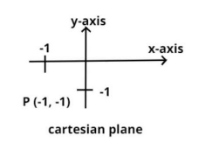
The pictorial representation of the Cartesian coordinates in the Cartesian plane is shown in the above diagram.
Let the point is P as shown in the figure.
Therefore, P = (x, y) = (-1, -1)
Therefore, x = -1 and y = -1
Now we have to convert these coordinates into the polar coordinates.
Now the polar coordinates is given as (r, $ \theta $ )
Where r is the magnitude and $ \theta $ is the angle in polar form.
And r vector is given as,
$ \vec r = x\hat i + y\hat j $ Where, $ \hat i $ and $ \hat j $ are the unit vectors along x and y axis respectively.
And $ \theta = {\tan ^{ - 1}}\left( {\dfrac{y}{x}} \right) $
Now substitute the values we have,
$ \vec r = - \hat i - \hat j $
Now take the magnitude of the above vector we have,
$ \left| {\vec r} \right| = \left| { - \hat i - \hat j} \right| = \sqrt {{{\left( { - 1} \right)}^2} + {{\left( { - 1} \right)}^2}} = \sqrt {1 + 1} = \sqrt 2 $
$ \Rightarrow r = \sqrt 2 $
And
$ \theta = {\tan ^{ - 1}}\left( {\dfrac{{ - 1}}{{ - 1}}} \right) $
Now simplify this we have,
$ \Rightarrow \theta = {\tan ^{ - 1}}\left( 1 \right) $
Now as we know that $ {\tan ^{ - 1}}\left( 1 \right) = {\tan ^{ - 1}}\left( {\tan \dfrac{\pi }{4}} \right) = \dfrac{\pi }{4} $ but as the given Cartesian coordinates lies in 3rd quadrant as shown in the figure and tan is positive in 3rd quadrant and negative in 2nd quadrant so it is written as
$ \Rightarrow \theta = {\tan ^{ - 1}}\left( {\tan \left( {\pi + \dfrac{\pi }{4}} \right)} \right) = - {\tan ^{ - 1}}\left( {\tan \left( {\pi - \dfrac{\pi }{4}} \right)} \right) $
$ \Rightarrow \theta = \left( {\pi + \dfrac{\pi }{4}} \right) = - \left( {\pi - \dfrac{\pi }{4}} \right) $
$ \Rightarrow \theta = \left( {\dfrac{{5\pi }}{4}} \right) = - \left( {\dfrac{{3\pi }}{4}} \right) $
So the polar coordinates of the given Cartesian coordinates is $ \left( {r,\theta } \right) = \left( {\sqrt 2 , - \dfrac{{3\pi }}{4}} \right) $ .
So this is the required answer.
Hence option (D) is the correct answer.
Note The trick point here was consideration of the fact that the given points are lying on the third quadrant as the x and y coordinates of the given points are both negative and thus the angle obtained has to be taken into the third quadrant only. Since upto $ \pi $ we have the second quadrant so the third quadrant angles can be evaluated.
Complete step-by-step answer:
The pictorial representation of the Cartesian coordinates in the Cartesian plane is shown in the above diagram.
Let the point is P as shown in the figure.
Therefore, P = (x, y) = (-1, -1)
Therefore, x = -1 and y = -1
Now we have to convert these coordinates into the polar coordinates.
Now the polar coordinates is given as (r, $ \theta $ )
Where r is the magnitude and $ \theta $ is the angle in polar form.
And r vector is given as,
$ \vec r = x\hat i + y\hat j $ Where, $ \hat i $ and $ \hat j $ are the unit vectors along x and y axis respectively.
And $ \theta = {\tan ^{ - 1}}\left( {\dfrac{y}{x}} \right) $
Now substitute the values we have,
$ \vec r = - \hat i - \hat j $
Now take the magnitude of the above vector we have,
$ \left| {\vec r} \right| = \left| { - \hat i - \hat j} \right| = \sqrt {{{\left( { - 1} \right)}^2} + {{\left( { - 1} \right)}^2}} = \sqrt {1 + 1} = \sqrt 2 $
$ \Rightarrow r = \sqrt 2 $
And
$ \theta = {\tan ^{ - 1}}\left( {\dfrac{{ - 1}}{{ - 1}}} \right) $
Now simplify this we have,
$ \Rightarrow \theta = {\tan ^{ - 1}}\left( 1 \right) $
Now as we know that $ {\tan ^{ - 1}}\left( 1 \right) = {\tan ^{ - 1}}\left( {\tan \dfrac{\pi }{4}} \right) = \dfrac{\pi }{4} $ but as the given Cartesian coordinates lies in 3rd quadrant as shown in the figure and tan is positive in 3rd quadrant and negative in 2nd quadrant so it is written as
$ \Rightarrow \theta = {\tan ^{ - 1}}\left( {\tan \left( {\pi + \dfrac{\pi }{4}} \right)} \right) = - {\tan ^{ - 1}}\left( {\tan \left( {\pi - \dfrac{\pi }{4}} \right)} \right) $
$ \Rightarrow \theta = \left( {\pi + \dfrac{\pi }{4}} \right) = - \left( {\pi - \dfrac{\pi }{4}} \right) $
$ \Rightarrow \theta = \left( {\dfrac{{5\pi }}{4}} \right) = - \left( {\dfrac{{3\pi }}{4}} \right) $
So the polar coordinates of the given Cartesian coordinates is $ \left( {r,\theta } \right) = \left( {\sqrt 2 , - \dfrac{{3\pi }}{4}} \right) $ .
So this is the required answer.
Hence option (D) is the correct answer.
Note The trick point here was consideration of the fact that the given points are lying on the third quadrant as the x and y coordinates of the given points are both negative and thus the angle obtained has to be taken into the third quadrant only. Since upto $ \pi $ we have the second quadrant so the third quadrant angles can be evaluated.
Recently Updated Pages
Master Class 12 Business Studies: Engaging Questions & Answers for Success

Master Class 12 Chemistry: Engaging Questions & Answers for Success
Master Class 12 Biology: Engaging Questions & Answers for Success
Class 12 Question and Answer - Your Ultimate Solutions Guide
Master Class 11 Social Science: Engaging Questions & Answers for Success
Master Class 11 Chemistry: Engaging Questions & Answers for Success
Trending doubts
Which are the Top 10 Largest Countries of the World?
Draw a labelled sketch of the human eye class 12 physics CBSE
Name the crygenes that control cotton bollworm and class 12 biology CBSE
Differentiate between homogeneous and heterogeneous class 12 chemistry CBSE
Ribosomal RNA is actively synthesised in A Nucleoplasm class 12 biology CBSE
How many molecules of ATP and NADPH are required information class 12 biology CBSE