




The points \[{z_1},{z_2},{z_3},{z_4}\], in the complex plane are the vertices of a parallelogram taken in order, if and only if
1) \[{z_1} + {z_4} = {z_2} + {z_3}\]
2) \[{z_1} + {z_3} = {z_2} + {z_4}\]
3) \[{z_1} + {z_2} = {z_3} + {z_4}\]
4) None of these
Answer
 Verified
517.2k+ views
Hint: This question requires the knowledge of parallelogram. If one is aware about the condition for which the quadrilateral is considered as a parallelogram, then the question is easy. The condition is: \[ \Rightarrow \dfrac{{{z_1} + {z_3}}}{2} = \dfrac{{{z_2} + {z_4}}}{2}\]
As the mid-points are common, the diagonals of a parallelogram lie on the same point. We must know that the diagonals of a parallelogram bisect each other to attempt such questions
Complete step-by-step answer:
We know that the diagonals of a parallelogram bisect each other. This means that the intersection of the two diagonals of a parallelogram is the midpoint of both the diagonals.
Thus, applying the above condition to create a parallelogram in the imaginary plane,
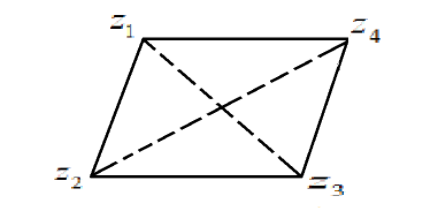
Now, we know the midpoint formula. So, the coordinates of the midpoint of a line segment are the arithmetic mean of the coordinates of the endpoints of the line segment. Also, the midpoints of the two diagonals of a parallelogram are the same.
Now, we also know the midpoint of line formed by joining two complex numbers on argand plane is given by the arithmetic mean of the two complex numbers as $\left( {\dfrac{{a + b}}{2}} \right)$. Hence, we have,
\[ \Rightarrow \dfrac{{{z_1} + {z_3}}}{2} = \dfrac{{{z_2} + {z_4}}}{2}\]
Multiplying, 2 on both sides of the equation we get,
\[ \Rightarrow {z_1} + {z_3} = {z_2} + {z_4}\]
Hence, this is the condition for the points to be the vertices of the parallelogram.
So, the correct answer is “Option 2”.
Note: In Euclidean geometry, a parallelogram is a simple quadrilateral with two pairs of parallel sides. The opposite or facing sides of a parallelogram are of equal length and the opposite angles of a parallelogram are of equal measure
As the mid-points are common, the diagonals of a parallelogram lie on the same point. We must know that the diagonals of a parallelogram bisect each other to attempt such questions
Complete step-by-step answer:
We know that the diagonals of a parallelogram bisect each other. This means that the intersection of the two diagonals of a parallelogram is the midpoint of both the diagonals.
Thus, applying the above condition to create a parallelogram in the imaginary plane,
Now, we know the midpoint formula. So, the coordinates of the midpoint of a line segment are the arithmetic mean of the coordinates of the endpoints of the line segment. Also, the midpoints of the two diagonals of a parallelogram are the same.
Now, we also know the midpoint of line formed by joining two complex numbers on argand plane is given by the arithmetic mean of the two complex numbers as $\left( {\dfrac{{a + b}}{2}} \right)$. Hence, we have,
\[ \Rightarrow \dfrac{{{z_1} + {z_3}}}{2} = \dfrac{{{z_2} + {z_4}}}{2}\]
Multiplying, 2 on both sides of the equation we get,
\[ \Rightarrow {z_1} + {z_3} = {z_2} + {z_4}\]
Hence, this is the condition for the points to be the vertices of the parallelogram.
So, the correct answer is “Option 2”.
Note: In Euclidean geometry, a parallelogram is a simple quadrilateral with two pairs of parallel sides. The opposite or facing sides of a parallelogram are of equal length and the opposite angles of a parallelogram are of equal measure

Recently Updated Pages
Three beakers labelled as A B and C each containing 25 mL of water were taken A small amount of NaOH anhydrous CuSO4 and NaCl were added to the beakers A B and C respectively It was observed that there was an increase in the temperature of the solutions contained in beakers A and B whereas in case of beaker C the temperature of the solution falls Which one of the following statements isarecorrect i In beakers A and B exothermic process has occurred ii In beakers A and B endothermic process has occurred iii In beaker C exothermic process has occurred iv In beaker C endothermic process has occurred

Master Class 8 Social Science: Engaging Questions & Answers for Success
Master Class 8 Science: Engaging Questions & Answers for Success
Master Class 8 Maths: Engaging Questions & Answers for Success
Class 8 Question and Answer - Your Ultimate Solutions Guide
Master Class 9 Social Science: Engaging Questions & Answers for Success
Three beakers labelled as A B and C each containing 25 mL of water were taken A small amount of NaOH anhydrous CuSO4 and NaCl were added to the beakers A B and C respectively It was observed that there was an increase in the temperature of the solutions contained in beakers A and B whereas in case of beaker C the temperature of the solution falls Which one of the following statements isarecorrect i In beakers A and B exothermic process has occurred ii In beakers A and B endothermic process has occurred iii In beaker C exothermic process has occurred iv In beaker C endothermic process has occurred
Master Class 8 Social Science: Engaging Questions & Answers for Success
Master Class 8 Science: Engaging Questions & Answers for Success
Trending doubts
What is BLO What is the full form of BLO class 8 social science CBSE
What are the 12 elements of nature class 8 chemistry CBSE
Give me the opposite gender of Duck class 8 english CBSE
Name the states through which the Tropic of Cancer class 8 social science CBSE
Citizens of India can vote at the age of A 18 years class 8 social science CBSE
Advantages and disadvantages of science