




The points A(-4, 9, 6) , B(-1, 6, 6) and C(0, 7, 10) form which type of triangle?
Answer
 Verified
522.6k+ views
Hint: A triangle can be of three types, equilateral, isosceles and scalene. A separate criteria of a triangle is when one of its angles is a right angle. In that case, the triangle is termed as a right-angled triangle. We shall find the length of three sides of our triangle and see for what type of triangle is formed. We will then check if one of the angle’s is a right-angle using Pythagoras theorem.
Complete step by step answer:
The first step in our procedure to find the length of three sides of the triangle. This length is equal to the distance between two points of the triangle. Here, we can calculate this length by using the distance formula when co-ordinates of two points are given. Thus, we have:
The length of side AB is equal to:
$\begin{align}
& \Rightarrow AB=\sqrt{{{\left[ -1-\left( -4 \right) \right]}^{2}}+{{\left[ 6-9 \right]}^{2}}+{{\left[ 6-6 \right]}^{2}}} \\
& \Rightarrow AB=\sqrt{{{\left( 3 \right)}^{2}}+{{\left( -3 \right)}^{2}}+{{\left( 0 \right)}^{2}}} \\
& \Rightarrow AB=\sqrt{9+9} \\
& \therefore AB=\sqrt{18} \\
\end{align}$
Now, the length of side BC is equal to:
$\begin{align}
& \Rightarrow BC=\sqrt{{{\left[ 0-\left( -1 \right) \right]}^{2}}+{{\left[ 7-6 \right]}^{2}}+{{\left[ 10-6 \right]}^{2}}} \\
& \Rightarrow BC=\sqrt{{{1}^{2}}+{{\left( 1 \right)}^{2}}+{{\left( 4 \right)}^{2}}} \\
& \Rightarrow BC=\sqrt{1+1+16} \\
& \therefore BC=\sqrt{18} \\
\end{align}$
And lastly, the length CA is equal to:
$\begin{align}
& \Rightarrow CA=\sqrt{{{\left[ \left( -4 \right)-0 \right]}^{2}}+{{\left[ 9-7 \right]}^{2}}+{{\left[ 6-10 \right]}^{2}}} \\
& \Rightarrow CA=\sqrt{{{\left( -4 \right)}^{2}}+{{\left( 2 \right)}^{2}}+{{\left( -4 \right)}^{2}}} \\
\end{align}$
$\begin{align}
& \Rightarrow CA=\sqrt{16+4+16} \\
& \therefore CA=\sqrt{36} \\
\end{align}$
Thus, from our above calculation, we can clearly see that AB is equal to BC. Therefore, our triangle is an isosceles triangle. Now, we will check if it’s a right-angled triangle. This can be done as follows:
$\begin{align}
& \Rightarrow A{{B}^{2}}={{\left( \sqrt{18} \right)}^{2}}=18 \\
& \Rightarrow B{{C}^{2}}={{\left( \sqrt{18} \right)}^{2}}=18 \\
& \Rightarrow C{{A}^{2}}={{\left( \sqrt{36} \right)}^{2}}=36 \\
\end{align}$
Here, we can see that:
$\Rightarrow {{\left( AB \right)}^{2}}+{{\left( BC \right)}^{2}}={{\left( CA \right)}^{2}}$
This means that, the triangle is right angled about point B. Thus our triangle can be constructed as follows:
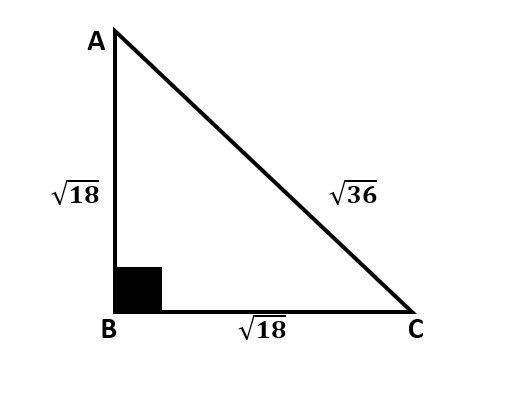
Hence, the points A(-4, 9, 6) , B(-1, 6, 6) and C(0, 7, 10) form a right-angled isosceles triangle.
Note: Even though the points were given in a three-dimensional coordinate system, the triangle formed will always be planar. This is because to construct a three-dimensional object, we need to define at least four unique points in our system. A unique three-point system will always form a triangle in space.
Complete step by step answer:
The first step in our procedure to find the length of three sides of the triangle. This length is equal to the distance between two points of the triangle. Here, we can calculate this length by using the distance formula when co-ordinates of two points are given. Thus, we have:
The length of side AB is equal to:
$\begin{align}
& \Rightarrow AB=\sqrt{{{\left[ -1-\left( -4 \right) \right]}^{2}}+{{\left[ 6-9 \right]}^{2}}+{{\left[ 6-6 \right]}^{2}}} \\
& \Rightarrow AB=\sqrt{{{\left( 3 \right)}^{2}}+{{\left( -3 \right)}^{2}}+{{\left( 0 \right)}^{2}}} \\
& \Rightarrow AB=\sqrt{9+9} \\
& \therefore AB=\sqrt{18} \\
\end{align}$
Now, the length of side BC is equal to:
$\begin{align}
& \Rightarrow BC=\sqrt{{{\left[ 0-\left( -1 \right) \right]}^{2}}+{{\left[ 7-6 \right]}^{2}}+{{\left[ 10-6 \right]}^{2}}} \\
& \Rightarrow BC=\sqrt{{{1}^{2}}+{{\left( 1 \right)}^{2}}+{{\left( 4 \right)}^{2}}} \\
& \Rightarrow BC=\sqrt{1+1+16} \\
& \therefore BC=\sqrt{18} \\
\end{align}$
And lastly, the length CA is equal to:
$\begin{align}
& \Rightarrow CA=\sqrt{{{\left[ \left( -4 \right)-0 \right]}^{2}}+{{\left[ 9-7 \right]}^{2}}+{{\left[ 6-10 \right]}^{2}}} \\
& \Rightarrow CA=\sqrt{{{\left( -4 \right)}^{2}}+{{\left( 2 \right)}^{2}}+{{\left( -4 \right)}^{2}}} \\
\end{align}$
$\begin{align}
& \Rightarrow CA=\sqrt{16+4+16} \\
& \therefore CA=\sqrt{36} \\
\end{align}$
Thus, from our above calculation, we can clearly see that AB is equal to BC. Therefore, our triangle is an isosceles triangle. Now, we will check if it’s a right-angled triangle. This can be done as follows:
$\begin{align}
& \Rightarrow A{{B}^{2}}={{\left( \sqrt{18} \right)}^{2}}=18 \\
& \Rightarrow B{{C}^{2}}={{\left( \sqrt{18} \right)}^{2}}=18 \\
& \Rightarrow C{{A}^{2}}={{\left( \sqrt{36} \right)}^{2}}=36 \\
\end{align}$
Here, we can see that:
$\Rightarrow {{\left( AB \right)}^{2}}+{{\left( BC \right)}^{2}}={{\left( CA \right)}^{2}}$
This means that, the triangle is right angled about point B. Thus our triangle can be constructed as follows:
Hence, the points A(-4, 9, 6) , B(-1, 6, 6) and C(0, 7, 10) form a right-angled isosceles triangle.
Note: Even though the points were given in a three-dimensional coordinate system, the triangle formed will always be planar. This is because to construct a three-dimensional object, we need to define at least four unique points in our system. A unique three-point system will always form a triangle in space.
Recently Updated Pages
Master Class 10 Computer Science: Engaging Questions & Answers for Success

Master Class 10 General Knowledge: Engaging Questions & Answers for Success
Master Class 10 English: Engaging Questions & Answers for Success
Master Class 10 Social Science: Engaging Questions & Answers for Success
Master Class 10 Maths: Engaging Questions & Answers for Success
Master Class 10 Science: Engaging Questions & Answers for Success
Trending doubts
What is the median of the first 10 natural numbers class 10 maths CBSE
Which women's tennis player has 24 Grand Slam singles titles?
Who is the Brand Ambassador of Incredible India?
Why is there a time difference of about 5 hours between class 10 social science CBSE
Write a letter to the principal requesting him to grant class 10 english CBSE
A moving boat is observed from the top of a 150 m high class 10 maths CBSE