




The point of intersection of X and Y axis is called:
A . Origin
B . Null point
C . Common point
D . None of these
Answer
 Verified
629.1k+ views
Hint: To solve the question given above, we will first see what are x-axis and y-axis. Then we will consider a variable point on x-axis and a variable point on y-axis. We will then move these points such that their distance keeps on decreasing. When the distance between them becomes zero, which will be the intersection point of these axis.
Complete step-by-step answer:
Before solving the above question, we must know what x-axis is and what y-axis is. The x-axis is a horizontal axis of a system of coordinates. X-axis contains the value of all the real numbers. The y-axis is a vertical axis of a system of coordinates. Y-axis contains the value of all the real numbers. Now, we have to find the intersection point of the axis. The intersection point is a point where both the lines meet. In other words, intersection point is a point at which both the lines give the same value.
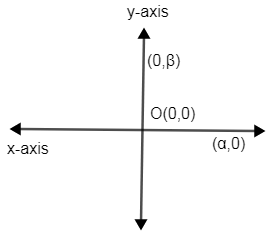
Now, we will consider a point $\alpha $ on x-axis $\left( \alpha >0 \right)$ and a point \[\beta \] on y-axis $\left( \beta >0 \right)$ . let us move $\alpha $ and $\beta $ such that the distance between them keeps on decreasing. For the distance to decrease their absolute value should decrease. Now, at point $\left( 0,0 \right)$ , the distance between them becomes zero. This point will be the intersection point of both the axes. The point $\left( 0,0 \right)$ is called the origin . Thus, the point of intersection of X and Y axes is called origin.
Hence, option (a) is correct.
Note: Similarly to x-axis and y-axis, if there had been a third axis perpendicular to both of them, say z-axis, then also the intersection point of all the axis would have been origin. We can prove it similarly by taking a point on z-axis and decreasing its distance from other two points
Complete step-by-step answer:
Before solving the above question, we must know what x-axis is and what y-axis is. The x-axis is a horizontal axis of a system of coordinates. X-axis contains the value of all the real numbers. The y-axis is a vertical axis of a system of coordinates. Y-axis contains the value of all the real numbers. Now, we have to find the intersection point of the axis. The intersection point is a point where both the lines meet. In other words, intersection point is a point at which both the lines give the same value.
Now, we will consider a point $\alpha $ on x-axis $\left( \alpha >0 \right)$ and a point \[\beta \] on y-axis $\left( \beta >0 \right)$ . let us move $\alpha $ and $\beta $ such that the distance between them keeps on decreasing. For the distance to decrease their absolute value should decrease. Now, at point $\left( 0,0 \right)$ , the distance between them becomes zero. This point will be the intersection point of both the axes. The point $\left( 0,0 \right)$ is called the origin . Thus, the point of intersection of X and Y axes is called origin.
Hence, option (a) is correct.
Note: Similarly to x-axis and y-axis, if there had been a third axis perpendicular to both of them, say z-axis, then also the intersection point of all the axis would have been origin. We can prove it similarly by taking a point on z-axis and decreasing its distance from other two points

Recently Updated Pages
Master Class 12 Business Studies: Engaging Questions & Answers for Success

Master Class 12 Biology: Engaging Questions & Answers for Success
Master Class 12 Chemistry: Engaging Questions & Answers for Success
Class 12 Question and Answer - Your Ultimate Solutions Guide
Master Class 11 Social Science: Engaging Questions & Answers for Success
Master Class 11 English: Engaging Questions & Answers for Success
Trending doubts
What is BLO What is the full form of BLO class 8 social science CBSE
Citizens of India can vote at the age of A 18 years class 8 social science CBSE
Right to vote is a AFundamental Right BFundamental class 8 social science CBSE
Give me the opposite gender of Duck class 8 english CBSE
What are the 12 elements of nature class 8 chemistry CBSE
Full form of STD, ISD and PCO