




The point in the eye from which optic nerves and blood vessels leave the eyeball is called ____________.
(A) Yellow spot
(B) Blindspot
(C) Pars optica
(D) Green spot
Answer
 Verified
621k+ views
Hint: The point in the eye from which optic nerves and blood vessels leave the eyeball is that part which does not have any light-sensitive cells i.e rods and cones and is completely dark.
Complete step by step answer:
The point in the eye from which optic nerves and blood vessels leave the eyeball is called the Blindspot. The blind spot is the place in the visual field that corresponds to the lack of light-detecting photoreceptor cells which are usually present on the optic disc of the retina where the optic nerve usually passes through the optic disc.
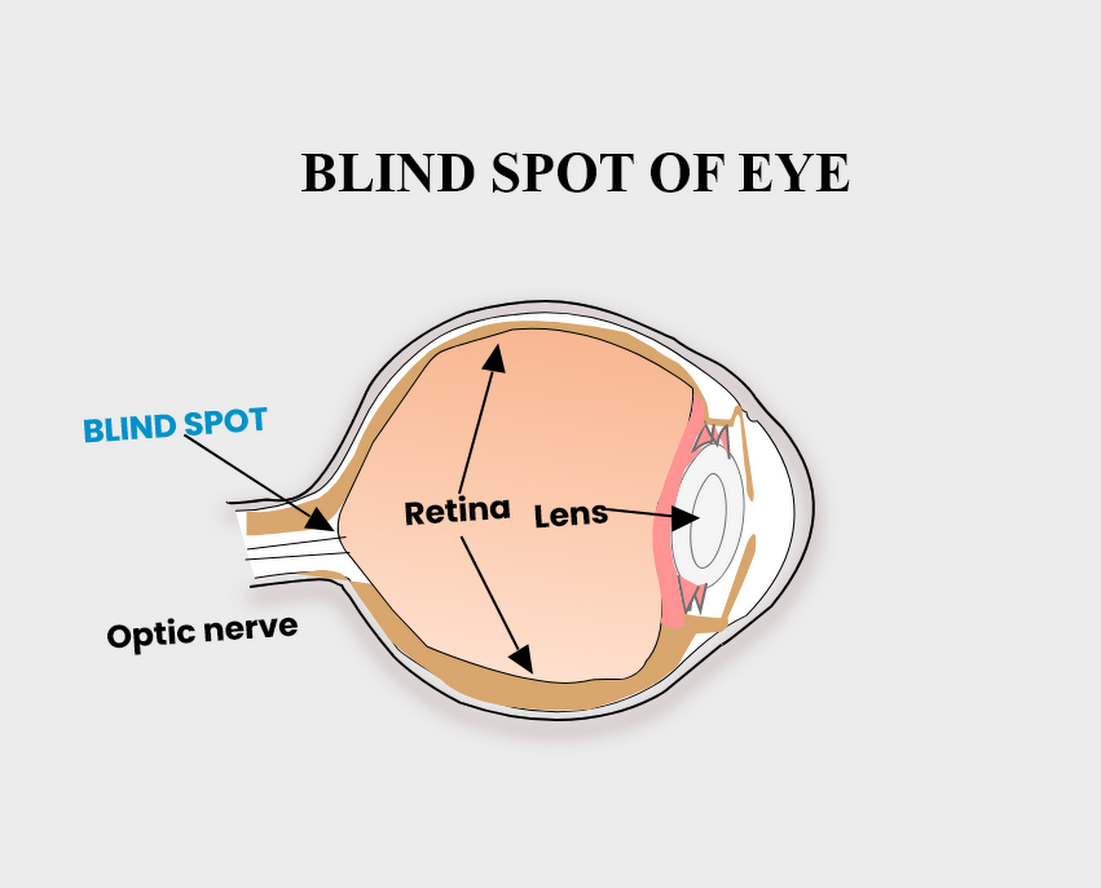
So, the correct answer is ‘Blindspot’.
Additional Information: A particular blind spot known as the physiological blind spot, and also a"blind point". As there are no cells present to detect light on the optic disc, the corresponding part of the field of vision is completely invisible. We do not normally perceive the blind spot and this is just because some process in our brains interpolates the blind spot based on surrounding detail and information from the other eye.
Location of Blind Spot-It is located about $12^\circ - 15^\circ$ temporally and $1.5^\circ$ below the horizontal and is roughly $7.5^\circ$ high and $5.5^\circ$ wide.
Note: Exceptions are seen everywhere in biology. Although all vertebrates present have this blind spot, the eyes of cephalopods ( a member of molluscan ), which are only superficially similar, do not have a blind spot. In cephalopod, it is noticed that the optic nerve approaches the receptors from the behind, so it does not create a break in the retina.
Complete step by step answer:
The point in the eye from which optic nerves and blood vessels leave the eyeball is called the Blindspot. The blind spot is the place in the visual field that corresponds to the lack of light-detecting photoreceptor cells which are usually present on the optic disc of the retina where the optic nerve usually passes through the optic disc.
So, the correct answer is ‘Blindspot’.
Additional Information: A particular blind spot known as the physiological blind spot, and also a"blind point". As there are no cells present to detect light on the optic disc, the corresponding part of the field of vision is completely invisible. We do not normally perceive the blind spot and this is just because some process in our brains interpolates the blind spot based on surrounding detail and information from the other eye.
Location of Blind Spot-It is located about $12^\circ - 15^\circ$ temporally and $1.5^\circ$ below the horizontal and is roughly $7.5^\circ$ high and $5.5^\circ$ wide.
Note: Exceptions are seen everywhere in biology. Although all vertebrates present have this blind spot, the eyes of cephalopods ( a member of molluscan ), which are only superficially similar, do not have a blind spot. In cephalopod, it is noticed that the optic nerve approaches the receptors from the behind, so it does not create a break in the retina.
Recently Updated Pages
Master Class 11 English: Engaging Questions & Answers for Success

Master Class 11 Social Science: Engaging Questions & Answers for Success
Master Class 11 Maths: Engaging Questions & Answers for Success
Master Class 11 Biology: Engaging Questions & Answers for Success
Master Class 11 Physics: Engaging Questions & Answers for Success
Master Class 11 Chemistry: Engaging Questions & Answers for Success
Trending doubts
One Metric ton is equal to kg A 10000 B 1000 C 100 class 11 physics CBSE
Difference Between Prokaryotic Cells and Eukaryotic Cells
Find the value of the expression given below sin 30circ class 11 maths CBSE
Difference between physical and chemical change class 11 chemistry CBSE
Two of the body parts which do not appear in MRI are class 11 biology CBSE
Draw a diagram of a plant cell and label at least eight class 11 biology CBSE