




The point $A(1,-2),B(2,3),C(k,2),D(-4,-3)$ are the vertices of a parallelogram. Find the value of k and the altitude of the parallelogram corresponding to the AB.
Answer
 Verified
626.7k+ views
Hints: In a parallelogram diagonal bisect each other. So we can use this property to find the value of k. In parallelogram perpendicular from one vertex divide opposite side in ratio of $1:2$. By using this property we can find altitude corresponding to AB.
Complete step-by-step solution -
In the given question coordinates of vertices are $A(1,-2),B(2,3),C(k,2),D(-4,-3)$.
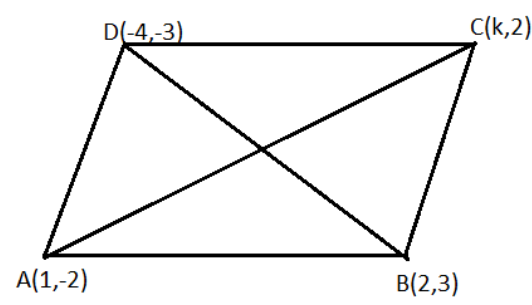
As we know, diagonals of parallelograms bisects each other. So we can say the midpoint of AC and BD should coincide with each other.
In general if we coordinates of endpoints of a line are $({{x}_{1}},{{y}_{1}})\And ({{x}_{2}},{{y}_{2}})$ then coordinate of midpoint is $\left( \dfrac{{{x}_{1}}+{{x}_{2}}}{2},\dfrac{{{y}_{1}}+{{y}_{2}}}{2} \right)$
So we can write coordinate of midpoint of AC is
$\Rightarrow \left( \dfrac{1+k}{2},\dfrac{-2+2}{2} \right)$
$\Rightarrow \left( \dfrac{1+k}{2},0 \right)$
Similarly we can write coordinate of midpoint of BD is
$\Rightarrow \left( \dfrac{-4+2}{2},\dfrac{-3+3}{2} \right)$
$\Rightarrow \left( \dfrac{-2}{2},0 \right)$
$\Rightarrow \left( -1,0 \right)$
As we discussed, the midpoint of AC and BD coincide with each other.
So we can write
$\Rightarrow \dfrac{1+k}{2}=-1$
$\Rightarrow 1+k=-2$
$\Rightarrow k=-2-1$
$\Rightarrow k=-3$
So the required value of k is -3.
Now we can draw altitude corresponding to AB as in below figure:
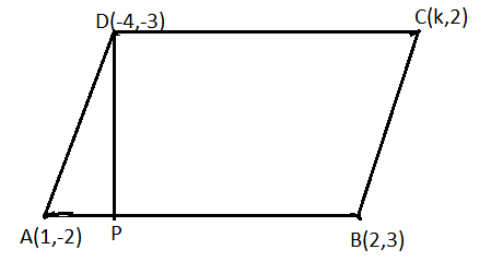
In parallelogram, if we draw altitude from vertices then it divides the opposite side in ratio of
Now we can use the section formula to find the coordinate of P.
According to section formula If a point dividing a side with end coordinates of vertices $({{x}_{1}},{{y}_{1}})\And ({{x}_{2}},{{y}_{2}})$in ratio of ${{m}_{1}}:{{m}_{2}}$ then we can write coordinate of that point as $\left( \dfrac{{{m}_{1}}{{x}_{2}}+{{m}_{2}}{{x}_{1}}}{{{m}_{1}}+{{m}_{2}}},\dfrac{{{m}_{1}}{{y}_{2}}+{{m}_{2}}{{y}_{1}}}{{{m}_{1}}+{{m}_{2}}} \right)$.
In the given question coordinates of A and B are $(1,-2)\And (2,3)$ . P divides side AB in ratio of $1:2$. So coordinate of P is
$\Rightarrow \left( \dfrac{1\times 2+2\times 1}{1+2},\dfrac{1\times 3+2\times -2}{1+2} \right)$
$\Rightarrow \left( \dfrac{4}{3},\dfrac{-1}{3} \right)$
According to distance formula if coordinates of endpoints of a side are $({{x}_{1}},{{y}_{1}})\And ({{x}_{2}},{{y}_{2}})$ then distance(d) between that two point is $d=\sqrt{{{\left( {{x}_{2}}-{{x}_{1}} \right)}^{2}}+{{\left( {{y}_{2}}-{{y}_{1}} \right)}^{2}}}$ . This formula is known as distance formula.
As we have coordinates of D and P are $(-4,-3)\And \left( \dfrac{4}{3},\dfrac{-1}{3} \right)$
So length of DP is
\[\Rightarrow DP=\sqrt{{{\left( \dfrac{4}{3}-(-4) \right)}^{2}}+{{\left( \dfrac{-1}{3}-(-3) \right)}^{2}}}\]
\[\Rightarrow DP=\sqrt{{{\left( \dfrac{4}{3}+4 \right)}^{2}}+{{\left( \dfrac{-1}{3}+3 \right)}^{2}}}\]
\[\Rightarrow DP=\sqrt{{{\left( \dfrac{4+12}{3} \right)}^{2}}+{{\left( \dfrac{-1+9}{3} \right)}^{2}}}\]
\[\Rightarrow DP=\sqrt{{{\left( \dfrac{16}{3} \right)}^{2}}+{{\left( \dfrac{8}{3} \right)}^{2}}}\]
\[\Rightarrow DP=\sqrt{\dfrac{256}{9}+\dfrac{64}{9}}\]
\[\Rightarrow DP=\sqrt{\dfrac{320}{9}}\]
\[\Rightarrow DP=\dfrac{4\sqrt{20}}{3}\]
Hence altitude corresponding to AB is \[DP=\dfrac{4\sqrt{20}}{3}\].
Note: As in this question we need to take care about basic fundamental formulas of coordinates as we discussed in question. Also if we say two points are coinciding to each other it means their corresponding coordinates of x and y should be the same.
Complete step-by-step solution -
In the given question coordinates of vertices are $A(1,-2),B(2,3),C(k,2),D(-4,-3)$.
As we know, diagonals of parallelograms bisects each other. So we can say the midpoint of AC and BD should coincide with each other.
In general if we coordinates of endpoints of a line are $({{x}_{1}},{{y}_{1}})\And ({{x}_{2}},{{y}_{2}})$ then coordinate of midpoint is $\left( \dfrac{{{x}_{1}}+{{x}_{2}}}{2},\dfrac{{{y}_{1}}+{{y}_{2}}}{2} \right)$
So we can write coordinate of midpoint of AC is
$\Rightarrow \left( \dfrac{1+k}{2},\dfrac{-2+2}{2} \right)$
$\Rightarrow \left( \dfrac{1+k}{2},0 \right)$
Similarly we can write coordinate of midpoint of BD is
$\Rightarrow \left( \dfrac{-4+2}{2},\dfrac{-3+3}{2} \right)$
$\Rightarrow \left( \dfrac{-2}{2},0 \right)$
$\Rightarrow \left( -1,0 \right)$
As we discussed, the midpoint of AC and BD coincide with each other.
So we can write
$\Rightarrow \dfrac{1+k}{2}=-1$
$\Rightarrow 1+k=-2$
$\Rightarrow k=-2-1$
$\Rightarrow k=-3$
So the required value of k is -3.
Now we can draw altitude corresponding to AB as in below figure:
In parallelogram, if we draw altitude from vertices then it divides the opposite side in ratio of
Now we can use the section formula to find the coordinate of P.
According to section formula If a point dividing a side with end coordinates of vertices $({{x}_{1}},{{y}_{1}})\And ({{x}_{2}},{{y}_{2}})$in ratio of ${{m}_{1}}:{{m}_{2}}$ then we can write coordinate of that point as $\left( \dfrac{{{m}_{1}}{{x}_{2}}+{{m}_{2}}{{x}_{1}}}{{{m}_{1}}+{{m}_{2}}},\dfrac{{{m}_{1}}{{y}_{2}}+{{m}_{2}}{{y}_{1}}}{{{m}_{1}}+{{m}_{2}}} \right)$.
In the given question coordinates of A and B are $(1,-2)\And (2,3)$ . P divides side AB in ratio of $1:2$. So coordinate of P is
$\Rightarrow \left( \dfrac{1\times 2+2\times 1}{1+2},\dfrac{1\times 3+2\times -2}{1+2} \right)$
$\Rightarrow \left( \dfrac{4}{3},\dfrac{-1}{3} \right)$
According to distance formula if coordinates of endpoints of a side are $({{x}_{1}},{{y}_{1}})\And ({{x}_{2}},{{y}_{2}})$ then distance(d) between that two point is $d=\sqrt{{{\left( {{x}_{2}}-{{x}_{1}} \right)}^{2}}+{{\left( {{y}_{2}}-{{y}_{1}} \right)}^{2}}}$ . This formula is known as distance formula.
As we have coordinates of D and P are $(-4,-3)\And \left( \dfrac{4}{3},\dfrac{-1}{3} \right)$
So length of DP is
\[\Rightarrow DP=\sqrt{{{\left( \dfrac{4}{3}-(-4) \right)}^{2}}+{{\left( \dfrac{-1}{3}-(-3) \right)}^{2}}}\]
\[\Rightarrow DP=\sqrt{{{\left( \dfrac{4}{3}+4 \right)}^{2}}+{{\left( \dfrac{-1}{3}+3 \right)}^{2}}}\]
\[\Rightarrow DP=\sqrt{{{\left( \dfrac{4+12}{3} \right)}^{2}}+{{\left( \dfrac{-1+9}{3} \right)}^{2}}}\]
\[\Rightarrow DP=\sqrt{{{\left( \dfrac{16}{3} \right)}^{2}}+{{\left( \dfrac{8}{3} \right)}^{2}}}\]
\[\Rightarrow DP=\sqrt{\dfrac{256}{9}+\dfrac{64}{9}}\]
\[\Rightarrow DP=\sqrt{\dfrac{320}{9}}\]
\[\Rightarrow DP=\dfrac{4\sqrt{20}}{3}\]
Hence altitude corresponding to AB is \[DP=\dfrac{4\sqrt{20}}{3}\].
Note: As in this question we need to take care about basic fundamental formulas of coordinates as we discussed in question. Also if we say two points are coinciding to each other it means their corresponding coordinates of x and y should be the same.
Recently Updated Pages
Master Class 12 Business Studies: Engaging Questions & Answers for Success

Master Class 12 Biology: Engaging Questions & Answers for Success
Master Class 12 Chemistry: Engaging Questions & Answers for Success
Class 12 Question and Answer - Your Ultimate Solutions Guide
Master Class 11 Social Science: Engaging Questions & Answers for Success
Master Class 11 English: Engaging Questions & Answers for Success
Trending doubts
Find the sum of series 1 + 2 + 3 + 4 + 5 + + 100 class 9 maths CBSE
Fill the blanks with the suitable prepositions 1 The class 9 english CBSE
Difference Between Plant Cell and Animal Cell
How many hours before the closure of election must class 9 social science CBSE
What is pollution? How many types of pollution? Define it
Name 10 Living and Non living things class 9 biology CBSE