




The place(s) where the value of 'g' is unaffected by the increase (or) decrease in the speed of rotation of the earth about its own axis is-
(A) The north pole
(B) The south pole
(C) The equator
(D) None of the above
Answer
 Verified
584.7k+ views
Hint
We will use the parallelogram law of vectors to solve the equation. If two vectors are acting simultaneously at a point, then it can be represented both in magnitude and direction by the adjacent sides drawn from a point.
Complete step by step answer
According to the picture we can applied parallelogram law of vector addition,
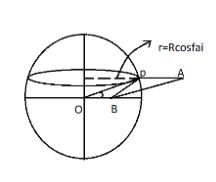
Now,$P{B^2} = P{O^2} + P{A^2} + 2POPAcos(180^\circ - \phi )$
Let us assume B is the point where the value of g is affected.
So,
$\Rightarrow {(m{g^1})^2} = {(mg)^2} + {(m{w^2}Rcos\phi )^2} + 2mgm{w^2}Rcos\phi ( - cos\phi ) $
$\Rightarrow {m^2}{g^1}^{^2} = {m^2}{g^2} + {m^2}{w^4}{R^2}co{s^2}\phi - 2{m^2}g{w^2}Rco{s^2}\phi $
$\therefore {g^{{1^2}}} = {g^2}(1 + \dfrac{{{w^4}{R^2}co{s^2}\phi }}{{{g^2}}} - \dfrac{{2{w^2}Rco{s^2}\phi }}{g})$
Here $w$ is very small.
So, $w^2$ can be neglected and the term containing $w^4$ can be neglected,
${g^{{1^2}}} = {g^2}(1 - \dfrac{{2{w^2}Rco{s^2}\phi }}{g})$
Or,${g^1} = g{(1 - \dfrac{{2{w^2}Rco{s^2}\phi }}{g})^{\dfrac{1}{2}}}$
Now, applying binomial expansion and neglecting higher powers we get,
$\;\therefore {g^1} = g(1 - \dfrac{1}{2} \times \dfrac{{2{w^2}Rco{s^2}\phi }}{g})$
$ \Rightarrow {g^1} = g(1 - \dfrac{{{w^2}Rco{s^2}\phi }}{g})$
$ \Rightarrow {g^1} = g - {w^2}Rco{s^2}\phi $
At poles,$\phi =90^0$
∴ $g^1 = g$ which is independent of $w$.
Thus the places where the value of ′$g$′ is unaffected by the increase/decrease in the speed of rotation of the earth about its own axis are the north and south poles.
Note
It actually depends upon exactly where on Earth you fall. $g$ is not truly constant; it varies from location to location. $9.8 m/s^2$ is just an average. The true value varies with your latitude and longitude (mainly due to surface variations in Earth's density).
We will use the parallelogram law of vectors to solve the equation. If two vectors are acting simultaneously at a point, then it can be represented both in magnitude and direction by the adjacent sides drawn from a point.
Complete step by step answer
According to the picture we can applied parallelogram law of vector addition,
Now,$P{B^2} = P{O^2} + P{A^2} + 2POPAcos(180^\circ - \phi )$
Let us assume B is the point where the value of g is affected.
So,
$\Rightarrow {(m{g^1})^2} = {(mg)^2} + {(m{w^2}Rcos\phi )^2} + 2mgm{w^2}Rcos\phi ( - cos\phi ) $
$\Rightarrow {m^2}{g^1}^{^2} = {m^2}{g^2} + {m^2}{w^4}{R^2}co{s^2}\phi - 2{m^2}g{w^2}Rco{s^2}\phi $
$\therefore {g^{{1^2}}} = {g^2}(1 + \dfrac{{{w^4}{R^2}co{s^2}\phi }}{{{g^2}}} - \dfrac{{2{w^2}Rco{s^2}\phi }}{g})$
Here $w$ is very small.
So, $w^2$ can be neglected and the term containing $w^4$ can be neglected,
${g^{{1^2}}} = {g^2}(1 - \dfrac{{2{w^2}Rco{s^2}\phi }}{g})$
Or,${g^1} = g{(1 - \dfrac{{2{w^2}Rco{s^2}\phi }}{g})^{\dfrac{1}{2}}}$
Now, applying binomial expansion and neglecting higher powers we get,
$\;\therefore {g^1} = g(1 - \dfrac{1}{2} \times \dfrac{{2{w^2}Rco{s^2}\phi }}{g})$
$ \Rightarrow {g^1} = g(1 - \dfrac{{{w^2}Rco{s^2}\phi }}{g})$
$ \Rightarrow {g^1} = g - {w^2}Rco{s^2}\phi $
At poles,$\phi =90^0$
∴ $g^1 = g$ which is independent of $w$.
Thus the places where the value of ′$g$′ is unaffected by the increase/decrease in the speed of rotation of the earth about its own axis are the north and south poles.
Note
It actually depends upon exactly where on Earth you fall. $g$ is not truly constant; it varies from location to location. $9.8 m/s^2$ is just an average. The true value varies with your latitude and longitude (mainly due to surface variations in Earth's density).
Recently Updated Pages
Master Class 11 Computer Science: Engaging Questions & Answers for Success

Master Class 11 Business Studies: Engaging Questions & Answers for Success
Master Class 11 Economics: Engaging Questions & Answers for Success
Master Class 11 English: Engaging Questions & Answers for Success
Master Class 11 Maths: Engaging Questions & Answers for Success
Master Class 11 Biology: Engaging Questions & Answers for Success
Trending doubts
One Metric ton is equal to kg A 10000 B 1000 C 100 class 11 physics CBSE
There are 720 permutations of the digits 1 2 3 4 5 class 11 maths CBSE
Discuss the various forms of bacteria class 11 biology CBSE
Draw a diagram of a plant cell and label at least eight class 11 biology CBSE
State the laws of reflection of light
Explain zero factorial class 11 maths CBSE