




The picture shown below represents a planet (blue) orbiting a star. This particular planet has a highly elliptical orbit, as shown. At what point in the orbit is the planet moving the fastest?
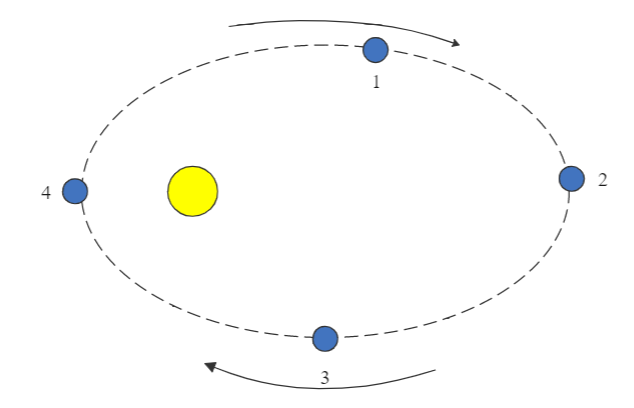
A. 1
B. 2
C. 3
D. 4
E. We cannot determine where the planet is moving the fastest, since Kepler’s Laws apply only to planets in our solar system.
Answer
 Verified
582.3k+ views
Hint
Planetary motion is explained by Kepler’s laws of planetary motion. For a planet orbiting a star in an isolated system, the same rules apply as would in our solar system
Formula used: $ L = mvr $ where $ L $ is the angular momentum of the planet, $ m $ is the mass of the planet, $ v $ is the planet’s speed, and $ r $ is the distance of the planet from its orbit to the star.
Complete step by step answer
We are provided with a single planet system around a star. We know that the angular momentum of a planet is given as:
$ L = mvr $
According to the question, as the planet is moving in an elliptical orbit its angular momentum will remain constant. So will the mass. Bringing the constant terms $ L $ and $ m $ together on one side:
$\Rightarrow \dfrac{L}{m} = vr = {\text{ constant}} $
As the product of velocity and the distance to the star are constant, they exhibit an inverse relationship with each other.
This means as the radius decreases, the velocity will increase. So, to answer our question, the maximum velocity will occur when the distance is the smallest, and this happens at point 4.
Hence, the correct answer is option (D).
Note
We know that any two massive objects exert a force of gravity on each other. Since, the star weighs much more than the planet, the planet is bound to be attracted to the star. This causes the origin of orbits and the revolution of planets around stars. The Earth is at a distance of 149 million km from the Sun, but still orbits the Sun following precise physics. This is how further the range of gravitational attraction goes.
Planetary motion is explained by Kepler’s laws of planetary motion. For a planet orbiting a star in an isolated system, the same rules apply as would in our solar system
Formula used: $ L = mvr $ where $ L $ is the angular momentum of the planet, $ m $ is the mass of the planet, $ v $ is the planet’s speed, and $ r $ is the distance of the planet from its orbit to the star.
Complete step by step answer
We are provided with a single planet system around a star. We know that the angular momentum of a planet is given as:
$ L = mvr $
According to the question, as the planet is moving in an elliptical orbit its angular momentum will remain constant. So will the mass. Bringing the constant terms $ L $ and $ m $ together on one side:
$\Rightarrow \dfrac{L}{m} = vr = {\text{ constant}} $
As the product of velocity and the distance to the star are constant, they exhibit an inverse relationship with each other.
This means as the radius decreases, the velocity will increase. So, to answer our question, the maximum velocity will occur when the distance is the smallest, and this happens at point 4.
Hence, the correct answer is option (D).
Note
We know that any two massive objects exert a force of gravity on each other. Since, the star weighs much more than the planet, the planet is bound to be attracted to the star. This causes the origin of orbits and the revolution of planets around stars. The Earth is at a distance of 149 million km from the Sun, but still orbits the Sun following precise physics. This is how further the range of gravitational attraction goes.
Recently Updated Pages
Master Class 11 English: Engaging Questions & Answers for Success

Master Class 11 Maths: Engaging Questions & Answers for Success
Master Class 11 Biology: Engaging Questions & Answers for Success
Master Class 11 Social Science: Engaging Questions & Answers for Success
Master Class 11 Physics: Engaging Questions & Answers for Success
Master Class 11 Accountancy: Engaging Questions & Answers for Success
Trending doubts
One Metric ton is equal to kg A 10000 B 1000 C 100 class 11 physics CBSE
There are 720 permutations of the digits 1 2 3 4 5 class 11 maths CBSE
Discuss the various forms of bacteria class 11 biology CBSE
Draw a diagram of a plant cell and label at least eight class 11 biology CBSE
State the laws of reflection of light
Explain zero factorial class 11 maths CBSE