




The phenomenon of electromagnetic induction is:
A. The process of changing a body
B. The process of generating magnetic field due to current passing through a coil
C. Producing induced current in a coil due to relative motion between a magnet and the coil
D. The process of rotating a coil of an electric motor
Answer
 Verified
570.6k+ views
Hint: First write down the definition of electromagnetic induction. We will check the mechanism and laws behind electromagnetic induction. Make a rough figure and write the related formula, i.e., $\varepsilon=-\dfrac{d\phi}{dt}$ and then conclude the answer.
Formula used: $\varepsilon=-\dfrac{d\phi}{dt}$
Complete step by step solution:
It was found experimentally by the scientists that when a coil conducts current it produces some magnetic fields as well. This was the magnetic effect of a conducting wire or coil. But could the reverse be true as well? If a wire or coil is placed in a magnetic field, will the coil start to conduct current automatically?
Well, Faraday found that when a coil is kept in a changing or varying magnetic field, it can conduct current. The wire actually generates some electromotive force within itself. This phenomenon was termed as electromagnetic induction.
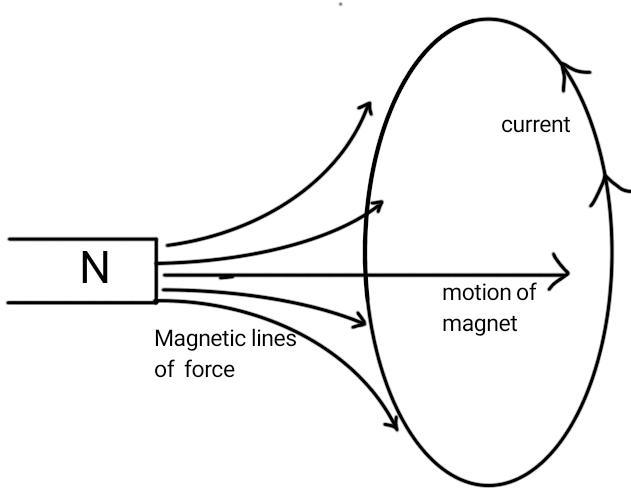
If $\phi$ be the magnetic flux linked with a coil, then its value will be different for different positions of its nearby magnet. So, if the magnet be moving, the flux changes, and the generated electromotive force is given by,
$\varepsilon=-\dfrac{d\phi}{dt}$
Sometimes, an ‘n’ is written on the right side of the equation to represent the number of turns on the coil.
Hence, whenever there is a relative velocity between a coil and a magnet, an electromotive force is generated in the coil which generates current. This is called electromagnetic induction.
Hence, option C is the correct answer.
Additional information:
The principle of electromagnetic induction is used in Induction Oven, Electric Brakes, Dynamo etc. Lentz's law states that the electromotive force generated by a changing magnetic field tries to stop the cause of its own generation. This principle is widely used in circuit inductors and transformers.
Note: Remember the following things:
1. Never confuse electromagnetic induction with the magnetic effect of a conducting wire. They are two opposite events.
2. When the magnet and coil are kept close at a fixed distance, there will be no current. They must be in relative motion.
3. The faster one moves the magnet, more current is generated.
Formula used: $\varepsilon=-\dfrac{d\phi}{dt}$
Complete step by step solution:
It was found experimentally by the scientists that when a coil conducts current it produces some magnetic fields as well. This was the magnetic effect of a conducting wire or coil. But could the reverse be true as well? If a wire or coil is placed in a magnetic field, will the coil start to conduct current automatically?
Well, Faraday found that when a coil is kept in a changing or varying magnetic field, it can conduct current. The wire actually generates some electromotive force within itself. This phenomenon was termed as electromagnetic induction.
If $\phi$ be the magnetic flux linked with a coil, then its value will be different for different positions of its nearby magnet. So, if the magnet be moving, the flux changes, and the generated electromotive force is given by,
$\varepsilon=-\dfrac{d\phi}{dt}$
Sometimes, an ‘n’ is written on the right side of the equation to represent the number of turns on the coil.
Hence, whenever there is a relative velocity between a coil and a magnet, an electromotive force is generated in the coil which generates current. This is called electromagnetic induction.
Hence, option C is the correct answer.
Additional information:
The principle of electromagnetic induction is used in Induction Oven, Electric Brakes, Dynamo etc. Lentz's law states that the electromotive force generated by a changing magnetic field tries to stop the cause of its own generation. This principle is widely used in circuit inductors and transformers.
Note: Remember the following things:
1. Never confuse electromagnetic induction with the magnetic effect of a conducting wire. They are two opposite events.
2. When the magnet and coil are kept close at a fixed distance, there will be no current. They must be in relative motion.
3. The faster one moves the magnet, more current is generated.
Recently Updated Pages
Master Class 11 English: Engaging Questions & Answers for Success

Master Class 11 Social Science: Engaging Questions & Answers for Success
Master Class 11 Maths: Engaging Questions & Answers for Success
Master Class 11 Biology: Engaging Questions & Answers for Success
Master Class 11 Physics: Engaging Questions & Answers for Success
Master Class 11 Chemistry: Engaging Questions & Answers for Success
Trending doubts
One Metric ton is equal to kg A 10000 B 1000 C 100 class 11 physics CBSE
Difference Between Prokaryotic Cells and Eukaryotic Cells
Find the value of the expression given below sin 30circ class 11 maths CBSE
Difference between physical and chemical change class 11 chemistry CBSE
Two of the body parts which do not appear in MRI are class 11 biology CBSE
Draw a diagram of a plant cell and label at least eight class 11 biology CBSE