




The perpendicular distance of the point $P\left( {3,4} \right)$ from the y-axis is
A.$3$
B.$4$
C.$5$
D.$7$
Answer
 Verified
550.5k+ views
Hint: In order to find the distance between the point P and the y-axis, initiate with marking the point on the graph, then draw the perpendicular line joining the point P and the point on the y-axis. Either calculate the units or calculate the x-axis distance parallelly to the perpendicular line and will get the results.
Complete step-by-step answer:
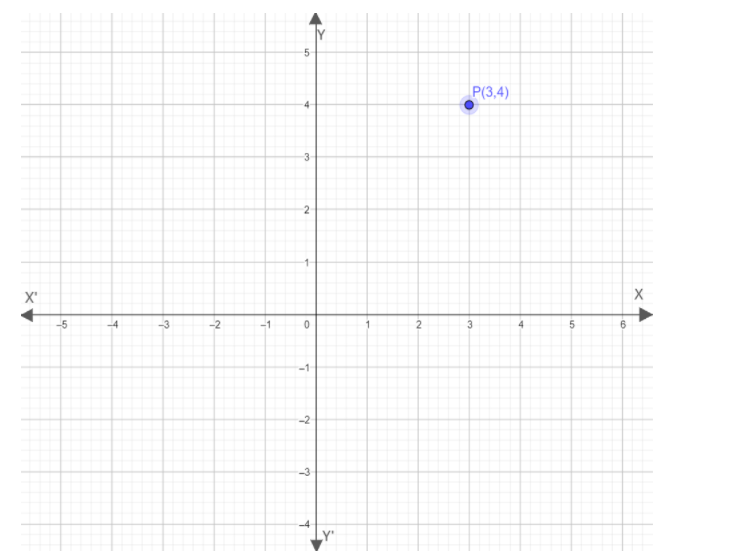
We are given with a point $P\left( {3,4} \right)$. Marking the point on the graph by marking first the point the 3 units in the x-axis and 4 units in the y-axis. Combining them and marking the point. And, the desired representation is:
Now, joining the perpendicular line from the point P to the y-axis, and we get:

Now, drawing a line parallel to this perpendicular in the x-axis from the origin to the same point marked that is 3. And, the figure obtained is as:
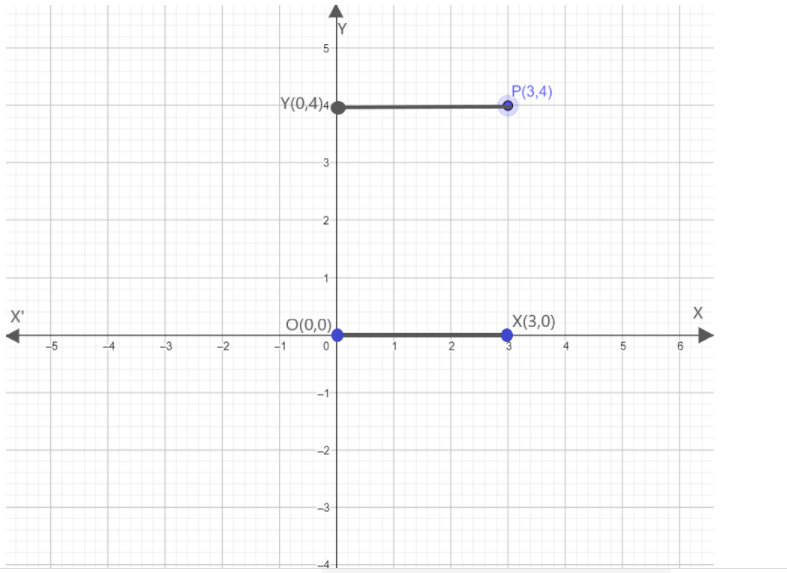
Now, from the graph obtained we can see that the two parallel lines are equal and the length of the parallel will be 3 units as calculating the units from $O\left( {0,0} \right)$ to $X\left( {3,0} \right)$.
That means the value of another line that is the from the point perpendicular to the y-axis will also be 3 units.
Hence, the perpendicular distance of the point $P\left( {3,4} \right)$ from the y-axis is $3$.
Therefore, Option A is correct.
So, the correct answer is “Option A”.
Note: Remember, the perpendicular distance from a point to the y-axis will always be equal to the x-coordinate and the perpendicular distance from a point to the x-axis will always be equal to the y-coordinate.
Despite knowing the fact, it is needed to draw the graph for better understanding.
Complete step-by-step answer:
We are given with a point $P\left( {3,4} \right)$. Marking the point on the graph by marking first the point the 3 units in the x-axis and 4 units in the y-axis. Combining them and marking the point. And, the desired representation is:
Now, joining the perpendicular line from the point P to the y-axis, and we get:
Now, drawing a line parallel to this perpendicular in the x-axis from the origin to the same point marked that is 3. And, the figure obtained is as:
Now, from the graph obtained we can see that the two parallel lines are equal and the length of the parallel will be 3 units as calculating the units from $O\left( {0,0} \right)$ to $X\left( {3,0} \right)$.
That means the value of another line that is the from the point perpendicular to the y-axis will also be 3 units.
Hence, the perpendicular distance of the point $P\left( {3,4} \right)$ from the y-axis is $3$.
Therefore, Option A is correct.
So, the correct answer is “Option A”.
Note: Remember, the perpendicular distance from a point to the y-axis will always be equal to the x-coordinate and the perpendicular distance from a point to the x-axis will always be equal to the y-coordinate.
Despite knowing the fact, it is needed to draw the graph for better understanding.
Recently Updated Pages
Basicity of sulphurous acid and sulphuric acid are

Master Class 12 Economics: Engaging Questions & Answers for Success
Master Class 12 Biology: Engaging Questions & Answers for Success
Master Class 11 English: Engaging Questions & Answers for Success
Master Class 11 Physics: Engaging Questions & Answers for Success
Master Class 11 Computer Science: Engaging Questions & Answers for Success
Trending doubts
What is the Total Duration of Football Match?
Explain the Treaty of Vienna of 1815 class 10 social science CBSE
In football, which nation is called "La Roja"?
Why is there a time difference of about 5 hours between class 10 social science CBSE
10 examples of evaporation in daily life with explanations
What is the full form of POSCO class 10 social science CBSE