




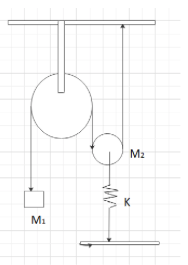
What would be the period of the free oscillations of the system shown here if mass \[{M_1}\] is pulled down a little? Force constant of the spring is\[k\], the mass of fixed pulley is negligible and movable pulley is smooth
A)$T = 2\pi \sqrt {\dfrac{{{M_1} + {M_2}}}{k}} $
B)$T = 2\pi \sqrt {\dfrac{{{M_1} + 4{M_2}}}{k}} $
C) $T = 2\pi \sqrt {\dfrac{{{M_2} + 4{M_1}}}{k}} $
D)$T = 2\pi \sqrt {\dfrac{{{M_2} + 3{M_1}}}{k}} $
Answer
 Verified
580.2k+ views
Hint:In this question, we can calculate the force equations for both masses. After that we can use both equations and deduce them in one equation. We have to simplify the equation to form the equation of SHM. After comparing this equation with the standard equation, we can find the expression for frequency.
Complete step by step solution: -
Let the system spring extended by \[x\]at equilibrium position. Then in this position the tension of mass \[{M_1}\]is ${T'}$and mass \[{M_2}\](pulley) be $2{T'}$.
So, we have force equation as for the both masses-
For\[{M_1}\], $T = {M_1}g$
And for\[{M_2}\], $k{x_0} = 2T - {M_2}g$.................(i)
Now consider displacement of mass \[{M_2}\]displaced by\[x\]. The corresponding displacement for mass of block \[{M_1}\]is\[2x\]. And in this position tension on \[{M_1}\]be ${T^{''}}$ and on \[{M_2}\]be $2{T^{''}}$.
So, for\[{M_2}\],
\[{M_2}\dfrac{{{d^2}x}}{{d{t^2}}} = 2{T^{''}} - {M_2}g - kx - k{x_0}\]................(ii)
For \[{M_1}\]
\[{M_1}\dfrac{{{d^2}(2x)}}{{d{t^2}}} = {M_1}g - {T^{''}}\].........................(iii)
Multiplying equation (iii) by \[2\]and adding it with equation (ii), we get
\[({M_2} + 4{M_1})\dfrac{{{d^2}x}}{{d{t^2}}} = 2{M_1}g - {M_2}g - kx - k{x_0}\]
Putting the value of$k{x_0}$, we get-
\[
({M_2} + 4{M_1})\dfrac{{{d^2}x}}{{d{t^2}}} = 2{M_1}g - {M_2}g - kx - 2{M_1}g + {M_2}g \\
\Rightarrow ({M_2} + 4{M_1})\dfrac{{{d^2}x}}{{d{t^2}}} = - kx \\
\]
\[
\Rightarrow \dfrac{{{d^2}x}}{{d{t^2}}} + \dfrac{{kx}}{{({M_2} + 4{M_1})}} = 0 \\
\Rightarrow \dfrac{{{d^2}x}}{{d{t^2}}} + \left( {\dfrac{k}{{({M_2} + 4{M_1})}}} \right)x = 0 \\
\]
Comparing this equation with $\dfrac{{{d^2}x}}{{d{t^2}}} + \omega x = 0$, we get-
Angular frequency, $\omega = \sqrt {\dfrac{k}{{{M_2} + 4{M_1}}}} $
We know that the time period, $T = \dfrac{{2\pi }}{\omega }$
Putting the value of$\omega $, we get-
\[
T = \dfrac{{2\pi }}{{\sqrt {\dfrac{k}{{{M_2} + 4{M_1}}}} }} \\
\Rightarrow T = 2\pi \sqrt {\dfrac{{{M_2} + 4{M_1}}}{k}} \\
\]
Therefore, option C is correct.
Note: -In this question, we have to remember that the force equations for both masses are different for the first mass there is no spring so the equation does not have a spring constant. While for the second mass the spring is attached so the spring constant part will be in the equation. We have to try to deduce the equation in such a way that the final equation will be in the form of $\dfrac{{{d^2}x}}{{d{t^2}}} + \omega x = 0$.
Complete step by step solution: -
Let the system spring extended by \[x\]at equilibrium position. Then in this position the tension of mass \[{M_1}\]is ${T'}$and mass \[{M_2}\](pulley) be $2{T'}$.
So, we have force equation as for the both masses-
For\[{M_1}\], $T = {M_1}g$
And for\[{M_2}\], $k{x_0} = 2T - {M_2}g$.................(i)
Now consider displacement of mass \[{M_2}\]displaced by\[x\]. The corresponding displacement for mass of block \[{M_1}\]is\[2x\]. And in this position tension on \[{M_1}\]be ${T^{''}}$ and on \[{M_2}\]be $2{T^{''}}$.
So, for\[{M_2}\],
\[{M_2}\dfrac{{{d^2}x}}{{d{t^2}}} = 2{T^{''}} - {M_2}g - kx - k{x_0}\]................(ii)
For \[{M_1}\]
\[{M_1}\dfrac{{{d^2}(2x)}}{{d{t^2}}} = {M_1}g - {T^{''}}\].........................(iii)
Multiplying equation (iii) by \[2\]and adding it with equation (ii), we get
\[({M_2} + 4{M_1})\dfrac{{{d^2}x}}{{d{t^2}}} = 2{M_1}g - {M_2}g - kx - k{x_0}\]
Putting the value of$k{x_0}$, we get-
\[
({M_2} + 4{M_1})\dfrac{{{d^2}x}}{{d{t^2}}} = 2{M_1}g - {M_2}g - kx - 2{M_1}g + {M_2}g \\
\Rightarrow ({M_2} + 4{M_1})\dfrac{{{d^2}x}}{{d{t^2}}} = - kx \\
\]
\[
\Rightarrow \dfrac{{{d^2}x}}{{d{t^2}}} + \dfrac{{kx}}{{({M_2} + 4{M_1})}} = 0 \\
\Rightarrow \dfrac{{{d^2}x}}{{d{t^2}}} + \left( {\dfrac{k}{{({M_2} + 4{M_1})}}} \right)x = 0 \\
\]
Comparing this equation with $\dfrac{{{d^2}x}}{{d{t^2}}} + \omega x = 0$, we get-
Angular frequency, $\omega = \sqrt {\dfrac{k}{{{M_2} + 4{M_1}}}} $
We know that the time period, $T = \dfrac{{2\pi }}{\omega }$
Putting the value of$\omega $, we get-
\[
T = \dfrac{{2\pi }}{{\sqrt {\dfrac{k}{{{M_2} + 4{M_1}}}} }} \\
\Rightarrow T = 2\pi \sqrt {\dfrac{{{M_2} + 4{M_1}}}{k}} \\
\]
Therefore, option C is correct.
Note: -In this question, we have to remember that the force equations for both masses are different for the first mass there is no spring so the equation does not have a spring constant. While for the second mass the spring is attached so the spring constant part will be in the equation. We have to try to deduce the equation in such a way that the final equation will be in the form of $\dfrac{{{d^2}x}}{{d{t^2}}} + \omega x = 0$.
Recently Updated Pages
Master Class 11 Computer Science: Engaging Questions & Answers for Success

Master Class 11 Business Studies: Engaging Questions & Answers for Success
Master Class 11 Economics: Engaging Questions & Answers for Success
Master Class 11 English: Engaging Questions & Answers for Success
Master Class 11 Maths: Engaging Questions & Answers for Success
Master Class 11 Biology: Engaging Questions & Answers for Success
Trending doubts
One Metric ton is equal to kg A 10000 B 1000 C 100 class 11 physics CBSE
There are 720 permutations of the digits 1 2 3 4 5 class 11 maths CBSE
Discuss the various forms of bacteria class 11 biology CBSE
Draw a diagram of a plant cell and label at least eight class 11 biology CBSE
State the laws of reflection of light
10 examples of friction in our daily life