




The perimeters of two similar triangles ABC and LMN are 60 cm and 48 cm respectively. If LM = 8 cm,
The length of AB is
A. 10 cm
B. 8 cm
C. 6 cm
D. 4 cm
Answer
 Verified
624.9k+ views
Hint: First of all, draw the diagram of the given triangles which will give us an idea of what we have to find, then equate the ratio of the perimeters of the triangles and their sides as the given triangles are similar.
Complete step-by-step answer:
The given triangles ABC and LMN are as shown in the below figure:
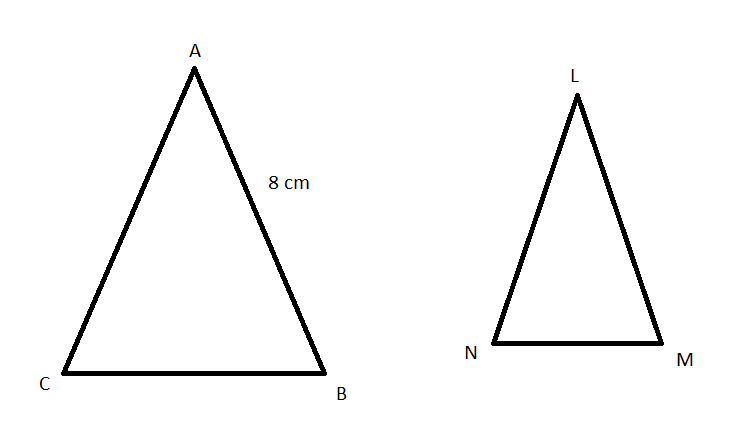
Given the perimeter of the triangle ABC \[ = AB + BC + AC = 60{\text{ cm}}\]
Given the perimeter of the triangle LMN \[ = LM + MN + LN = 48{\text{ cm}}\]
Also, given LM = 8 cm
As the triangle’s ABC and LMN are similar, the ratio of the perimeters of the triangles and their sides are equal.
So, we have
\[
\dfrac{{AB + BC + AC}}{{LM + MN + LN}} = \dfrac{{AB}}{{LM}} \\
\dfrac{{60}}{{48}} = \dfrac{{AB}}{8} \\
AB = \dfrac{{60}}{{48}} \times 8 = 10 \\
\therefore AB = 10{\text{ cm}} \\
\]
Hence the length of AB is 10 cm.
Thus, the correct option is A. 10 cm.
Note: The ratios of corresponding sides of the two triangles are in equal if they are similar. The perimeter of the triangle is equal to the sum of their sides. All the lengths of the sides are always less than the perimeter of the triangle.
Complete step-by-step answer:
The given triangles ABC and LMN are as shown in the below figure:
Given the perimeter of the triangle ABC \[ = AB + BC + AC = 60{\text{ cm}}\]
Given the perimeter of the triangle LMN \[ = LM + MN + LN = 48{\text{ cm}}\]
Also, given LM = 8 cm
As the triangle’s ABC and LMN are similar, the ratio of the perimeters of the triangles and their sides are equal.
So, we have
\[
\dfrac{{AB + BC + AC}}{{LM + MN + LN}} = \dfrac{{AB}}{{LM}} \\
\dfrac{{60}}{{48}} = \dfrac{{AB}}{8} \\
AB = \dfrac{{60}}{{48}} \times 8 = 10 \\
\therefore AB = 10{\text{ cm}} \\
\]
Hence the length of AB is 10 cm.
Thus, the correct option is A. 10 cm.
Note: The ratios of corresponding sides of the two triangles are in equal if they are similar. The perimeter of the triangle is equal to the sum of their sides. All the lengths of the sides are always less than the perimeter of the triangle.
Recently Updated Pages
Basicity of sulphurous acid and sulphuric acid are

Master Class 9 Social Science: Engaging Questions & Answers for Success
Master Class 9 Science: Engaging Questions & Answers for Success
Master Class 9 Maths: Engaging Questions & Answers for Success
Master Class 9 General Knowledge: Engaging Questions & Answers for Success
Class 9 Question and Answer - Your Ultimate Solutions Guide
Trending doubts
Fill the blanks with the suitable prepositions 1 The class 9 english CBSE
Difference Between Plant Cell and Animal Cell
Find the sum of series 1 + 2 + 3 + 4 + 5 + + 100 class 9 maths CBSE
Distinguish between Conventional and nonconventional class 9 social science CBSE
What is pollution? How many types of pollution? Define it
Describe the 4 stages of the Unification of German class 9 social science CBSE