




The perimeter of two similar triangles ABC and PQR are 35 cm and 45 cm respectively. Then, the ratio of the areas of the two triangles is _________.
Answer
 Verified
600.3k+ views
Hint:
Here, we need to find the ratio of the two triangles. We will use the given information, the formula of perimeter of triangles, and the property of similar triangles to find the ratio of the corresponding sides of the two triangles. Then, we will use the ratio of the corresponding sides of the two triangles to find the ratio of the areas of the two triangles.
Complete step by step solution:
First, we will draw the two similar triangles.
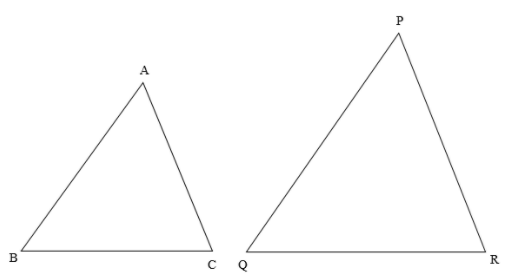
Here, ABC and PQR are the two similar triangles.
The ratio of the corresponding sides of two similar triangles is always equal.
Therefore, we get
\[\dfrac{{AB}}{{PQ}} = \dfrac{{BC}}{{QR}} = \dfrac{{CA}}{{RP}}\]
Let \[\dfrac{{AB}}{{PQ}} = \dfrac{{BC}}{{QR}} = \dfrac{{CA}}{{RP}} = x\].
Therefore, we get the equations
\[\dfrac{{AB}}{{PQ}} = x\], \[\dfrac{{BC}}{{QR}} = x\], and \[\dfrac{{CA}}{{RP}} = x\]
Multiplying both sides of the equation \[\dfrac{{AB}}{{PQ}} = x\] by \[PQ\], we get
\[ \Rightarrow AB = xPQ\]
Multiplying both sides of the equation \[\dfrac{{BC}}{{QR}} = x\] by \[QR\], we get
\[ \Rightarrow BC = xQR\]
Multiplying both sides of the equation \[\dfrac{{CA}}{{RP}} = x\] by \[RP\], we get
\[ \Rightarrow CA = x \cdot RP\]
Now, we will use the formula for the perimeter of the two triangles.
The perimeter of a triangle is the sum of all of its three sides.
Therefore, we get
Perimeter of triangle PQR \[ = PQ + QR + RP\]
It is given that the perimeter of triangle PQR is 45 cm.
Thus, we get the equation
\[ \Rightarrow PQ + QR + RP = 45\]
Similarly, we get
Perimeter of triangle ABC \[ = AB + BC + CA\]
It is given that the perimeter of triangle ABC is 35 cm.
Thus, we get the equation
\[ \Rightarrow AB + BC + CA = 35\]
Substituting \[AB = xPQ\], \[BC = x \cdot QR\], and \[CA = x \cdot RP\] in the equation, we get
\[ \Rightarrow x \cdot PQ + x \cdot QR + x \cdot RP = 35\]
Factoring out the term \[x\] from the expression, we get
\[ \Rightarrow x\left( {PQ + QR + RP} \right) = 35\]
Substituting \[PQ + QR + RP = 45\] in the equation, we get
\[ \Rightarrow x\left( {45} \right) = 35\]
This is a linear equation in terms of \[x\]. We will solve this to find the value of \[x\], and hence, the ratio of the sides of the two similar triangles.
Dividing both sides of the equation by 45, we get
\[ \Rightarrow \dfrac{{x\left( {45} \right)}}{{45}} = \dfrac{{35}}{{45}}\]
Thus, we get
\[ \Rightarrow x = \dfrac{{35}}{{45}} = \dfrac{7}{9}\]
Substituting \[x = \dfrac{7}{9}\] in the equation \[\dfrac{{AB}}{{PQ}} = \dfrac{{BC}}{{QR}} = \dfrac{{CA}}{{RP}} = x\], we get
\[ \Rightarrow \dfrac{{AB}}{{PQ}} = \dfrac{{BC}}{{QR}} = \dfrac{{CA}}{{RP}} = \dfrac{7}{9}\]
Thus, the ratio of the corresponding sides of the two similar triangles ABC and PQR is \[\dfrac{7}{9}\].
Finally, we will find the ratio of the areas of the similar triangles ABC and PQR.
The ratio of the areas of two similar triangles is the square of the ratio of any pair of corresponding sides of the two triangles.
Therefore, taking the corresponding sides AB and PQ, we get
Area of triangle ABC \[ \div \] Area of triangle PQR\[ = {\left( {\dfrac{{AB}}{{PQ}}} \right)^2}\]
Substituting \[\dfrac{{AB}}{{PQ}} = \dfrac{7}{9}\] in the equation, we get
\[ \Rightarrow \]Area of triangle ABC \[ \div \] Area of triangle PQR\[ = {\left( {\dfrac{7}{9}} \right)^2}\]
Simplifying the expression, we get
\[ \Rightarrow \]Area of triangle ABC \[ \div \] Area of triangle PQR\[ = \dfrac{{49}}{{81}}\]
Therefore, we get the ratio of the areas of the two similar triangles ABC and PQR as \[49:81\].
Note:
The two triangles given in the problem are similar triangles. Two triangles are similar if they have the same shape, irrespective of the size of the two triangles. The size may be equal or may not be equal. All congruent triangles are similar, but all similar triangles are not congruent.
We have formed a linear equation in one variable in terms of \[k\] in the solution. A linear equation in one variable is an equation of the form \[ax + b = 0\], where \[a\] and \[b\] are integers. A linear equation of the form \[ax + b = 0\] has only one solution.
Here, we need to find the ratio of the two triangles. We will use the given information, the formula of perimeter of triangles, and the property of similar triangles to find the ratio of the corresponding sides of the two triangles. Then, we will use the ratio of the corresponding sides of the two triangles to find the ratio of the areas of the two triangles.
Complete step by step solution:
First, we will draw the two similar triangles.
Here, ABC and PQR are the two similar triangles.
The ratio of the corresponding sides of two similar triangles is always equal.
Therefore, we get
\[\dfrac{{AB}}{{PQ}} = \dfrac{{BC}}{{QR}} = \dfrac{{CA}}{{RP}}\]
Let \[\dfrac{{AB}}{{PQ}} = \dfrac{{BC}}{{QR}} = \dfrac{{CA}}{{RP}} = x\].
Therefore, we get the equations
\[\dfrac{{AB}}{{PQ}} = x\], \[\dfrac{{BC}}{{QR}} = x\], and \[\dfrac{{CA}}{{RP}} = x\]
Multiplying both sides of the equation \[\dfrac{{AB}}{{PQ}} = x\] by \[PQ\], we get
\[ \Rightarrow AB = xPQ\]
Multiplying both sides of the equation \[\dfrac{{BC}}{{QR}} = x\] by \[QR\], we get
\[ \Rightarrow BC = xQR\]
Multiplying both sides of the equation \[\dfrac{{CA}}{{RP}} = x\] by \[RP\], we get
\[ \Rightarrow CA = x \cdot RP\]
Now, we will use the formula for the perimeter of the two triangles.
The perimeter of a triangle is the sum of all of its three sides.
Therefore, we get
Perimeter of triangle PQR \[ = PQ + QR + RP\]
It is given that the perimeter of triangle PQR is 45 cm.
Thus, we get the equation
\[ \Rightarrow PQ + QR + RP = 45\]
Similarly, we get
Perimeter of triangle ABC \[ = AB + BC + CA\]
It is given that the perimeter of triangle ABC is 35 cm.
Thus, we get the equation
\[ \Rightarrow AB + BC + CA = 35\]
Substituting \[AB = xPQ\], \[BC = x \cdot QR\], and \[CA = x \cdot RP\] in the equation, we get
\[ \Rightarrow x \cdot PQ + x \cdot QR + x \cdot RP = 35\]
Factoring out the term \[x\] from the expression, we get
\[ \Rightarrow x\left( {PQ + QR + RP} \right) = 35\]
Substituting \[PQ + QR + RP = 45\] in the equation, we get
\[ \Rightarrow x\left( {45} \right) = 35\]
This is a linear equation in terms of \[x\]. We will solve this to find the value of \[x\], and hence, the ratio of the sides of the two similar triangles.
Dividing both sides of the equation by 45, we get
\[ \Rightarrow \dfrac{{x\left( {45} \right)}}{{45}} = \dfrac{{35}}{{45}}\]
Thus, we get
\[ \Rightarrow x = \dfrac{{35}}{{45}} = \dfrac{7}{9}\]
Substituting \[x = \dfrac{7}{9}\] in the equation \[\dfrac{{AB}}{{PQ}} = \dfrac{{BC}}{{QR}} = \dfrac{{CA}}{{RP}} = x\], we get
\[ \Rightarrow \dfrac{{AB}}{{PQ}} = \dfrac{{BC}}{{QR}} = \dfrac{{CA}}{{RP}} = \dfrac{7}{9}\]
Thus, the ratio of the corresponding sides of the two similar triangles ABC and PQR is \[\dfrac{7}{9}\].
Finally, we will find the ratio of the areas of the similar triangles ABC and PQR.
The ratio of the areas of two similar triangles is the square of the ratio of any pair of corresponding sides of the two triangles.
Therefore, taking the corresponding sides AB and PQ, we get
Area of triangle ABC \[ \div \] Area of triangle PQR\[ = {\left( {\dfrac{{AB}}{{PQ}}} \right)^2}\]
Substituting \[\dfrac{{AB}}{{PQ}} = \dfrac{7}{9}\] in the equation, we get
\[ \Rightarrow \]Area of triangle ABC \[ \div \] Area of triangle PQR\[ = {\left( {\dfrac{7}{9}} \right)^2}\]
Simplifying the expression, we get
\[ \Rightarrow \]Area of triangle ABC \[ \div \] Area of triangle PQR\[ = \dfrac{{49}}{{81}}\]
Therefore, we get the ratio of the areas of the two similar triangles ABC and PQR as \[49:81\].
Note:
The two triangles given in the problem are similar triangles. Two triangles are similar if they have the same shape, irrespective of the size of the two triangles. The size may be equal or may not be equal. All congruent triangles are similar, but all similar triangles are not congruent.
We have formed a linear equation in one variable in terms of \[k\] in the solution. A linear equation in one variable is an equation of the form \[ax + b = 0\], where \[a\] and \[b\] are integers. A linear equation of the form \[ax + b = 0\] has only one solution.
Recently Updated Pages
Master Class 12 Economics: Engaging Questions & Answers for Success

Master Class 12 English: Engaging Questions & Answers for Success
Master Class 12 Social Science: Engaging Questions & Answers for Success
Master Class 12 Maths: Engaging Questions & Answers for Success
Master Class 12 Physics: Engaging Questions & Answers for Success
Master Class 9 General Knowledge: Engaging Questions & Answers for Success
Trending doubts
What is the Full Form of ICSE / ISC ?
What is the Full Form of ICSE, CBSE and SSC
Differentiate between the Western and the Eastern class 9 social science CBSE
What comes after 10 crore in Indian system class 9 maths CBSE
Write the 6 fundamental rights of India and explain in detail
Differentiate between nationstate and modern state class 9 social science CBSE