




The perimeter of an equilateral triangle is 60 cm, then the area is
\[\left( \text{a} \right)\text{ }10\sqrt{3}\text{ }c{{m}^{2}}\]
\[\left( \text{b} \right)\text{ }15\sqrt{3}\text{ }c{{m}^{2}}\]
\[\left( \text{c} \right)\text{ 20}\sqrt{3}\text{ }c{{m}^{2}}\]
\[\left( \text{d} \right)\text{ 100}\sqrt{3}\text{ }c{{m}^{2}}\]
Answer
 Verified
599.1k+ views
Hint: To solve the given question, first we will find out what type of triangle is an equilateral triangle, and accordingly we will assume the sides of the given equilateral triangle. We are given that the perimeter is 60 cm and for an equilateral triangle, it is given by 3 \[\times \] side length. Using this, side length can be obtained. After doing this, we will find the height of the triangle using the trigonometric ratio of \[\sin \theta =\dfrac{\text{perpendicular}}{\text{hypotenuse}}.\] Now, to find the area, we will use the formula given as \[\dfrac{1}{2}\times \text{base}\times \text{height}\text{.}\]
Complete step by step solution:
Before we solve this question, we must know what an equilateral triangle is. An equilateral triangle is a type of triangle in which all the sides are equal and the angle between each adjacent side pair is \[{{60}^{o}}.\] We will assume that the length of each side is x. The rough sketch of the equilateral triangle is shown below.
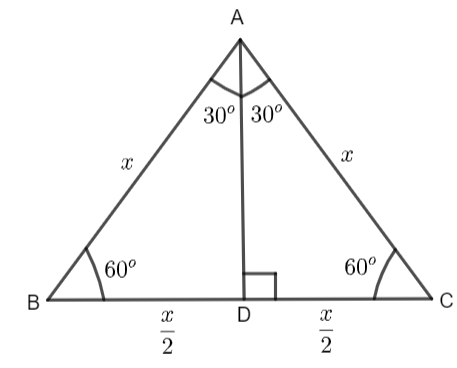
In the above figure, AB, BC and AC are the sides of the equilateral triangle such that AB = BC = AC = x. AD is the height of the triangle ABC. Now, it is given in the question that the perimeter of the triangle is 60 cm, i.e. the sum of all the sides of the given equilateral triangle is \[{{60}^{o}}.\] Thus, we have,
\[AB+BC+AC=60cm\]
\[\Rightarrow x+x+x=60cm\]
\[\Rightarrow 3x=60cm\]
\[\Rightarrow x=20cm\]
Thus, AB = 20 cm, BC = 20 cm and AC = 20 cm.
\[BD=DC=\dfrac{20}{2}cm\]
\[\Rightarrow BD=DC=10cm\]
Now, we will find the height of the triangle. For this, we will consider the right-angled triangle ADB. In right-angled triangle ADB, we have,
\[\sin {{60}^{o}}=\dfrac{AD}{AB}\]
\[\Rightarrow \sin {{60}^{o}}=\dfrac{AD}{20cm}\]
We know that, \[\sin {{60}^{o}}=\dfrac{\sqrt{3}}{2},\] so we have,
\[\Rightarrow \dfrac{\sqrt{3}}{2}=\dfrac{AD}{20cm}\]
\[\Rightarrow AD=20\times \dfrac{\sqrt{3}}{2}cm\]
\[\Rightarrow AD=10\sqrt{3}\text{ }cm\]
Now, we will calculate the area. The area of any triangle with the given base and height is calculated by the formula:
\[\text{Area of the triangle}=\dfrac{1}{2}\times \left( \text{base} \right)\times \left( \text{height} \right)\]
Thus, we get,
\[\text{Area of }\Delta ABC=\dfrac{1}{2}\times \left( BC \right)\times \left( AD \right)\]
\[\Rightarrow \text{Area of }\Delta ABC=\dfrac{1}{2}\times \left( 20cm \right)\times \left( 10\sqrt{3}cm \right)\]
\[\Rightarrow \text{Area of }\Delta ABC=\dfrac{20\times 10\sqrt{3}}{2}c{{m}^{2}}\]
\[\Rightarrow \text{Area of }\Delta ABC=100\sqrt{3}\text{ }c{{m}^{2}}\]
Hence, option (d) is the right answer.
Note: If the sides of the given equilateral triangle are given and assume that it is ‘a’, then the area of the equilateral triangle is given by,
\[\text{Area }=\dfrac{\sqrt{3}}{4}{{a}^{2}}\]
In our case, a = 20 cm.
\[\Rightarrow \text{Area of }\Delta \text{ABC}=\dfrac{\sqrt{3}}{4}{{\left( 20cm \right)}^{2}}\]
\[\Rightarrow \text{Area of }\Delta \text{ABC}=\dfrac{\sqrt{3}}{4}400c{{m}^{2}}\]
\[\Rightarrow \text{Area of }\Delta \text{ABC}=100\sqrt{3}\text{ }c{{m}^{2}}\]
The advantage of this method is that we do not need to calculate the height of the triangle.
Complete step by step solution:
Before we solve this question, we must know what an equilateral triangle is. An equilateral triangle is a type of triangle in which all the sides are equal and the angle between each adjacent side pair is \[{{60}^{o}}.\] We will assume that the length of each side is x. The rough sketch of the equilateral triangle is shown below.
In the above figure, AB, BC and AC are the sides of the equilateral triangle such that AB = BC = AC = x. AD is the height of the triangle ABC. Now, it is given in the question that the perimeter of the triangle is 60 cm, i.e. the sum of all the sides of the given equilateral triangle is \[{{60}^{o}}.\] Thus, we have,
\[AB+BC+AC=60cm\]
\[\Rightarrow x+x+x=60cm\]
\[\Rightarrow 3x=60cm\]
\[\Rightarrow x=20cm\]
Thus, AB = 20 cm, BC = 20 cm and AC = 20 cm.
\[BD=DC=\dfrac{20}{2}cm\]
\[\Rightarrow BD=DC=10cm\]
Now, we will find the height of the triangle. For this, we will consider the right-angled triangle ADB. In right-angled triangle ADB, we have,
\[\sin {{60}^{o}}=\dfrac{AD}{AB}\]
\[\Rightarrow \sin {{60}^{o}}=\dfrac{AD}{20cm}\]
We know that, \[\sin {{60}^{o}}=\dfrac{\sqrt{3}}{2},\] so we have,
\[\Rightarrow \dfrac{\sqrt{3}}{2}=\dfrac{AD}{20cm}\]
\[\Rightarrow AD=20\times \dfrac{\sqrt{3}}{2}cm\]
\[\Rightarrow AD=10\sqrt{3}\text{ }cm\]
Now, we will calculate the area. The area of any triangle with the given base and height is calculated by the formula:
\[\text{Area of the triangle}=\dfrac{1}{2}\times \left( \text{base} \right)\times \left( \text{height} \right)\]
Thus, we get,
\[\text{Area of }\Delta ABC=\dfrac{1}{2}\times \left( BC \right)\times \left( AD \right)\]
\[\Rightarrow \text{Area of }\Delta ABC=\dfrac{1}{2}\times \left( 20cm \right)\times \left( 10\sqrt{3}cm \right)\]
\[\Rightarrow \text{Area of }\Delta ABC=\dfrac{20\times 10\sqrt{3}}{2}c{{m}^{2}}\]
\[\Rightarrow \text{Area of }\Delta ABC=100\sqrt{3}\text{ }c{{m}^{2}}\]
Hence, option (d) is the right answer.
Note: If the sides of the given equilateral triangle are given and assume that it is ‘a’, then the area of the equilateral triangle is given by,
\[\text{Area }=\dfrac{\sqrt{3}}{4}{{a}^{2}}\]
In our case, a = 20 cm.
\[\Rightarrow \text{Area of }\Delta \text{ABC}=\dfrac{\sqrt{3}}{4}{{\left( 20cm \right)}^{2}}\]
\[\Rightarrow \text{Area of }\Delta \text{ABC}=\dfrac{\sqrt{3}}{4}400c{{m}^{2}}\]
\[\Rightarrow \text{Area of }\Delta \text{ABC}=100\sqrt{3}\text{ }c{{m}^{2}}\]
The advantage of this method is that we do not need to calculate the height of the triangle.
Recently Updated Pages
Master Class 9 General Knowledge: Engaging Questions & Answers for Success

Master Class 9 Social Science: Engaging Questions & Answers for Success
Master Class 9 English: Engaging Questions & Answers for Success
Master Class 9 Maths: Engaging Questions & Answers for Success
Master Class 9 Science: Engaging Questions & Answers for Success
Class 9 Question and Answer - Your Ultimate Solutions Guide
Trending doubts
Difference Between Plant Cell and Animal Cell
Fill the blanks with the suitable prepositions 1 The class 9 english CBSE
Who is eligible for RTE class 9 social science CBSE
Which places in India experience sunrise first and class 9 social science CBSE
What is pollution? How many types of pollution? Define it
Name 10 Living and Non living things class 9 biology CBSE