



The perimeter of a right angled triangle is 30 cm and its hypotenuse is 13 cm. Find the lengths of the other two sides.
Answer
 Verified
584.1k+ views
Hint: Assume the two unknown sides of the triangle to be some variable. Frame an equation in these two variables using the value of perimeter given in the question. Frame another equation between these two using Pythagoras theorem as the value of hypotenuse is already given. Solve these two equations to get the lengths of unknown sides.
Complete step-by-step solution:
According to the question, the hypotenuse of a right angled triangle is 13 cm and its perimeter is 30 cm. We have to determine the lengths of unknown sides.
Let the lengths of the unknown sides be \[x\] and \[y\] cm as shown in the below figure:
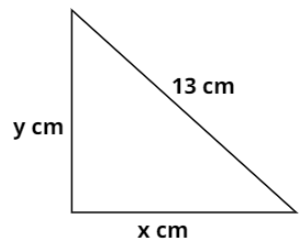
As the perimeter of the triangle is 30 cm, we have:
$
\Rightarrow x + y + 13 = 30 \\
\Rightarrow x + y = 17{\text{ }}.....{\text{(1)}}
$
Further, from Pythagoras theorem we know that for a right angled triangle:
\[ \Rightarrow {\text{Bas}}{{\text{e}}^2} + {\text{Perpendicula}}{{\text{r}}^2} = {\text{Hypotenus}}{{\text{e}}^2}\]
Applying this theorem for the above triangle, we’ll get:
$
\Rightarrow {x^2} + {y^2} = {13^2} \\
\Rightarrow {x^2} + {y^2} = 169{\text{ }}.....{\text{(2)}}
$
From an algebraic formula, we know that ${\left( {a + b} \right)^2} = {a^2} + {b^2} + 2ab$. Applying this formula while squaring equation (1) on both sides, we’ll get:
\[
\Rightarrow {\left( {x + y} \right)^2} = {17^2} \\
\Rightarrow {x^2} + {y^2} + 2xy = 289
\]
Putting the value of \[{x^2} + {y^2}\] from equation (2), we’ll get:
\[
\Rightarrow 169 + 2xy = 289 \\
\Rightarrow 2xy = 120{\text{ }}.....{\text{(3)}}
\]
Now, subtracting equation (3) from equation (2), we’ll get:
$ \Rightarrow {x^2} + {y^2} - 2xy = 169 - 120$
From another algebraic formula, we know that ${a^2} + {b^2} - 2ab = {\left( {a - b} \right)^2}$. Applying this formula, we’ll get:
\[ \Rightarrow {\left( {x - y} \right)^2} = 49\]
Taking square root on both sides, we have:
\[
\Rightarrow \left| {x - y} \right| = 7 \\
\Rightarrow x - y = \pm 7
\]
If we take positive sign into consideration, we’ll get:
$ \Rightarrow x - y = 7{\text{ }}.....{\text{(4)}}$
Now, adding both equations (1) and (4), we’ll get:
$
\Rightarrow x + y + x - y = 17 + 7 \\
\Rightarrow 2x = 24 \\
\Rightarrow x = 12
$
Putting $x = 12$ in equation (1), we’ll get:
$
\Rightarrow 12 + y = 17 \\
\Rightarrow y = 5
$
Therefore the lengths of two unknown sides of the triangle (i.e. \[x\] and \[y\]) are 12 cm and 5 cm respectively.
Note: We have taken positive sign into consideration in \[\left| {x - y} \right| = 7\] while solving equations in the above problem. This leads us to $x - y = 7$ which is indicating that $x > y$.
We can also consider negative signs to solve the equations. This will lead us to $y - x = 7$ which is indicating $x < y$. If we solve equations using this condition, we’ll get the same results with only the difference that \[x\] and \[y\] will interchange their values.
Complete step-by-step solution:
According to the question, the hypotenuse of a right angled triangle is 13 cm and its perimeter is 30 cm. We have to determine the lengths of unknown sides.
Let the lengths of the unknown sides be \[x\] and \[y\] cm as shown in the below figure:
As the perimeter of the triangle is 30 cm, we have:
$
\Rightarrow x + y + 13 = 30 \\
\Rightarrow x + y = 17{\text{ }}.....{\text{(1)}}
$
Further, from Pythagoras theorem we know that for a right angled triangle:
\[ \Rightarrow {\text{Bas}}{{\text{e}}^2} + {\text{Perpendicula}}{{\text{r}}^2} = {\text{Hypotenus}}{{\text{e}}^2}\]
Applying this theorem for the above triangle, we’ll get:
$
\Rightarrow {x^2} + {y^2} = {13^2} \\
\Rightarrow {x^2} + {y^2} = 169{\text{ }}.....{\text{(2)}}
$
From an algebraic formula, we know that ${\left( {a + b} \right)^2} = {a^2} + {b^2} + 2ab$. Applying this formula while squaring equation (1) on both sides, we’ll get:
\[
\Rightarrow {\left( {x + y} \right)^2} = {17^2} \\
\Rightarrow {x^2} + {y^2} + 2xy = 289
\]
Putting the value of \[{x^2} + {y^2}\] from equation (2), we’ll get:
\[
\Rightarrow 169 + 2xy = 289 \\
\Rightarrow 2xy = 120{\text{ }}.....{\text{(3)}}
\]
Now, subtracting equation (3) from equation (2), we’ll get:
$ \Rightarrow {x^2} + {y^2} - 2xy = 169 - 120$
From another algebraic formula, we know that ${a^2} + {b^2} - 2ab = {\left( {a - b} \right)^2}$. Applying this formula, we’ll get:
\[ \Rightarrow {\left( {x - y} \right)^2} = 49\]
Taking square root on both sides, we have:
\[
\Rightarrow \left| {x - y} \right| = 7 \\
\Rightarrow x - y = \pm 7
\]
If we take positive sign into consideration, we’ll get:
$ \Rightarrow x - y = 7{\text{ }}.....{\text{(4)}}$
Now, adding both equations (1) and (4), we’ll get:
$
\Rightarrow x + y + x - y = 17 + 7 \\
\Rightarrow 2x = 24 \\
\Rightarrow x = 12
$
Putting $x = 12$ in equation (1), we’ll get:
$
\Rightarrow 12 + y = 17 \\
\Rightarrow y = 5
$
Therefore the lengths of two unknown sides of the triangle (i.e. \[x\] and \[y\]) are 12 cm and 5 cm respectively.
Note: We have taken positive sign into consideration in \[\left| {x - y} \right| = 7\] while solving equations in the above problem. This leads us to $x - y = 7$ which is indicating that $x > y$.
We can also consider negative signs to solve the equations. This will lead us to $y - x = 7$ which is indicating $x < y$. If we solve equations using this condition, we’ll get the same results with only the difference that \[x\] and \[y\] will interchange their values.
Recently Updated Pages
Master Class 11 English: Engaging Questions & Answers for Success

Master Class 11 Maths: Engaging Questions & Answers for Success
Class 11 Question and Answer - Your Ultimate Solutions Guide
Master Class 11 Biology: Engaging Questions & Answers for Success
Master Class 11 Physics: Engaging Questions & Answers for Success
Master Class 11 Accountancy: Engaging Questions & Answers for Success
Trending doubts
Find the sum of series 1 + 2 + 3 + 4 + 5 + + 100 class 9 maths CBSE
Fill the blanks with the suitable prepositions 1 The class 9 english CBSE
Difference Between Plant Cell and Animal Cell
How many hours before the closure of election must class 9 social science CBSE
What is pollution? How many types of pollution? Define it
Name 10 Living and Non living things class 9 biology CBSE