




The perimeter of a quadrant of a circle of radius r is:
(a) $\dfrac{\pi r}{2}$
(b) $2\pi r$
(c) $\dfrac{r}{2}\left( \pi +4 \right)$
(d) $2\pi r+\dfrac{r}{2}$
Answer
 Verified
621k+ views
Hint: Here, we will try to find the perimeter of the quadrant of a circle by using the formula for the perimeter of a circle which is $2\pi r$. We will the concept that a quadrant of a circle is one-fourth of a circle.
Complete step-by-step answer:
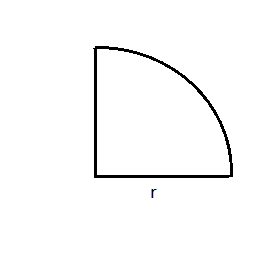
We know that a circle is defined as the locus of all the points that are equidistant from a fixed point called the centre of the circle. Now, a quadrant is one-fourth section of a circle which is obtained when a circle is divided evenly into four sections or rather 4 quadrants by a set of two lines which are perpendicular in nature.
Since, quadrant refers to the four quarters in the coordinate system. But, when it comes to a circle, the quarter of a circle is called a quadrant, which is a section of 90 degrees. When four such quadrants are joined, then we get a complete circle.
If the radius of a circle is r, then the perimeter of the circle is given as:
$P=2\pi r$
While finding the perimeter of a quadrant we need to add two times the radius of the circle to the perimeter of the curved boundary.
Perimeter of the curved boundary= $\dfrac{1}{4}\times 2\pi r$= $\dfrac{\pi r}{2}$
Now, on adding two times the radius of the circle to $\dfrac{\pi r}{2}$, we get:
$\begin{align}
& 2r+\dfrac{\pi r}{2} \\
& =\dfrac{r}{2}\left( \pi +4 \right) \\
\end{align}$
Hence, option (c) is the correct answer.
Note: Students should note here that the quadrant of a circle is one-fourth section of the circle. So, for finding the perimeter of the quadrant, we have to take one-fourth of the circumference of the circle. One should also keep in mind that two times the radius of the circle have to be added to on-fourth the circumference of the circle.
Complete step-by-step answer:
We know that a circle is defined as the locus of all the points that are equidistant from a fixed point called the centre of the circle. Now, a quadrant is one-fourth section of a circle which is obtained when a circle is divided evenly into four sections or rather 4 quadrants by a set of two lines which are perpendicular in nature.
Since, quadrant refers to the four quarters in the coordinate system. But, when it comes to a circle, the quarter of a circle is called a quadrant, which is a section of 90 degrees. When four such quadrants are joined, then we get a complete circle.
If the radius of a circle is r, then the perimeter of the circle is given as:
$P=2\pi r$
While finding the perimeter of a quadrant we need to add two times the radius of the circle to the perimeter of the curved boundary.
Perimeter of the curved boundary= $\dfrac{1}{4}\times 2\pi r$= $\dfrac{\pi r}{2}$
Now, on adding two times the radius of the circle to $\dfrac{\pi r}{2}$, we get:
$\begin{align}
& 2r+\dfrac{\pi r}{2} \\
& =\dfrac{r}{2}\left( \pi +4 \right) \\
\end{align}$
Hence, option (c) is the correct answer.
Note: Students should note here that the quadrant of a circle is one-fourth section of the circle. So, for finding the perimeter of the quadrant, we have to take one-fourth of the circumference of the circle. One should also keep in mind that two times the radius of the circle have to be added to on-fourth the circumference of the circle.
Recently Updated Pages
Master Class 11 English: Engaging Questions & Answers for Success

Master Class 11 Maths: Engaging Questions & Answers for Success
Class 11 Question and Answer - Your Ultimate Solutions Guide
Master Class 11 Biology: Engaging Questions & Answers for Success
Master Class 11 Physics: Engaging Questions & Answers for Success
Master Class 11 Accountancy: Engaging Questions & Answers for Success
Trending doubts
Differentiate between an exothermic and an endothermic class 11 chemistry CBSE
One Metric ton is equal to kg A 10000 B 1000 C 100 class 11 physics CBSE
In what year Guru Nanak Dev ji was born A15 April 1469 class 11 social science CBSE
Difference Between Prokaryotic Cells and Eukaryotic Cells
There are 720 permutations of the digits 1 2 3 4 5 class 11 maths CBSE
Draw a diagram of a plant cell and label at least eight class 11 biology CBSE