




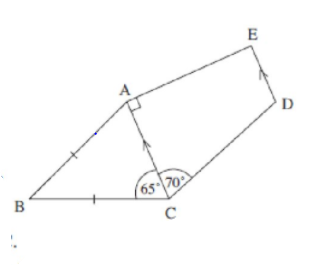
The pentagon ABCDE is the frame for Ibrahim's mountain bike.
ABC is an isosceles triangle in which AB=BC and angle BCA=65°.
In the quadrilateral, ACDE angle ACD=70°, angle CAE=90°, and AC is parallel to ED.
(a.) (i) Calculate the size of the angle ABC.
(ii) What facts about the angles of a triangle did you use in your calculation?
(b). Calculate the size of the angle CDE.
Answer
 Verified
584.4k+ views
Hint:A pentagon is a 5-sided Polygon. A regular pentagon has five lines of reflectional symmetry, and rotational symmetry of order 5 (through 72°, 144°, 216° and 288°). A convex pentagon has no angles pointing inwards. More precisely, no internal angles can be more than 180°. When any internal angle is greater than 180° it is concave.
Complete step by step solution:
(a). Given:
\[AB = BC\]
∠BCA=∠BAC=\[65^\circ \]
So,∠BCA+∠BAC+∠ABC=$180∘$
\[65^\circ + 65^\circ + \]∠ABC=\[180^\circ \]
∠ABC=\[180^\circ - 130^\circ \]
∠ABC=\[50\]
(b). ∠CDE+∠ACD=\[180^\circ \]
(Where AC||ED)
∠CDE+\[70^\circ = 180^\circ \]
∠CDE=\[110^\circ \]
Note: The properties of a simple pentagon (5-gon) are it must have five straight sides that meet to create five vertices but do not self-intersect: Pentagons have five straight sides. Pentagons have five interior angles, which sum to 540° The five sides do not intersect.
Additional information: There are two types of pentagon on the basis of sides and angles:
a. Regular pentagon
b. Irregular pentagon
Regular pentagon: A pentagon which has all five sides equal in length and eventually, all the five angles are equal in measure, is known as regular pentagon. Each interior angle of a regular pentagon is 1080.
Irregular pentagon: An irregular pentagon is a pentagon which does not have all sides equal. Also, it does not have all angles equal.
Pentagons can be regular or irregular and convex or concave. A regular pentagon is one with all equal sides and angles. Its interior angles are 108 degrees and its exterior angles are 72 degrees. An irregular pentagon is a shape that does not have equal sides and/or angles and therefore, does not have specified angles.
A convex pentagon is one whose vertices, or points where the sides meet, are pointing outwards as opposed to a concave pentagon whose vertices point inwards.
Complete step by step solution:
(a). Given:
\[AB = BC\]
∠BCA=∠BAC=\[65^\circ \]
So,∠BCA+∠BAC+∠ABC=$180∘$
\[65^\circ + 65^\circ + \]∠ABC=\[180^\circ \]
∠ABC=\[180^\circ - 130^\circ \]
∠ABC=\[50\]
(b). ∠CDE+∠ACD=\[180^\circ \]
(Where AC||ED)
∠CDE+\[70^\circ = 180^\circ \]
∠CDE=\[110^\circ \]
Note: The properties of a simple pentagon (5-gon) are it must have five straight sides that meet to create five vertices but do not self-intersect: Pentagons have five straight sides. Pentagons have five interior angles, which sum to 540° The five sides do not intersect.
Additional information: There are two types of pentagon on the basis of sides and angles:
a. Regular pentagon
b. Irregular pentagon
Regular pentagon: A pentagon which has all five sides equal in length and eventually, all the five angles are equal in measure, is known as regular pentagon. Each interior angle of a regular pentagon is 1080.
Irregular pentagon: An irregular pentagon is a pentagon which does not have all sides equal. Also, it does not have all angles equal.
Pentagons can be regular or irregular and convex or concave. A regular pentagon is one with all equal sides and angles. Its interior angles are 108 degrees and its exterior angles are 72 degrees. An irregular pentagon is a shape that does not have equal sides and/or angles and therefore, does not have specified angles.
A convex pentagon is one whose vertices, or points where the sides meet, are pointing outwards as opposed to a concave pentagon whose vertices point inwards.
Recently Updated Pages
Master Class 11 Computer Science: Engaging Questions & Answers for Success

Master Class 11 Business Studies: Engaging Questions & Answers for Success
Master Class 11 Economics: Engaging Questions & Answers for Success
Master Class 11 English: Engaging Questions & Answers for Success
Master Class 11 Maths: Engaging Questions & Answers for Success
Master Class 11 Biology: Engaging Questions & Answers for Success
Trending doubts
One Metric ton is equal to kg A 10000 B 1000 C 100 class 11 physics CBSE
There are 720 permutations of the digits 1 2 3 4 5 class 11 maths CBSE
Discuss the various forms of bacteria class 11 biology CBSE
Draw a diagram of a plant cell and label at least eight class 11 biology CBSE
State the laws of reflection of light
Explain zero factorial class 11 maths CBSE