



The parallel sides of trapezium are 6cm and 8cm. If the distance between them is 4cm, its area is
A.28 sq.cm
B.24 sq.cm
C.82 sq.cm
D.42 sq.cm
Answer
 Verified
630k+ views
Hint: In this question, we need to evaluate the area of the trapezium such that the parallel sides of trapezium are 6 cm and 8 cm. For this, we will use the relation between area, length of the parallel sides and length between the parallel sides.
Complete step-by-step answer:
Given the length of the parallel sides of trapezium
\[{L_1} = 6\;cm\] and \[{L_2} = 8\;cm\]
The distance between the parallel sides $D = 4\;cm$
Let us first draw a trapezium from the above given data
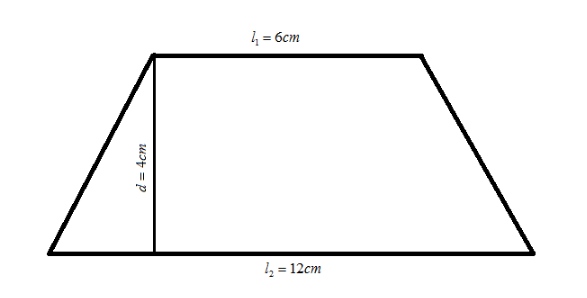
Now we already know the formula for the area of the trapezium which is equal to the product of the sum of parallel sides and distance between them multiplied by half as \[\dfrac{1}{2} \times \left( {{\text{sum of parallel sides}}} \right) \times \left( {{\text{distnace between parallel sides}}} \right)\]
\[
Area = \dfrac{1}{2} \times \left( {6 + 8} \right) \times 4 \\
= \dfrac{1}{2} \times \left( {14} \right) \times 4 \\
= 7 \times 4 \\
= 28\;c{m^2} \;
\]
Hence, the area of trapezoid whose parallel sides are 6cm and 8cm and the distance between them is 4 cm is \[ = 28\;c{m^2}\]
Option A is correct.
So, the correct answer is “Option A”.
Note: When a trapezoid has non parallel sides then the figure is known as irregular trapezoid then to find the area of the trapezoid we divide that geometric figure into a regular triangles or rectangles to find the area of the figure. The area of a trapezium is equal to the product of the sum of the parallel sides and the distance between them multiplied by the half which is given as \[\dfrac{1}{2} \times \left( {{\text{sum of parallel sides}}} \right) \times \left( {{\text{distnace between parallel sides}}} \right)\] .
Complete step-by-step answer:
Given the length of the parallel sides of trapezium
\[{L_1} = 6\;cm\] and \[{L_2} = 8\;cm\]
The distance between the parallel sides $D = 4\;cm$
Let us first draw a trapezium from the above given data
Now we already know the formula for the area of the trapezium which is equal to the product of the sum of parallel sides and distance between them multiplied by half as \[\dfrac{1}{2} \times \left( {{\text{sum of parallel sides}}} \right) \times \left( {{\text{distnace between parallel sides}}} \right)\]
\[
Area = \dfrac{1}{2} \times \left( {6 + 8} \right) \times 4 \\
= \dfrac{1}{2} \times \left( {14} \right) \times 4 \\
= 7 \times 4 \\
= 28\;c{m^2} \;
\]
Hence, the area of trapezoid whose parallel sides are 6cm and 8cm and the distance between them is 4 cm is \[ = 28\;c{m^2}\]
Option A is correct.
So, the correct answer is “Option A”.
Note: When a trapezoid has non parallel sides then the figure is known as irregular trapezoid then to find the area of the trapezoid we divide that geometric figure into a regular triangles or rectangles to find the area of the figure. The area of a trapezium is equal to the product of the sum of the parallel sides and the distance between them multiplied by the half which is given as \[\dfrac{1}{2} \times \left( {{\text{sum of parallel sides}}} \right) \times \left( {{\text{distnace between parallel sides}}} \right)\] .
Recently Updated Pages
Which will be the least stable resonating structure class 11 chemistry CBSE

Explain the structure of megasporangium class 12 biology CBSE
Differentiate between voluntary action and reflex class 10 biology CBSE
How many 5 digit telephone numbers can be construc-class-11-maths-CBSE
How do you find the angle of the resultant vector class 11 physics CBSE
Why is chloroform kept in dark coloured bottles class 12 chemistry CBSE
Trending doubts
10 slogans on organ donation class 8 english CBSE
Which Indian state shares the longest international class 8 social science CBSE
What are the methods of reducing friction. Explain
Distinguish between SouthWest and NorthEast monsoo class 8 social science CBSE
Is the word stars countable or uncountable class 8 english CBSE
Summary of the poem Where the Mind is Without Fear class 8 english CBSE