




The packing efficiency of the face centred cubic (fcc), body-centred cubic (bcc) and simple primitive cubic (pc) lattices follows the order:
A. fcc > bcc > pc
B. bcc > fcc > pc
C. pc > bcc > fcc
D. bcc > pc > fcc
Answer
 Verified
634.2k+ views
Hint: We know that each cube has 8 corners, 12 edges, 6 faces, 12 face diagonals and 8 body diagonals. Keeping this information in mind we need to proceed for the comparison.
Step by step answer:
The percentage efficiency of a simple cubic unit cell is:
Suppose,
Length of the unit cell \[\text{= a}\]
Radius of the sphere (atom) \[\text{= r}\]
Total volume of the unit cell \[\text{= }{{\text{a}}^{\text{3}}}\text{= }{{\left( \text{2r} \right)}^{\text{3}}}\text{= 8}{{\text{r}}^{\text{3}}}\]
Number of atoms per unit cell \[\text{= 8 }\!\!\times\!\!\text{ }\dfrac{\text{1}}{\text{8}}\text{ = 1}\]
Volume of the atom \[\text{r = }\dfrac{\text{1}}{\text{2}\sqrt{\text{2}}\text{a}}\]\[\text{= }\dfrac{\text{4}}{\text{3}}\text{ }\!\!\pi\!\!\text{ }{{\text{r}}^{\text{3}}}\]
\[\therefore \]packing fraction \[\text{= }\dfrac{\text{Occupied volume }}{\text{Total volume}}\text{ }\]
\[\text{= }\dfrac{\left( \text{4/3} \right)\text{ }\!\!\pi\!\!\text{ }{{\text{r}}^{\text{3}}}}{\text{8}{{\text{r}}^{\text{3}}}}\text{= 0}\text{.5233}\]
Thus, the percentage of occupied volume or packing efficiency \[\text{= 0}\text{.5233 }\!\!\times\!\!\text{ 100 = 52}\text{.33 }\!\!%\!\!\text{ }\]
The percentage efficiency of a body-centred unit cell is:
Suppose,
Length of the unit cell \[\text{= a}\]
Radius of the sphere (atom) \[\text{= r}\]
In this unit cell,
\[\text{a = }\dfrac{\text{4}}{\sqrt{\text{3}}}\text{ }\!\!\times\!\!\text{ r}\]
Total volume of the unit cell \[\text{= }{{\text{a}}^{\text{3}}}\text{= }{{\left( \dfrac{\text{4}}{\sqrt{\text{3}}} \right)}^{\text{3}}}{{\text{r}}^{\text{3}}}\text{= }\dfrac{\text{64}}{\text{3}\sqrt{\text{3}}}\text{ }{{\text{r}}^{\text{3}}}\]
Number of atoms per unit cell \[\text{= 2}\]
Volume of two atoms \[\text{= 2 }\!\!\times\!\!\text{ }\dfrac{\text{4}}{\text{3}}\text{ }\!\!\pi\!\!\text{ }{{\text{r}}^{\text{3}}}\]
Therefore, packing fraction (3D) \[\text{= }\dfrac{\text{Occupied volume }}{\text{Total volume}}\text{ }\]
\[\text{=}\dfrac{\text{2 }\!\!\times\!\!\text{ }\dfrac{\text{4}}{\text{3}}\text{ }\!\!\pi\!\!\text{ }{{\text{r}}^{\text{3}}}}{\dfrac{\text{64}}{\text{3}\sqrt{\text{3}}}{{\text{r}}^{\text{3}}}}\text{=0}\text{.68}\]
Thus, the percentage of occupied volume or packing efficiency \[\text{= 68 }\!\!%\!\!\text{ }\]
The percentage efficiency of a face-centred cubic unit cell:
Suppose,
Length of the unit cell \[\text{= a}\]
Radius of the sphere (atom) \[\text{= r}\]
In this unit cell,
\[\text{a=2}\sqrt{\text{2}}\times \text{r}\]
Total volume of the unit cell \[\text{=}{{\text{a}}^{\text{3}}}\text{=(2}\sqrt{\text{2}}{{\text{)}}^{\text{3}}}{{\text{r}}^{\text{3}}}\text{=16}\sqrt{\text{2}}{{\text{r}}^{\text{3}}}\]
Number of atoms per unit cell \[\text{= 4}\]
Volume of four atoms \[\text{= 4 }\!\!\times\!\!\text{ }\dfrac{\text{4}}{\text{3}}\text{ }\!\!\pi\!\!\text{ }{{\text{r}}^{\text{3}}}\]
(This is the occupied volume)
Therefore, packing fraction (3D) \[\text{=}\dfrac{\text{Occupied volume }}{\text{ Total volume}}\]
\[\text{=}\dfrac{\text{4 }\!\!\times\!\!\text{ }\dfrac{\text{4}}{\text{3}}\text{ }\!\!\pi\!\!\text{ }{{\text{r}}^{\text{3}}}}{\text{16}\sqrt{\text{2}}{{\text{r}}^{\text{3}}}}\text{=0}\text{.7401}\]
Thus, the percentage of occupied volume or packing efficiency \[\text{= 74}\text{.01 }\!\!%\!\!\text{ }\]
Hence we can see that the packing efficiency goes in to order:
fcc > bcc > pc
So Option A is the correct answer.
Note:

Atomic radius of simple cubic unit cell is: \[\text{r = }\dfrac{\text{a}}{\text{2}}\]
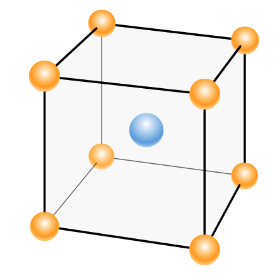
Atomic radius of body-centred unit cell is: \[\text{r = }\dfrac{\sqrt{\text{3}}}{\text{4 a}}\]

Atomic radius of face-centred unit cell is: \[\text{r = }\dfrac{\text{1}}{\text{2}\sqrt{\text{2}}\text{a}}\]
Step by step answer:
The percentage efficiency of a simple cubic unit cell is:
Suppose,
Length of the unit cell \[\text{= a}\]
Radius of the sphere (atom) \[\text{= r}\]
Total volume of the unit cell \[\text{= }{{\text{a}}^{\text{3}}}\text{= }{{\left( \text{2r} \right)}^{\text{3}}}\text{= 8}{{\text{r}}^{\text{3}}}\]
Number of atoms per unit cell \[\text{= 8 }\!\!\times\!\!\text{ }\dfrac{\text{1}}{\text{8}}\text{ = 1}\]
Volume of the atom \[\text{r = }\dfrac{\text{1}}{\text{2}\sqrt{\text{2}}\text{a}}\]\[\text{= }\dfrac{\text{4}}{\text{3}}\text{ }\!\!\pi\!\!\text{ }{{\text{r}}^{\text{3}}}\]
\[\therefore \]packing fraction \[\text{= }\dfrac{\text{Occupied volume }}{\text{Total volume}}\text{ }\]
\[\text{= }\dfrac{\left( \text{4/3} \right)\text{ }\!\!\pi\!\!\text{ }{{\text{r}}^{\text{3}}}}{\text{8}{{\text{r}}^{\text{3}}}}\text{= 0}\text{.5233}\]
Thus, the percentage of occupied volume or packing efficiency \[\text{= 0}\text{.5233 }\!\!\times\!\!\text{ 100 = 52}\text{.33 }\!\!%\!\!\text{ }\]
The percentage efficiency of a body-centred unit cell is:
Suppose,
Length of the unit cell \[\text{= a}\]
Radius of the sphere (atom) \[\text{= r}\]
In this unit cell,
\[\text{a = }\dfrac{\text{4}}{\sqrt{\text{3}}}\text{ }\!\!\times\!\!\text{ r}\]
Total volume of the unit cell \[\text{= }{{\text{a}}^{\text{3}}}\text{= }{{\left( \dfrac{\text{4}}{\sqrt{\text{3}}} \right)}^{\text{3}}}{{\text{r}}^{\text{3}}}\text{= }\dfrac{\text{64}}{\text{3}\sqrt{\text{3}}}\text{ }{{\text{r}}^{\text{3}}}\]
Number of atoms per unit cell \[\text{= 2}\]
Volume of two atoms \[\text{= 2 }\!\!\times\!\!\text{ }\dfrac{\text{4}}{\text{3}}\text{ }\!\!\pi\!\!\text{ }{{\text{r}}^{\text{3}}}\]
Therefore, packing fraction (3D) \[\text{= }\dfrac{\text{Occupied volume }}{\text{Total volume}}\text{ }\]
\[\text{=}\dfrac{\text{2 }\!\!\times\!\!\text{ }\dfrac{\text{4}}{\text{3}}\text{ }\!\!\pi\!\!\text{ }{{\text{r}}^{\text{3}}}}{\dfrac{\text{64}}{\text{3}\sqrt{\text{3}}}{{\text{r}}^{\text{3}}}}\text{=0}\text{.68}\]
Thus, the percentage of occupied volume or packing efficiency \[\text{= 68 }\!\!%\!\!\text{ }\]
The percentage efficiency of a face-centred cubic unit cell:
Suppose,
Length of the unit cell \[\text{= a}\]
Radius of the sphere (atom) \[\text{= r}\]
In this unit cell,
\[\text{a=2}\sqrt{\text{2}}\times \text{r}\]
Total volume of the unit cell \[\text{=}{{\text{a}}^{\text{3}}}\text{=(2}\sqrt{\text{2}}{{\text{)}}^{\text{3}}}{{\text{r}}^{\text{3}}}\text{=16}\sqrt{\text{2}}{{\text{r}}^{\text{3}}}\]
Number of atoms per unit cell \[\text{= 4}\]
Volume of four atoms \[\text{= 4 }\!\!\times\!\!\text{ }\dfrac{\text{4}}{\text{3}}\text{ }\!\!\pi\!\!\text{ }{{\text{r}}^{\text{3}}}\]
(This is the occupied volume)
Therefore, packing fraction (3D) \[\text{=}\dfrac{\text{Occupied volume }}{\text{ Total volume}}\]
\[\text{=}\dfrac{\text{4 }\!\!\times\!\!\text{ }\dfrac{\text{4}}{\text{3}}\text{ }\!\!\pi\!\!\text{ }{{\text{r}}^{\text{3}}}}{\text{16}\sqrt{\text{2}}{{\text{r}}^{\text{3}}}}\text{=0}\text{.7401}\]
Thus, the percentage of occupied volume or packing efficiency \[\text{= 74}\text{.01 }\!\!%\!\!\text{ }\]
Hence we can see that the packing efficiency goes in to order:
fcc > bcc > pc
So Option A is the correct answer.
Note:
Atomic radius of simple cubic unit cell is: \[\text{r = }\dfrac{\text{a}}{\text{2}}\]
Atomic radius of body-centred unit cell is: \[\text{r = }\dfrac{\sqrt{\text{3}}}{\text{4 a}}\]
Atomic radius of face-centred unit cell is: \[\text{r = }\dfrac{\text{1}}{\text{2}\sqrt{\text{2}}\text{a}}\]
Recently Updated Pages
Master Class 11 Social Science: Engaging Questions & Answers for Success

Master Class 11 English: Engaging Questions & Answers for Success
Master Class 11 Maths: Engaging Questions & Answers for Success
Master Class 11 Chemistry: Engaging Questions & Answers for Success
Master Class 11 Biology: Engaging Questions & Answers for Success
Master Class 11 Physics: Engaging Questions & Answers for Success
Trending doubts
One Metric ton is equal to kg A 10000 B 1000 C 100 class 11 physics CBSE
Difference Between Prokaryotic Cells and Eukaryotic Cells
There are 720 permutations of the digits 1 2 3 4 5 class 11 maths CBSE
Draw a diagram of a plant cell and label at least eight class 11 biology CBSE
Two of the body parts which do not appear in MRI are class 11 biology CBSE
Which gas is abundant in air class 11 chemistry CBSE