




The oxidation states of iodine in \[{\rm{HI}}{{\rm{O}}_{\rm{4}}}\], \[{{\rm{H}}_{\rm{3}}}{\rm{I}}{{\rm{O}}_{\rm{5}}}\]and \[{{\rm{H}}_{\rm{5}}}{\rm{I}}{{\rm{O}}_{\rm{6}}}\] are respectively
(A) \[ + 1\,\], \[ + 3\], \[ + 7\]
(B) \[ + 7\], \[ + 7\], \[ + 3\]
(C) \[ + 7\], \[ + 7\], \[ + 7\]
(D) \[ + 7\], \[ + 5\], \[ + 3\]
Answer
 Verified
602.1k+ views
Hint: As we know that the oxidation states usually referred to the charge of any chemical compound. For example, an oxygen atom is an electronegative atom and has \[ - 2\] charge due to only six electrons in its outermost orbital.
Complete answer:
The oxidation state of any atom is the state when that atom loses its electrons. In the above question, there are three compounds in which iodine loses its electrons. As we know that iodine is \[{\rm{1}}{{\rm{7}}^{{\rm{th}}}}\] group element and it has seven electrons in its outermost shell so it can lose maximum of seven electrons.
Let’s calculate the oxidation of iodine in these compounds.
In \[{\rm{HI}}{{\rm{O}}_{\rm{4}}}\],
Suppose x is the oxidation state of iodine, it is calculated as follows;
\[
\Rightarrow ( + 1) \times 1 + x + 4 \times \left( { - 2} \right) = 0\\
\Rightarrow x = + 7
\]
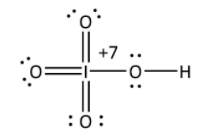
Here, the formal charge of hydrogen is and formal charge of oxygen is \[ - 2\] and represented as-
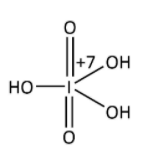
In \[{{\rm{H}}_{\rm{3}}}{\rm{I}}{{\rm{O}}_{\rm{5}}}\],
Suppose x is the oxidation state of iodine, it is calculated as follows;
\[
\Rightarrow ( + 1) \times 3 + x + 5 \times \left( { - 2} \right) = 0\\
\Rightarrow x = + 7
\]
And represented as-
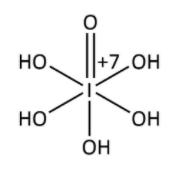
In \[{{\rm{H}}_{\rm{5}}}{\rm{I}}{{\rm{O}}_{\rm{6}}}\],
Suppose x is the oxidation state of iodine, it is calculated as follows;
\[
\Rightarrow ( + 1) \times 5 + x + 6 \times \left( { - 2} \right) = 0\\
\Rightarrow x = + 7
\]
Therefore, the oxidation state of iodine in all of three compounds is \[ + 7\].
The compound is represented as-
Hence, the correct answer is option (C).
Note: Any compound in which the central element exists with its highest oxidation state, will have the maximum oxidizing property such as \[{\rm{HI}}{{\rm{O}}_{\rm{4}}}\], \[{{\rm{H}}_{\rm{3}}}{\rm{I}}{{\rm{O}}_{\rm{5}}}\]and \[{{\rm{H}}_{\rm{5}}}{\rm{I}}{{\rm{O}}_{\rm{6}}}\]. These are said to be oxidizing agents.
Complete answer:
The oxidation state of any atom is the state when that atom loses its electrons. In the above question, there are three compounds in which iodine loses its electrons. As we know that iodine is \[{\rm{1}}{{\rm{7}}^{{\rm{th}}}}\] group element and it has seven electrons in its outermost shell so it can lose maximum of seven electrons.
Let’s calculate the oxidation of iodine in these compounds.
In \[{\rm{HI}}{{\rm{O}}_{\rm{4}}}\],
Suppose x is the oxidation state of iodine, it is calculated as follows;
\[
\Rightarrow ( + 1) \times 1 + x + 4 \times \left( { - 2} \right) = 0\\
\Rightarrow x = + 7
\]
Here, the formal charge of hydrogen is and formal charge of oxygen is \[ - 2\] and represented as-
In \[{{\rm{H}}_{\rm{3}}}{\rm{I}}{{\rm{O}}_{\rm{5}}}\],
Suppose x is the oxidation state of iodine, it is calculated as follows;
\[
\Rightarrow ( + 1) \times 3 + x + 5 \times \left( { - 2} \right) = 0\\
\Rightarrow x = + 7
\]
And represented as-
In \[{{\rm{H}}_{\rm{5}}}{\rm{I}}{{\rm{O}}_{\rm{6}}}\],
Suppose x is the oxidation state of iodine, it is calculated as follows;
\[
\Rightarrow ( + 1) \times 5 + x + 6 \times \left( { - 2} \right) = 0\\
\Rightarrow x = + 7
\]
Therefore, the oxidation state of iodine in all of three compounds is \[ + 7\].
The compound is represented as-
Hence, the correct answer is option (C).
Note: Any compound in which the central element exists with its highest oxidation state, will have the maximum oxidizing property such as \[{\rm{HI}}{{\rm{O}}_{\rm{4}}}\], \[{{\rm{H}}_{\rm{3}}}{\rm{I}}{{\rm{O}}_{\rm{5}}}\]and \[{{\rm{H}}_{\rm{5}}}{\rm{I}}{{\rm{O}}_{\rm{6}}}\]. These are said to be oxidizing agents.
Recently Updated Pages
Master Class 11 English: Engaging Questions & Answers for Success

Master Class 11 Social Science: Engaging Questions & Answers for Success
Master Class 11 Maths: Engaging Questions & Answers for Success
Master Class 11 Biology: Engaging Questions & Answers for Success
Master Class 11 Physics: Engaging Questions & Answers for Success
Master Class 11 Chemistry: Engaging Questions & Answers for Success
Trending doubts
One Metric ton is equal to kg A 10000 B 1000 C 100 class 11 physics CBSE
Difference Between Prokaryotic Cells and Eukaryotic Cells
Find the value of the expression given below sin 30circ class 11 maths CBSE
Difference between physical and chemical change class 11 chemistry CBSE
Two of the body parts which do not appear in MRI are class 11 biology CBSE
Draw a diagram of a plant cell and label at least eight class 11 biology CBSE