




The ortho and para hydrogen differ in respect of which of the following?
(A) In the molecular weight
(B) In the nature of spin of protons
(C) In the nature of spin of electrons
(D) In the number of protons
Answer
 Verified
657.9k+ views
Hint: Ortho and para hydrogen are the spin isomers of hydrogen where one of them has both nuclei rotating in the same direction while other has them rotating in different directions.
Complete step by step answer:
-Ortho and para hydrogen are the 2 spin isomers of hydrogen also known as allotropes of hydrogen.
-1 molecule of dihydrogen (${H_2}$) contains 2 atoms of hydrogen and the nuclei of both the hydrogen atoms is spinning. Based on the spin of the nuclei of the 2 hydrogen atoms the hydrogen are of 2 types namely: ortho and para hydrogen.
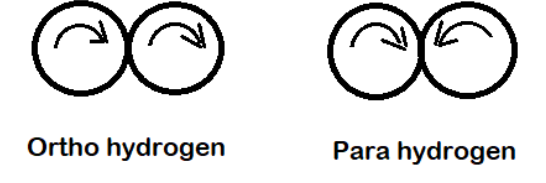
-The hydrogen molecule in which the spin of both the nuclei or the protons are in the same direction are known as ortho hydrogen. Since the spin is in one direction the net spin will be 1.
The hydrogen molecules in which the spin of both the nuclei or the protons are in opposite directions are known as para hydrogen. Since the spin is in 2 opposite directions the net spin will be 0.
So, we can see that the ortho and para hydrogen differ in the nuclear spin or the spin of protons.
-Para hydrogen is more stable than ortho hydrogen due to its 0 net spin. Para hydrogen also has a lower energy state than ortho hydrogen.
-The ordinary hydrogen we study about is an equilibrium mixture of both the ortho and para hydrogen molecules.
So, the correct option is: (B) In the nature of spin of protons.
Note:
The nucleus contains protons in it and so nuclear spin is known as proton spin. Also the concentration of ortho and para hydrogen varies according to temperature. At 0 K the hydrogen is mainly para and so is more stable. At room temperature the ortho and para hydrogen are present at a ratio of 3:1. Even at very high temperatures we can never obtain ortho to para ratio more than 3:1.
Complete step by step answer:
-Ortho and para hydrogen are the 2 spin isomers of hydrogen also known as allotropes of hydrogen.
-1 molecule of dihydrogen (${H_2}$) contains 2 atoms of hydrogen and the nuclei of both the hydrogen atoms is spinning. Based on the spin of the nuclei of the 2 hydrogen atoms the hydrogen are of 2 types namely: ortho and para hydrogen.
-The hydrogen molecule in which the spin of both the nuclei or the protons are in the same direction are known as ortho hydrogen. Since the spin is in one direction the net spin will be 1.
The hydrogen molecules in which the spin of both the nuclei or the protons are in opposite directions are known as para hydrogen. Since the spin is in 2 opposite directions the net spin will be 0.
So, we can see that the ortho and para hydrogen differ in the nuclear spin or the spin of protons.
-Para hydrogen is more stable than ortho hydrogen due to its 0 net spin. Para hydrogen also has a lower energy state than ortho hydrogen.
-The ordinary hydrogen we study about is an equilibrium mixture of both the ortho and para hydrogen molecules.
So, the correct option is: (B) In the nature of spin of protons.
Note:
The nucleus contains protons in it and so nuclear spin is known as proton spin. Also the concentration of ortho and para hydrogen varies according to temperature. At 0 K the hydrogen is mainly para and so is more stable. At room temperature the ortho and para hydrogen are present at a ratio of 3:1. Even at very high temperatures we can never obtain ortho to para ratio more than 3:1.
Recently Updated Pages
Write structures of the following compounds i 2 Chloro3methylpentane class 11 chemistry CBSE

What is BLO What is the full form of BLO class 8 social science CBSE
Explain the Treaty of Vienna of 1815 class 10 social science CBSE
A Paragraph on Pollution in about 100-150 Words
XIX+XXX A 49 B 51 C 55 D 44 class 5 maths CBSE
If x a + bt + ct2 where x is in meters and t is in class 11 physics CBSE
Trending doubts
One Metric ton is equal to kg A 10000 B 1000 C 100 class 11 physics CBSE
Find the value of the expression given below sin 30circ class 11 maths CBSE
What do you mean by retardation What is its SI uni class 11 physics CBSE
Draw a diagram of nephron and explain its structur class 11 biology CBSE
10 examples of friction in our daily life
Difference between physical and chemical change class 11 chemistry CBSE