




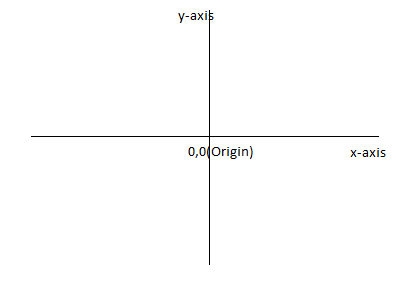
The origin (0,0) lies on the x-axis. State true or false.
Answer
 Verified
657.3k+ views
Hint: For finding the point on x-axis we have put the abscissa value i.e (x=0). Here for locating the point (0,0) we put abscissa value i.e (x=0) and ordinate value i.e (y=0).
Complete step-by-step answer:
Consider the linear equation $x+y = 0$.
If we put the value of y as 0, then we will be left with
$x+0 = 0$
From this we get the coordinate of x as 0.
If x as some value like x=6, x=2, etc
then these linear equations will be parallel to the x axis.
But when x=0, the linear equation will lie on the x-axis.
From this we can conclude that the coordinate (0,0) or the origin lies on the x-axis.
The given statement is true.
Note: In mathematics , the origin of a Euclidean space (coordinate system)is a special point, usually denoted by the letter O , it is used as a fixed point of reference for the geometry of the surrounding space. But in case of physical problems , the choice of origin is often arbitrary, meaning any choice of origin will ultimately give the same result.
When y=0 , the point obtained lies parallel to the x-axis.
When x=0 , the point obtained lies parallel to the y-axis.
Complete step-by-step answer:
Consider the linear equation $x+y = 0$.
If we put the value of y as 0, then we will be left with
$x+0 = 0$
From this we get the coordinate of x as 0.
If x as some value like x=6, x=2, etc
then these linear equations will be parallel to the x axis.
But when x=0, the linear equation will lie on the x-axis.
From this we can conclude that the coordinate (0,0) or the origin lies on the x-axis.
The given statement is true.
Note: In mathematics , the origin of a Euclidean space (coordinate system)is a special point, usually denoted by the letter O , it is used as a fixed point of reference for the geometry of the surrounding space. But in case of physical problems , the choice of origin is often arbitrary, meaning any choice of origin will ultimately give the same result.
When y=0 , the point obtained lies parallel to the x-axis.
When x=0 , the point obtained lies parallel to the y-axis.

Recently Updated Pages
What is BLO What is the full form of BLO class 8 social science CBSE

Explain the Treaty of Vienna of 1815 class 10 social science CBSE
10 examples of friction in our daily life
Draw a diagram of nephron and explain its structur class 11 biology CBSE
Write structures of the following compounds i 2 Chloro3methylpentane class 11 chemistry CBSE
A Paragraph on Pollution in about 100-150 Words
Trending doubts
Full Form of IASDMIPSIFSIRSPOLICE class 7 social science CBSE
List of coprime numbers from 1 to 100 class 7 maths CBSE
The plural of Chief is Chieves A True B False class 7 english CBSE
The founder of Jainism was A Rishabhadev B Neminath class 7 social science CBSE
Collective noun a of sailors class 7 english CBSE
Differentiate between weather and climate How do they class 7 social science CBSE