




The organs having the same origin and same functions are known as ……………..
Answer
 Verified
588.9k+ views
Hint: The similarity-based on origin, the similar basic plan of organization, and embryonic development are called homology. Different animals and plants show differences in their morphology but they show similarities in some characters. It can be homology as well as an analogy.
Complete answer:
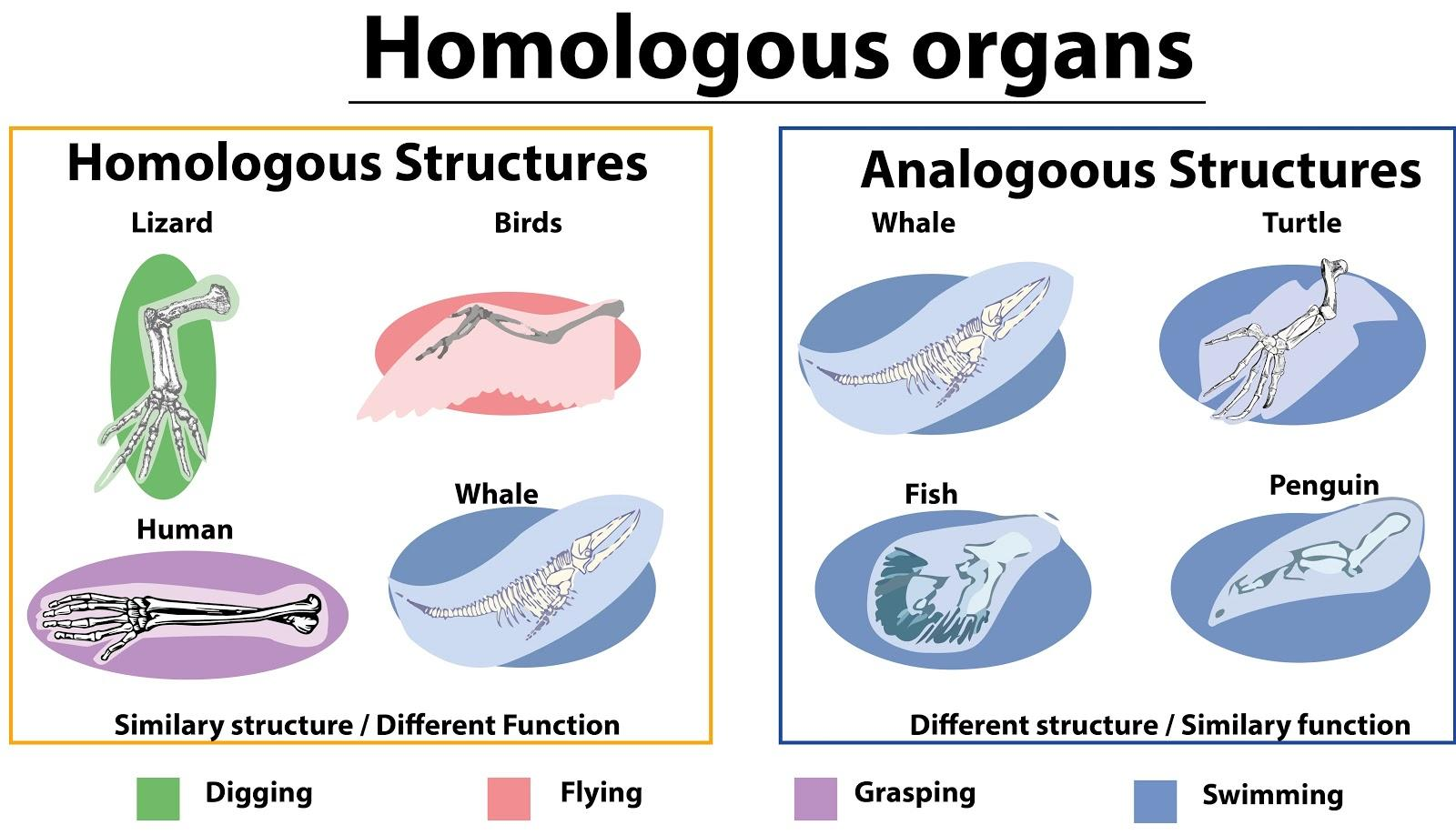
-The organs with the same origin, embryonic development, and same basic structure but their functions are different are called homologous organs.
-Forelimbs of mammals are a common example of homology. In their forelimbs, similar bones are present like humerus, radius, ulna, carpals, metacarpals, and phalanges.
-Homology can be observed in the skeleton, heart, blood vessels, and excretory system of different vertebrates.
-Mouthparts of insects are made of labrum, mandibles, and maxillae. However, their functions are different. In cockroaches, it is for biting and chewing. In the honeybee, it is for chewing and lapping and it is for piercing and sucking in mosquito
-Thorns of bougainvillea and tendril of cucurbita both are modified axillary buds.
-Another interesting example is testes in males and ovaries in females. Both develop from the same tissue although their functions are different.
So the correct answer to this question is “Homologous organs”.
Additional information:
-Homology shows divergent evolution.
-It is also seen amongst the molecules. This is called molecular homology.
-For example, the proteins found in the blood of man and apes are similar.
Note:
Homology is found in different animals indicating their evolution from a common ancestor. Some organisms get diverged after origin from a common ancestor. Later they give rise to new species adapted to new habitats and ways of life are called adaptive radiation. These organisms possess a large number of homologous organs. A variety of marsupials in Australia is an example.
Complete answer:
-The organs with the same origin, embryonic development, and same basic structure but their functions are different are called homologous organs.
-Forelimbs of mammals are a common example of homology. In their forelimbs, similar bones are present like humerus, radius, ulna, carpals, metacarpals, and phalanges.
-Homology can be observed in the skeleton, heart, blood vessels, and excretory system of different vertebrates.
-Mouthparts of insects are made of labrum, mandibles, and maxillae. However, their functions are different. In cockroaches, it is for biting and chewing. In the honeybee, it is for chewing and lapping and it is for piercing and sucking in mosquito
-Thorns of bougainvillea and tendril of cucurbita both are modified axillary buds.
-Another interesting example is testes in males and ovaries in females. Both develop from the same tissue although their functions are different.
So the correct answer to this question is “Homologous organs”.
Additional information:
-Homology shows divergent evolution.
-It is also seen amongst the molecules. This is called molecular homology.
-For example, the proteins found in the blood of man and apes are similar.
Note:
Homology is found in different animals indicating their evolution from a common ancestor. Some organisms get diverged after origin from a common ancestor. Later they give rise to new species adapted to new habitats and ways of life are called adaptive radiation. These organisms possess a large number of homologous organs. A variety of marsupials in Australia is an example.
Recently Updated Pages
Basicity of sulphurous acid and sulphuric acid are

Master Class 12 Economics: Engaging Questions & Answers for Success
Master Class 12 Biology: Engaging Questions & Answers for Success
Master Class 11 English: Engaging Questions & Answers for Success
Master Class 11 Physics: Engaging Questions & Answers for Success
Master Class 11 Computer Science: Engaging Questions & Answers for Success
Trending doubts
Draw a labelled sketch of the human eye class 12 physics CBSE
The chemical formula of tear gas is A CO Cl 2 B C 10 class 12 chemistry CBSE
Draw ray diagrams each showing i myopic eye and ii class 12 physics CBSE
Which are the Top 10 Largest Countries of the World?
Differentiate between homogeneous and heterogeneous class 12 chemistry CBSE
Which is the correct genotypic ratio of mendel dihybrid class 12 biology CBSE