




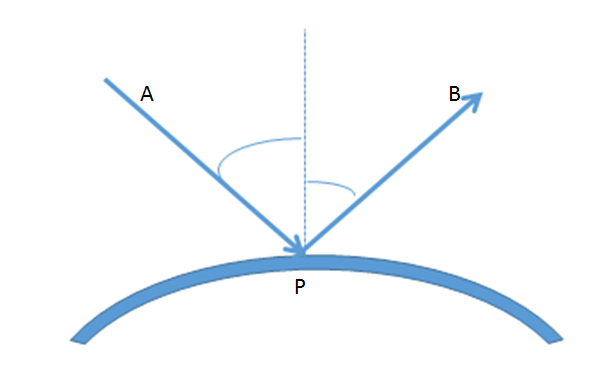
The optical path length followed by ray from point A to B given that laws of reflection are obeyed as shown in the figure is
a. Maximum
b. Minimum
c. Constant
d. None of these
Answer
 Verified
607.8k+ views
Hint: Here, we will use Fermat’s Principle of Extremum path. Fermat's principle states that “light travels between two points along the path that requires the least time, as compared to other nearby paths.” From Fermat's principle, one can derive (A) the law of reflection [the angle of incidence is equal to the angle of reflection] and (B) the law of refraction [Snell's law].
Complete step by step answer: According to Fermat’s Principle of extremum path, when light travels between two points A and B, it follows that path which requires the least time or minimum time.
Light travels along a path having minimum optical path length. But it is found that there are a number of cases in which the real path of light is the one for which the take taken is not a minimum but maximum.
-In the case of a spherical reflector, light prefers maximum time.
-In the case of an elliptical reflector, the light may take the same time for all paths.
So, the modified Fermat’s principle will be, a light ray traveling from one point to another point will traverse a path for which, compared to all neighboring paths, the time required is minimum or maximum or stationary. Since, in the question, we have a spherical reflector, therefore, the path length traveled by the light will be maximum.
Hence, option (a) is the correct answer.
Note: Fermat’s principle gives us an idea about both time and path length. One needs to be careful while considering the conditions for maximum and minimum path length and time. They are two different things and might affect the answer.
Complete step by step answer: According to Fermat’s Principle of extremum path, when light travels between two points A and B, it follows that path which requires the least time or minimum time.
Light travels along a path having minimum optical path length. But it is found that there are a number of cases in which the real path of light is the one for which the take taken is not a minimum but maximum.
-In the case of a spherical reflector, light prefers maximum time.
-In the case of an elliptical reflector, the light may take the same time for all paths.
So, the modified Fermat’s principle will be, a light ray traveling from one point to another point will traverse a path for which, compared to all neighboring paths, the time required is minimum or maximum or stationary. Since, in the question, we have a spherical reflector, therefore, the path length traveled by the light will be maximum.
Hence, option (a) is the correct answer.
Note: Fermat’s principle gives us an idea about both time and path length. One needs to be careful while considering the conditions for maximum and minimum path length and time. They are two different things and might affect the answer.
Recently Updated Pages
Master Class 12 Physics: Engaging Questions & Answers for Success

Master Class 12 Social Science: Engaging Questions & Answers for Success
Master Class 12 English: Engaging Questions & Answers for Success
Master Class 12 Maths: Engaging Questions & Answers for Success
Master Class 12 Business Studies: Engaging Questions & Answers for Success
Master Class 12 Chemistry: Engaging Questions & Answers for Success
Trending doubts
Draw a labelled sketch of the human eye class 12 physics CBSE
Which are the Top 10 Largest Countries of the World?
Draw ray diagrams each showing i myopic eye and ii class 12 physics CBSE
Which is the correct genotypic ratio of mendel dihybrid class 12 biology CBSE
Give 10 examples of unisexual and bisexual flowers
What is the Full Form of PVC, PET, HDPE, LDPE, PP and PS ?