




The ______ of any two corresponding sides in two equiangular triangles is always the same.
A. Size
B. Limits
C. Measures
D. Ratio
Answer
 Verified
640.8k+ views
Hint: We will take the help of the theorem that states that in two triangles, when the corresponding angles are equal, then their corresponding sides are in the same ratio. We will also take the help of similarity of triangles and using the AAA similarity in triangles, we will find the answer to the given question.
Complete step-by-step answer:
It is given in the question that we have to find in the blanks of the statement, the ______ of any two corresponding sides in two equiangular triangles is always the same. We know that in two triangles, if the corresponding angles are equal, then their corresponding sides are in the same ratio and they are similar triangles. This similarity is known as the AAA (Angle-Angle-Angle) similarity. We also know that angles of the equilateral triangle are equal and all of them are $60{}^\circ $. So, it means that their sides must be in the same ratio. For example, if we assume two triangles ABC and DEF as given in the figure below,
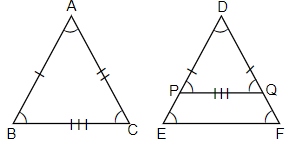
We can see that all the angles of triangle ABC and DEF are equal to $60{}^\circ $. Now, we will draw a line PQ in triangle DEF, such that $DP=AB$ and $DQ=AC$, and $\angle DPQ=\angle DQP=60{}^\circ $ as they both are the corresponding angles of $\angle DEF,\angle DFE$ respectively. Now, we will prove that $\Delta ABC\cong \Delta DPQ$. As we have assumed that the corresponding sides of $\Delta ABC=\Delta DPQ$, so it means that, $\angle B=\angle P=\angle E$. We also know that PQ is parallel to EF, so it means that,
$\dfrac{DP}{PE}=\dfrac{DQ}{QF}$
Since, $DP=AB$ and $DQ=AC$, we also get,
$\dfrac{AB}{DE}=\dfrac{AC}{DF}$
Similarly, we get,
$\dfrac{AB}{DE}=\dfrac{BC}{EF}$
Therefore, we get,
$\dfrac{AB}{DE}=\dfrac{AC}{DF}=\dfrac{BC}{EF}$
Hence, we have proved that triangle ABC is similar to triangle DEF, which means that the sides of the two similar triangles are in equal ratio. So, the ratio of any two corresponding sides in two equiangular triangles is always the same.
Therefore, the correct option is option D.
Note: Most of the students get confused with option A and option C. They think that if the angle measures are equal, then it means that by default they will have the equal measure of the corresponding sides too. It is not true because we can construct equilateral triangles of different measures, but the ratio of the sides of two equilateral triangles is the same. So, ratio is the correct answer.
Complete step-by-step answer:
It is given in the question that we have to find in the blanks of the statement, the ______ of any two corresponding sides in two equiangular triangles is always the same. We know that in two triangles, if the corresponding angles are equal, then their corresponding sides are in the same ratio and they are similar triangles. This similarity is known as the AAA (Angle-Angle-Angle) similarity. We also know that angles of the equilateral triangle are equal and all of them are $60{}^\circ $. So, it means that their sides must be in the same ratio. For example, if we assume two triangles ABC and DEF as given in the figure below,
We can see that all the angles of triangle ABC and DEF are equal to $60{}^\circ $. Now, we will draw a line PQ in triangle DEF, such that $DP=AB$ and $DQ=AC$, and $\angle DPQ=\angle DQP=60{}^\circ $ as they both are the corresponding angles of $\angle DEF,\angle DFE$ respectively. Now, we will prove that $\Delta ABC\cong \Delta DPQ$. As we have assumed that the corresponding sides of $\Delta ABC=\Delta DPQ$, so it means that, $\angle B=\angle P=\angle E$. We also know that PQ is parallel to EF, so it means that,
$\dfrac{DP}{PE}=\dfrac{DQ}{QF}$
Since, $DP=AB$ and $DQ=AC$, we also get,
$\dfrac{AB}{DE}=\dfrac{AC}{DF}$
Similarly, we get,
$\dfrac{AB}{DE}=\dfrac{BC}{EF}$
Therefore, we get,
$\dfrac{AB}{DE}=\dfrac{AC}{DF}=\dfrac{BC}{EF}$
Hence, we have proved that triangle ABC is similar to triangle DEF, which means that the sides of the two similar triangles are in equal ratio. So, the ratio of any two corresponding sides in two equiangular triangles is always the same.
Therefore, the correct option is option D.
Note: Most of the students get confused with option A and option C. They think that if the angle measures are equal, then it means that by default they will have the equal measure of the corresponding sides too. It is not true because we can construct equilateral triangles of different measures, but the ratio of the sides of two equilateral triangles is the same. So, ratio is the correct answer.
Recently Updated Pages
Master Class 11 English: Engaging Questions & Answers for Success

Master Class 11 Social Science: Engaging Questions & Answers for Success
Master Class 11 Maths: Engaging Questions & Answers for Success
Master Class 11 Biology: Engaging Questions & Answers for Success
Master Class 11 Physics: Engaging Questions & Answers for Success
Master Class 11 Chemistry: Engaging Questions & Answers for Success
Trending doubts
Explain the Treaty of Vienna of 1815 class 10 social science CBSE
What is the Total Duration of Football Match?
First Cotton Mill of India
In which year voting age was reduced from 21 to 18?
10 examples of evaporation in daily life with explanations
What planets have no moons Which one has only one moon class 10 physics CBSE