




The numerical ratio of displacement to distance covered is always:
A. Less than one
B. Equal to one
C. Equal to or less than one
D. Equal to or greater than one.
Answer
 Verified
633.3k+ views
Hint: Displacement is calculated along a straight line from initial position to the final position. Take any path which does not connect the starting and ending points directly. Measure the distance travelled using the path. Now, calculate the displacement and compare with the distance travelled.
Complete step by step answer:
First, we need to know the definitions of displacement and distance covered.
Displace is the difference between the final position and initial position. It does not incorporate the path taken to reach the final position.
Distance covered is the distance of the path taken to travel from the initial position to the final position.
Let’s look at the following image to understand the concept in simple terms:
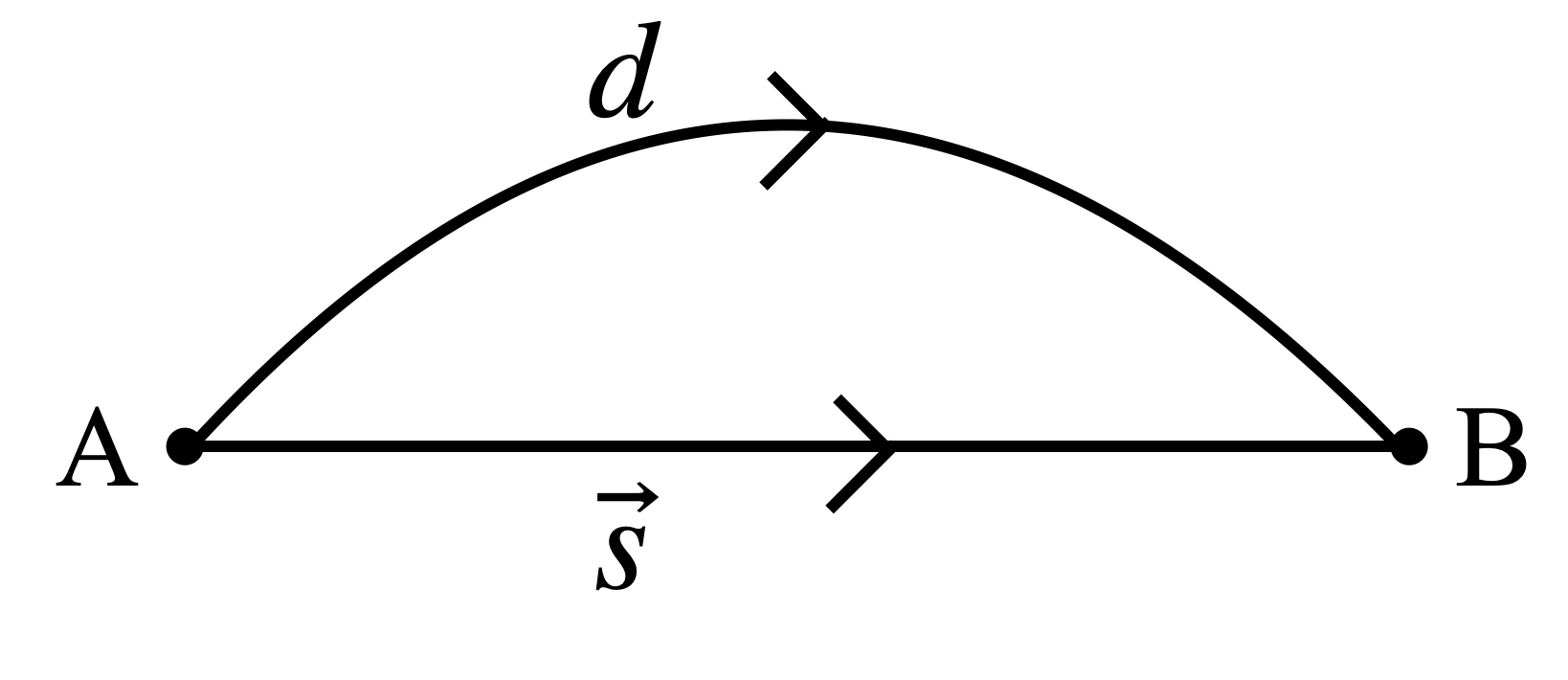
Let’s assume that an object travels from point A to point B in the curved path.
The curved path is a representative of any path which is not aligned with the straight-line AB.
Let’s assume that the distance covered by the object = d.
However, from definition the displacement of the object is always calculated by measuring the length of the straight line connecting the initial and final positions.
Hence, in this case, displacement = s
As we can see in the diagram, the distance covered by the object will always be more than the straight-line connecting points A and B. Because AB is the shortest path possible.
Displacement and distance covered by the particle will be equal only when it maintains the path AB and it does not change its direction of motion.
So, we can say for sure that displacement will always be equal or less than the distance covered.
Hence, the ratio of displacement and distance covered will always be equal to or less than one.
So, the correct choice is - (C).
Note: Displacement is a vector quantity as it depends on the relative position of the final and initial points. However, distance covered is a scalar quantity, and it does not depend on the direction of motion.
You need to consider all possible scenarios for a question like these. There can be exceptions and anomalies in the general statement which you need to be careful of.
Complete step by step answer:
First, we need to know the definitions of displacement and distance covered.
Displace is the difference between the final position and initial position. It does not incorporate the path taken to reach the final position.
Distance covered is the distance of the path taken to travel from the initial position to the final position.
Let’s look at the following image to understand the concept in simple terms:
Let’s assume that an object travels from point A to point B in the curved path.
The curved path is a representative of any path which is not aligned with the straight-line AB.
Let’s assume that the distance covered by the object = d.
However, from definition the displacement of the object is always calculated by measuring the length of the straight line connecting the initial and final positions.
Hence, in this case, displacement = s
As we can see in the diagram, the distance covered by the object will always be more than the straight-line connecting points A and B. Because AB is the shortest path possible.
Displacement and distance covered by the particle will be equal only when it maintains the path AB and it does not change its direction of motion.
So, we can say for sure that displacement will always be equal or less than the distance covered.
Hence, the ratio of displacement and distance covered will always be equal to or less than one.
So, the correct choice is - (C).
Note: Displacement is a vector quantity as it depends on the relative position of the final and initial points. However, distance covered is a scalar quantity, and it does not depend on the direction of motion.
You need to consider all possible scenarios for a question like these. There can be exceptions and anomalies in the general statement which you need to be careful of.
Recently Updated Pages
Master Class 11 English: Engaging Questions & Answers for Success

Master Class 11 Social Science: Engaging Questions & Answers for Success
Master Class 11 Maths: Engaging Questions & Answers for Success
Master Class 11 Chemistry: Engaging Questions & Answers for Success
Master Class 11 Biology: Engaging Questions & Answers for Success
Master Class 11 Physics: Engaging Questions & Answers for Success
Trending doubts
Explain the Treaty of Vienna of 1815 class 10 social science CBSE
Why is it 530 pm in india when it is 1200 afternoon class 10 social science CBSE
What is the full form of CNG A Complete Natural Gas class 10 social science CBSE
In cricket, what is a "Yorker" designed to do?
What is the full form of POSCO class 10 social science CBSE
Define Potential, Developed, Stock and Reserved resources