




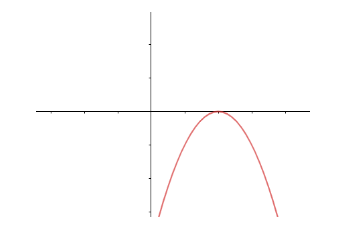
The number of zeroes of the polynomial from the graph is
(a) 0
(b) 1
(c) 2
(d) 3
Answer
 Verified
623.1k+ views
Hint: Start drawing all the details about the equation of the curve that you can gather from the graph given. The given is a parabola, so, the equation of the curve is a quadratic equation, so can have a maximum of two roots. Also, it is touching the x-axis, i.e., meeting the x-axis at only one point, so it has repeated roots. So, use all these details to reach the answer.
Complete step-by-step answer:
Let us start the solution to the above question by drawing the graph given in the question.
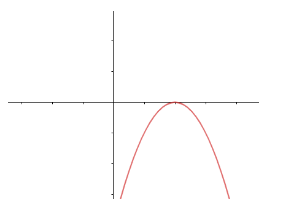
The curve given in the question is a parabola. For example: A general parabola with vertex at (0,0) can be represented by the equation $ {{x}^{2}}=4ay $ , which is a polynomial in which the maximum power of x is 2, so it is a quadratic equation. So, it is a sure thing that the equation of the curve is a quadratic equation. As it is a quadratic equation, the degree of the equation is 2, so it can have a maximum of two roots.
Also, the graph is touching the x-axis at a single point and the number of points where a curve cuts the x-axis is the number of roots of the equation of the curve. So, the given curve has one repeated root, i.e., only one root.
Hence, the answer to the above question is option (b).
Note: The other things that we can get after looking at the curve in the graph is: the coefficient of $ {{x}^{2}} $ in the equation of the curve is negative as the parabola is opening downward. Also, the root of the equation is positive, as the graph meets the x-axis in the right of the origin. The range of the equation of the curve is $ (-\infty ,0] $ .
Complete step-by-step answer:
Let us start the solution to the above question by drawing the graph given in the question.
The curve given in the question is a parabola. For example: A general parabola with vertex at (0,0) can be represented by the equation $ {{x}^{2}}=4ay $ , which is a polynomial in which the maximum power of x is 2, so it is a quadratic equation. So, it is a sure thing that the equation of the curve is a quadratic equation. As it is a quadratic equation, the degree of the equation is 2, so it can have a maximum of two roots.
Also, the graph is touching the x-axis at a single point and the number of points where a curve cuts the x-axis is the number of roots of the equation of the curve. So, the given curve has one repeated root, i.e., only one root.
Hence, the answer to the above question is option (b).
Note: The other things that we can get after looking at the curve in the graph is: the coefficient of $ {{x}^{2}} $ in the equation of the curve is negative as the parabola is opening downward. Also, the root of the equation is positive, as the graph meets the x-axis in the right of the origin. The range of the equation of the curve is $ (-\infty ,0] $ .
Recently Updated Pages
Master Class 12 Business Studies: Engaging Questions & Answers for Success

Master Class 12 Biology: Engaging Questions & Answers for Success
Master Class 12 Chemistry: Engaging Questions & Answers for Success
Class 12 Question and Answer - Your Ultimate Solutions Guide
Master Class 11 Social Science: Engaging Questions & Answers for Success
Master Class 11 English: Engaging Questions & Answers for Success
Trending doubts
What is BLO What is the full form of BLO class 8 social science CBSE
Citizens of India can vote at the age of A 18 years class 8 social science CBSE
Right to vote is a AFundamental Right BFundamental class 8 social science CBSE
10 slogans on organ donation class 8 english CBSE
Name the states through which the Tropic of Cancer class 8 social science CBSE
What are the methods of reducing friction. Explain