




The number of synergids and antipodals present in a typical angiosperm embryo sac at maturity respectively are
A. Two and three
B. One and three
C. Three and two
D. One and two
Answer
 Verified
651.6k+ views
Hint: In an embryo sac, there are synergids, an egg cell, antipodal cells and two polar nuclei are present. The two polar nuclei are present at the center of the embryo sac and its ploidy is (n+n).
Complete answer:Synergids – They are also known as the helper cells or the Co-operative cells. They are present in the micropylar end. They are two in number. These cells have a micropylar nucleus and a chalazal vacuole. They lack a cell wall at their micropylar end due to the presence of the filiform apparatus.
Antipodals – They are the vegetative cells of the embryo sac. They are three in number. They are present towards the chalazal end.
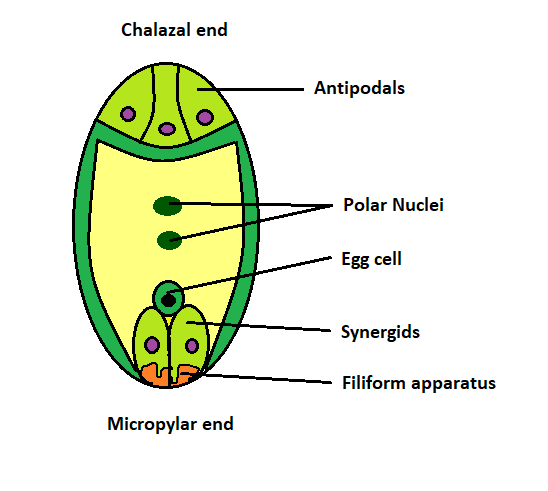
Thus, the number of synergids and antipodals present in a typical angiosperm embryo sac at maturity are two and three respectively.
Hence, the correct answer is option (A).
Additional Information: The embryo sac consists of the following type of cells –
1. Central cell – It is the largest cell in the embryo sac. It contains two polar nuclei. These two nuclei fuse just before the fertilization to form the secondary nucleus or the definitive nucleus.
2. Egg cell – It is found at the micropylar end along with the synergids. Its cytoplasmic polarity is opposite to that of the synergid. The wall of the egg cell is thicker at the micropylar end. It has a micropylar vacuole and the chalazal nucleus.
3. Synergids
4. Antipodals
Note: The synergids and the Antipodal cells degenerate after the process of fertilization. The synergid degenerates as soon as the pollen-pistil interaction is activated, and the pollen tube reaches and touches the wall of the embryo sac. When the synergid is destroyed then two black spots are formed known as the X-bodies. The two X-bodies are from the nucleus of one synergid and nucleus of one pollen tube respectively.
Complete answer:Synergids – They are also known as the helper cells or the Co-operative cells. They are present in the micropylar end. They are two in number. These cells have a micropylar nucleus and a chalazal vacuole. They lack a cell wall at their micropylar end due to the presence of the filiform apparatus.
Antipodals – They are the vegetative cells of the embryo sac. They are three in number. They are present towards the chalazal end.
Thus, the number of synergids and antipodals present in a typical angiosperm embryo sac at maturity are two and three respectively.
Hence, the correct answer is option (A).
Additional Information: The embryo sac consists of the following type of cells –
1. Central cell – It is the largest cell in the embryo sac. It contains two polar nuclei. These two nuclei fuse just before the fertilization to form the secondary nucleus or the definitive nucleus.
2. Egg cell – It is found at the micropylar end along with the synergids. Its cytoplasmic polarity is opposite to that of the synergid. The wall of the egg cell is thicker at the micropylar end. It has a micropylar vacuole and the chalazal nucleus.
3. Synergids
4. Antipodals
Note: The synergids and the Antipodal cells degenerate after the process of fertilization. The synergid degenerates as soon as the pollen-pistil interaction is activated, and the pollen tube reaches and touches the wall of the embryo sac. When the synergid is destroyed then two black spots are formed known as the X-bodies. The two X-bodies are from the nucleus of one synergid and nucleus of one pollen tube respectively.
Recently Updated Pages
Master Class 12 Physics: Engaging Questions & Answers for Success

Master Class 12 Social Science: Engaging Questions & Answers for Success
Master Class 12 English: Engaging Questions & Answers for Success
Master Class 12 Maths: Engaging Questions & Answers for Success
Master Class 12 Business Studies: Engaging Questions & Answers for Success
Master Class 12 Chemistry: Engaging Questions & Answers for Success
Trending doubts
Draw a labelled sketch of the human eye class 12 physics CBSE
Which are the Top 10 Largest Countries of the World?
Draw ray diagrams each showing i myopic eye and ii class 12 physics CBSE
One megawatt is equal to how many units of electri class 12 physics CBSE
Which is the correct genotypic ratio of mendel dihybrid class 12 biology CBSE
Give 10 examples of unisexual and bisexual flowers