




The number of solutions of the equation \[{{x}^{3}}+{{x}^{2}}+4x+2\sin x=0\text{ in 0}\le \text{x}\le \text{2x}\] is
A. Zero
B. One
C. Two
D. Four
Answer
 Verified
654.9k+ views
Hint: As the question has algebra and trigonometric combination it is hard to find roots. So, try to separate them and draw graphs of trigonometric and algebraic equations. By this you can get the number of solutions as intersection points.
Complete step by step solution:
Given equation in the question is written in the form as:
\[{{x}^{3}}+{{x}^{2}}+4x+2\sin x=0\text{ }\]
By subtracting 2sinx on both sides of equation, we get it as:
\[{{x}^{3}}+{{x}^{2}}+4x=-2\sin x\]
Let us assume h(x) is a function given by \[{{x}^{3}}+{{x}^{2}}+4x\]
Let us assume g(x) is a function given by -2sinx
Differentiation of h(x): \[h(x)={{x}^{3}}+{{x}^{2}}+4x\]
We know differentiation properties from which we can say:
\[\dfrac{d}{dx}{{x}^{n}}={{x}^{n-1}}\]
By differentiating on both sides for h(x) equation, we get it as:
\[\dfrac{d}{dx}h\left( x \right)=\dfrac{d}{dx}\left( {{x}^{3}}+{{x}^{2}}+4x \right)\]
By substituting the differentiation formula, we get it as:
\[{{h}^{1}}\left( x \right)=3{{x}^{2}}+2x+4\]
Now we will find discriminant of this \[{{h}^{1}}\left( x \right)\] we get
\[D\text{ of a}{{\text{x}}^{\text{2}}}\text{+bx+c=0 is given by }{{\text{b}}^{\text{2}}}\text{-4ac}\]
\[D\text{ of }{{h}^{1}}\left( x \right)\Rightarrow a=3,b=2,c=4.\]
By substituting in formula, we get:
\[D\text{ of }{{h}^{1}}\left( x \right)=4-4.4.3\]
By simplifying the above equation, we get the D values as:
\[D\text{ of }{{h}^{1}}\left( x \right)=4-48\]
By simplifying the above equation, we get the value of D as:
\[D\text{ of }{{h}^{1}}\left( x \right)=-44\]
As we can see, we say the value of D follows inequality: \[\text{D}<0\]
Whenever we get determinant always negative for \[{{f}^{1}}\left( x \right)\] the \[\text{f}\left( \text{x} \right)\] is always increasing.
By this statement we can say the graph of \[{{x}^{3}}+{{x}^{2}}+4x\] is
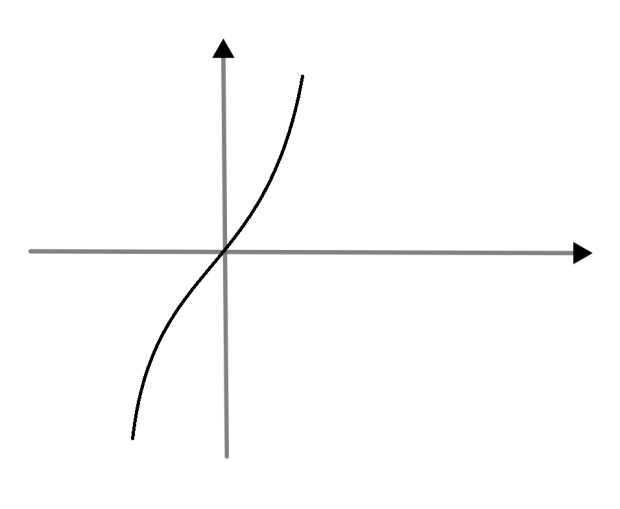
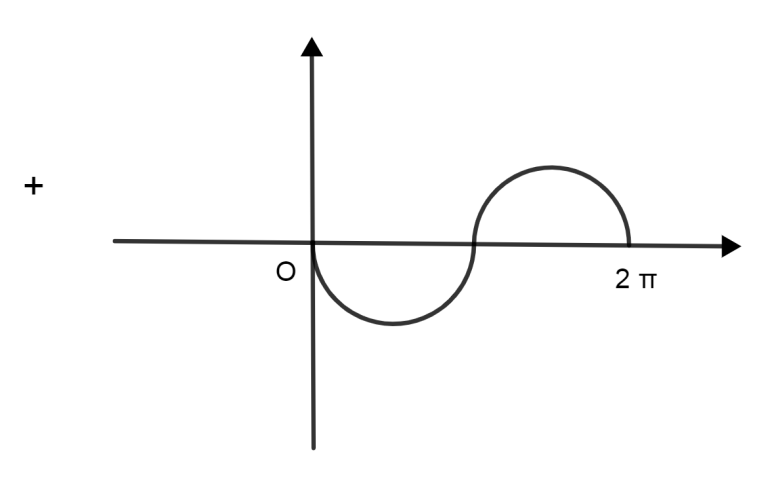
Now we need to plot \[-\text{2sinx}\] So, “-“sign depicts that it is a reflection of the x axis to the original graph. 2 depicts that its amplitude increases. By combining above two graphs we get only one solution which is \[\text{x}=0\].
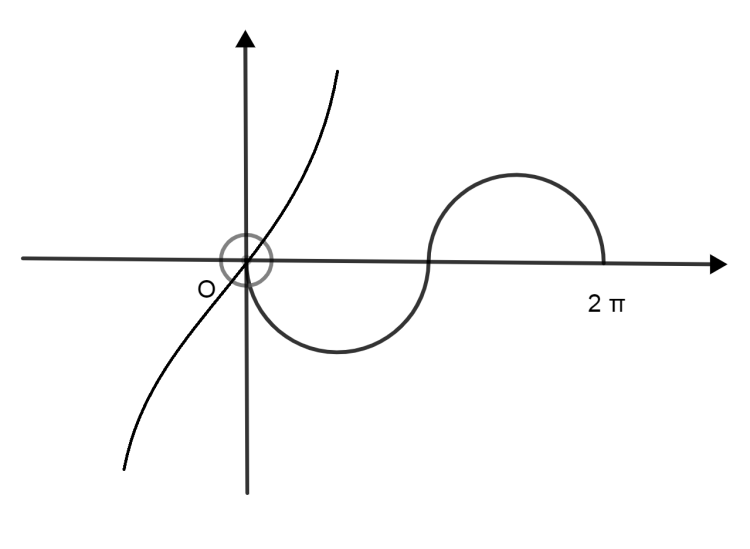
So, the correct answer is “Option B”.
Note: Be careful while differentiating you must check each term because if you miss any term then discriminant value may change. We say upper part of sinx graph does not touch because it a \[\pi \] distance from original but \[{{\text{x}}^{\text{3}}}\] graph raises to high before that \[\pi \] distance so no way that \[\text{sinx}\]graph touches \[{{\text{x}}^{\text{3}}}\] graph other than at point \[\text{x}=0\].
Complete step by step solution:
Given equation in the question is written in the form as:
\[{{x}^{3}}+{{x}^{2}}+4x+2\sin x=0\text{ }\]
By subtracting 2sinx on both sides of equation, we get it as:
\[{{x}^{3}}+{{x}^{2}}+4x=-2\sin x\]
Let us assume h(x) is a function given by \[{{x}^{3}}+{{x}^{2}}+4x\]
Let us assume g(x) is a function given by -2sinx
Differentiation of h(x): \[h(x)={{x}^{3}}+{{x}^{2}}+4x\]
We know differentiation properties from which we can say:
\[\dfrac{d}{dx}{{x}^{n}}={{x}^{n-1}}\]
By differentiating on both sides for h(x) equation, we get it as:
\[\dfrac{d}{dx}h\left( x \right)=\dfrac{d}{dx}\left( {{x}^{3}}+{{x}^{2}}+4x \right)\]
By substituting the differentiation formula, we get it as:
\[{{h}^{1}}\left( x \right)=3{{x}^{2}}+2x+4\]
Now we will find discriminant of this \[{{h}^{1}}\left( x \right)\] we get
\[D\text{ of a}{{\text{x}}^{\text{2}}}\text{+bx+c=0 is given by }{{\text{b}}^{\text{2}}}\text{-4ac}\]
\[D\text{ of }{{h}^{1}}\left( x \right)\Rightarrow a=3,b=2,c=4.\]
By substituting in formula, we get:
\[D\text{ of }{{h}^{1}}\left( x \right)=4-4.4.3\]
By simplifying the above equation, we get the D values as:
\[D\text{ of }{{h}^{1}}\left( x \right)=4-48\]
By simplifying the above equation, we get the value of D as:
\[D\text{ of }{{h}^{1}}\left( x \right)=-44\]
As we can see, we say the value of D follows inequality: \[\text{D}<0\]
Whenever we get determinant always negative for \[{{f}^{1}}\left( x \right)\] the \[\text{f}\left( \text{x} \right)\] is always increasing.
By this statement we can say the graph of \[{{x}^{3}}+{{x}^{2}}+4x\] is
Now we need to plot \[-\text{2sinx}\] So, “-“sign depicts that it is a reflection of the x axis to the original graph. 2 depicts that its amplitude increases. By combining above two graphs we get only one solution which is \[\text{x}=0\].
So, the correct answer is “Option B”.
Note: Be careful while differentiating you must check each term because if you miss any term then discriminant value may change. We say upper part of sinx graph does not touch because it a \[\pi \] distance from original but \[{{\text{x}}^{\text{3}}}\] graph raises to high before that \[\pi \] distance so no way that \[\text{sinx}\]graph touches \[{{\text{x}}^{\text{3}}}\] graph other than at point \[\text{x}=0\].
Recently Updated Pages
Which will be the least stable resonating structure class 11 chemistry CBSE

How many 5 digit telephone numbers can be construc-class-11-maths-CBSE
How do you find the angle of the resultant vector class 11 physics CBSE
Draw labelled diagram of the following i Gram seed class 11 biology CBSE
1 Quintal is equal to a 110 kg b 10 kg c 100kg d 1000 class 11 physics CBSE
What is the need and importance of classification class 11 biology CBSE
Trending doubts
One Metric ton is equal to kg A 10000 B 1000 C 100 class 11 physics CBSE
Find the value of the expression given below sin 30circ class 11 maths CBSE
Draw a diagram of nephron and explain its structur class 11 biology CBSE
10 examples of friction in our daily life
Proton was discovered by A Thomson B Rutherford C Chadwick class 11 chemistry CBSE
The teeth used for biting and cutting food are called class 11 biology CBSE