



The number of solution of \[{{\log }_{4}}\left( x-1 \right)={{\log }_{2}}\left( x-3 \right)\] is
A) \[3\]
B) \[1\]
C) \[2\]
D) \[0\]
Answer
 Verified
586.5k+ views
Hint: To find the number of solution, first we need to determine the domain of the functions as to how far the solutions will go or be valid and after that we equate the L.H.S with R.H.S by dividing both the L.H.S and R.H.S with their respective log bases using the formula as:
\[{{\log }_{a}}\left( X \right)=\dfrac{\log X}{\log a}\]
Complete step-by-step answer:
First let us determine the value \[x\] is valid as you can see that one is \[x-1\] while other is \[x-3\] hence, the smallest values of \[x\] has to be \[3\] as any less than that we result in negative value for \[x-3\] and log of negative value is invalid. Hence, the L.H.S and R.H.S are valid for \x>3\.
\[{{\log }_{4}}\left( x-1 \right)={{\log }_{2}}\left( x-3 \right)\]
Using the conversion formula as: \[{{\log }_{a}}X=\dfrac{\log X}{\log a}\]
\[\dfrac{\log \left( x-1 \right)}{2\log 2}=\dfrac{\log \left( x-3 \right)}{\log 2}\]
Cross-multiplying the values we get:
\[\Rightarrow \dfrac{\log \left( x-1 \right)}{\log 2}=\dfrac{2\log \left( x-3 \right)}{\log 2}\]
\[\Rightarrow \dfrac{\log \left( x-1 \right)}{\log 2}=\dfrac{\log {{\left( x-3 \right)}^{2}}}{\log 2}\]
\[\Rightarrow \dfrac{\log \left( x-1 \right)}{1}=\dfrac{\log {{\left( x-3 \right)}^{2}}}{\log 2}\times \log 2\]
\[\Rightarrow \log \left( x-1 \right)=\log {{\left( x-3 \right)}^{2}}\]
Cancelling the log terms on both the sides
\[\Rightarrow \left( x-1 \right)={{\left( x-3 \right)}^{2}}\]
expanding the RHS using the $(a-b)^2$ formula
\[\Rightarrow x-1={{x}^{2}}-6x+9\]
Take all the terms to one side
\[\Rightarrow {{x}^{2}}-6x-x+9+1=0\]
\[\Rightarrow {{x}^{2}}-7x+10\]
\[\Rightarrow \left( x-5 \right)\left( x-2 \right)=0\]
The value of \[x\] is given as \[x=2,5\] and the domain is \[x>3\] therefore, the only value left is \[x=5\].
Note: Another method to find the number of solution is by graphical method, first draw the graphs \[{{\log }_{4}}\left( x-1 \right)\] (in red) and \[{{\log }_{2}}\left( x-3 \right)\] (in blue) and find the point/s where both the graph intersect. The graph intersects at \[x=4,x=2\]. As seen in the graph below:
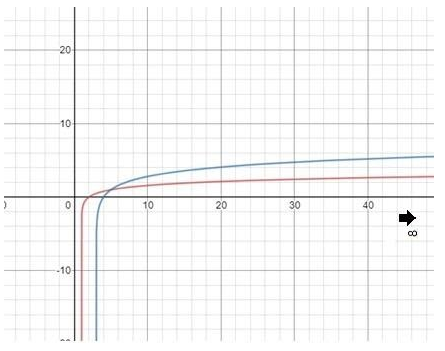
The only point where the graph intersects is \[\left( 5,1 \right)\].
\[{{\log }_{a}}\left( X \right)=\dfrac{\log X}{\log a}\]
Complete step-by-step answer:
First let us determine the value \[x\] is valid as you can see that one is \[x-1\] while other is \[x-3\] hence, the smallest values of \[x\] has to be \[3\] as any less than that we result in negative value for \[x-3\] and log of negative value is invalid. Hence, the L.H.S and R.H.S are valid for \x>3\.
\[{{\log }_{4}}\left( x-1 \right)={{\log }_{2}}\left( x-3 \right)\]
Using the conversion formula as: \[{{\log }_{a}}X=\dfrac{\log X}{\log a}\]
\[\dfrac{\log \left( x-1 \right)}{2\log 2}=\dfrac{\log \left( x-3 \right)}{\log 2}\]
Cross-multiplying the values we get:
\[\Rightarrow \dfrac{\log \left( x-1 \right)}{\log 2}=\dfrac{2\log \left( x-3 \right)}{\log 2}\]
\[\Rightarrow \dfrac{\log \left( x-1 \right)}{\log 2}=\dfrac{\log {{\left( x-3 \right)}^{2}}}{\log 2}\]
\[\Rightarrow \dfrac{\log \left( x-1 \right)}{1}=\dfrac{\log {{\left( x-3 \right)}^{2}}}{\log 2}\times \log 2\]
\[\Rightarrow \log \left( x-1 \right)=\log {{\left( x-3 \right)}^{2}}\]
Cancelling the log terms on both the sides
\[\Rightarrow \left( x-1 \right)={{\left( x-3 \right)}^{2}}\]
expanding the RHS using the $(a-b)^2$ formula
\[\Rightarrow x-1={{x}^{2}}-6x+9\]
Take all the terms to one side
\[\Rightarrow {{x}^{2}}-6x-x+9+1=0\]
\[\Rightarrow {{x}^{2}}-7x+10\]
\[\Rightarrow \left( x-5 \right)\left( x-2 \right)=0\]
The value of \[x\] is given as \[x=2,5\] and the domain is \[x>3\] therefore, the only value left is \[x=5\].
Note: Another method to find the number of solution is by graphical method, first draw the graphs \[{{\log }_{4}}\left( x-1 \right)\] (in red) and \[{{\log }_{2}}\left( x-3 \right)\] (in blue) and find the point/s where both the graph intersect. The graph intersects at \[x=4,x=2\]. As seen in the graph below:
The only point where the graph intersects is \[\left( 5,1 \right)\].
Recently Updated Pages
Master Class 9 General Knowledge: Engaging Questions & Answers for Success

Master Class 9 Social Science: Engaging Questions & Answers for Success
Master Class 9 English: Engaging Questions & Answers for Success
Master Class 9 Maths: Engaging Questions & Answers for Success
Master Class 9 Science: Engaging Questions & Answers for Success
Class 9 Question and Answer - Your Ultimate Solutions Guide
Trending doubts
Difference Between Plant Cell and Animal Cell
Fill the blanks with the suitable prepositions 1 The class 9 english CBSE
Who is eligible for RTE class 9 social science CBSE
Which places in India experience sunrise first and class 9 social science CBSE
What is pollution? How many types of pollution? Define it
Name 10 Living and Non living things class 9 biology CBSE