




The number of $S - S\,$ bonds in sulphur trioxide trimer, $\left( {{S_3}{O_9}} \right)$ is:
A. three
B. two
C. one
D. zero
Answer
 Verified
625.5k+ views
Hint: Sulphur trioxide trimer has the chemical formula $\left( {{{\rm{S}}_{\rm{3}}}{{\rm{O}}_{\rm{9}}}} \right)$, that is it has three sulphur atoms and nine oxygen atoms. The chemical formula of Sulphur trioxide is ${\rm{S}}{{\rm{O}}_{\rm{3}}}$.
Complete step by step answer:
We can draw the structure of Sulphur trioxide trimer as follows.
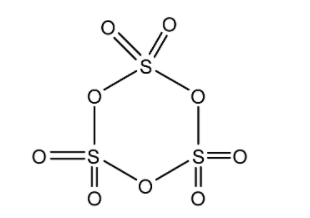
In the structure of the Sulphur trioxide trimer above, we can see that all the three sulphur atoms are bonded with oxygen atoms on all the sides. We see that there is no bond taking place between the sulphur atoms. So, we can conclude that the number of $S - S\,$ bonds in sulphur trioxide trimer, $\left( {{S_3}{O_9}} \right)$ is zero.
So, out of the given four options, option D is the correct option.
Additional Information:
Sulfur trioxide is a colourless liquid. It can also exist as fibre-like crystals or like ice or also as a gas. When Sulphur trioxide is exposed to air, it takes up water molecules and releases white fumes. Sulfur trioxide reacts with water forming sulphuric acid. Sulfur trioxide is also called sulfuric oxide and also as sulfuric anhydride. It is used for production of sulphuric acid and other chemicals as well as explosives. Sulphuric acid is a colourless, clear oily liquid and it is very corrosive. It is also called as a sulphite acid hydrogen sulfate and also sometimes as battery acids. It is used in the production of explosives, fertilizers, and other acids in petroleum purification. It is also used in the pickling of metal and in the lead-acid batteries.
Note:
There exist no bonds between the sulphur atoms in sulfur trioxide trimer. Three S-O-S bonds and six S-O bonds exist in the sulfur trioxide trimer compound.
Complete step by step answer:
We can draw the structure of Sulphur trioxide trimer as follows.
In the structure of the Sulphur trioxide trimer above, we can see that all the three sulphur atoms are bonded with oxygen atoms on all the sides. We see that there is no bond taking place between the sulphur atoms. So, we can conclude that the number of $S - S\,$ bonds in sulphur trioxide trimer, $\left( {{S_3}{O_9}} \right)$ is zero.
So, out of the given four options, option D is the correct option.
Additional Information:
Sulfur trioxide is a colourless liquid. It can also exist as fibre-like crystals or like ice or also as a gas. When Sulphur trioxide is exposed to air, it takes up water molecules and releases white fumes. Sulfur trioxide reacts with water forming sulphuric acid. Sulfur trioxide is also called sulfuric oxide and also as sulfuric anhydride. It is used for production of sulphuric acid and other chemicals as well as explosives. Sulphuric acid is a colourless, clear oily liquid and it is very corrosive. It is also called as a sulphite acid hydrogen sulfate and also sometimes as battery acids. It is used in the production of explosives, fertilizers, and other acids in petroleum purification. It is also used in the pickling of metal and in the lead-acid batteries.
Note:
There exist no bonds between the sulphur atoms in sulfur trioxide trimer. Three S-O-S bonds and six S-O bonds exist in the sulfur trioxide trimer compound.
Recently Updated Pages
Master Class 12 Economics: Engaging Questions & Answers for Success

Master Class 12 English: Engaging Questions & Answers for Success
Master Class 12 Social Science: Engaging Questions & Answers for Success
Master Class 12 Maths: Engaging Questions & Answers for Success
Master Class 12 Physics: Engaging Questions & Answers for Success
Master Class 11 Social Science: Engaging Questions & Answers for Success
Trending doubts
One Metric ton is equal to kg A 10000 B 1000 C 100 class 11 physics CBSE
Difference Between Prokaryotic Cells and Eukaryotic Cells
Two of the body parts which do not appear in MRI are class 11 biology CBSE
1 ton equals to A 100 kg B 1000 kg C 10 kg D 10000 class 11 physics CBSE
Draw a diagram of nephron and explain its structur class 11 biology CBSE
10 examples of friction in our daily life