




The number of possible isomers of butene are:
(A) $ 3 $
(B) $ 2 $
(C) $ 4 $
(D) $ 5 $
Answer
 Verified
578.1k+ views
Hint: The concept of isomerism occurs when two or more molecules have the same chemical formula but different chemical structures. Isomers are chemical compounds with similar chemical formulae that vary in properties and atom structure in the molecule. As a result, compounds that show isomerism are referred to as isomers.
Complete answer:
Butene is an alkene with the formula $ {C_4}{H_8} $ that is also known as butylene. Butene may refer to all of the compounds individually. They are colourless gases that are present in crude oil as a minor constituent in amounts that make extraction impossible. Butene is made by catalytic cracking of long-chain hydrocarbons left over from crude oil refining. Fractional distillation is used to remove butene from a mixture of products produced by cracking.
Butene can be used as a monomer for polybutene, but it is more costly than polypropylene and other polymers with shorter carbon chains.
There are four geometrical isomers of Butene:
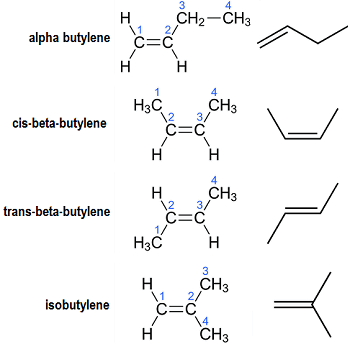
Some organic compounds, such as cyclobutane and methylcyclopropane, have the formula $ {C_4}{H_8} $ , but they are not alkenes and do not come under the name butene. There are also four-carbon cyclic alkenes, such as cyclobutene and two isomers of methylcyclopropene, but they don't have the formula $ {C_4}{H_8} $ and aren't covered here.
So option (c) is correct.
Note:
1-Butene is a stable compound that readily polymerizes to polybutene. Its primary use is as a commoner in the manufacture of specific types of polyethylene, such as linear low-density polyethylene (LLDPE). Polypropylene resins, butylene oxide, and butanone have all used it as a precursor.
Complete answer:
Butene is an alkene with the formula $ {C_4}{H_8} $ that is also known as butylene. Butene may refer to all of the compounds individually. They are colourless gases that are present in crude oil as a minor constituent in amounts that make extraction impossible. Butene is made by catalytic cracking of long-chain hydrocarbons left over from crude oil refining. Fractional distillation is used to remove butene from a mixture of products produced by cracking.
Butene can be used as a monomer for polybutene, but it is more costly than polypropylene and other polymers with shorter carbon chains.
There are four geometrical isomers of Butene:
Some organic compounds, such as cyclobutane and methylcyclopropane, have the formula $ {C_4}{H_8} $ , but they are not alkenes and do not come under the name butene. There are also four-carbon cyclic alkenes, such as cyclobutene and two isomers of methylcyclopropene, but they don't have the formula $ {C_4}{H_8} $ and aren't covered here.
So option (c) is correct.
Note:
1-Butene is a stable compound that readily polymerizes to polybutene. Its primary use is as a commoner in the manufacture of specific types of polyethylene, such as linear low-density polyethylene (LLDPE). Polypropylene resins, butylene oxide, and butanone have all used it as a precursor.
Recently Updated Pages
Write structures of the following compounds i 2 Chloro3methylpentane class 11 chemistry CBSE

What is BLO What is the full form of BLO class 8 social science CBSE
Explain the Treaty of Vienna of 1815 class 10 social science CBSE
A Paragraph on Pollution in about 100-150 Words
XIX+XXX A 49 B 51 C 55 D 44 class 5 maths CBSE
If x a + bt + ct2 where x is in meters and t is in class 11 physics CBSE
Trending doubts
One Metric ton is equal to kg A 10000 B 1000 C 100 class 11 physics CBSE
Find the value of the expression given below sin 30circ class 11 maths CBSE
What do you mean by retardation What is its SI uni class 11 physics CBSE
Draw a diagram of nephron and explain its structur class 11 biology CBSE
10 examples of friction in our daily life
Difference between physical and chemical change class 11 chemistry CBSE